Have you ever wanted to test a Google Ads change without gambling an entire campaign budget on it?
That’s exactly where Google AI Max is getting more interesting.
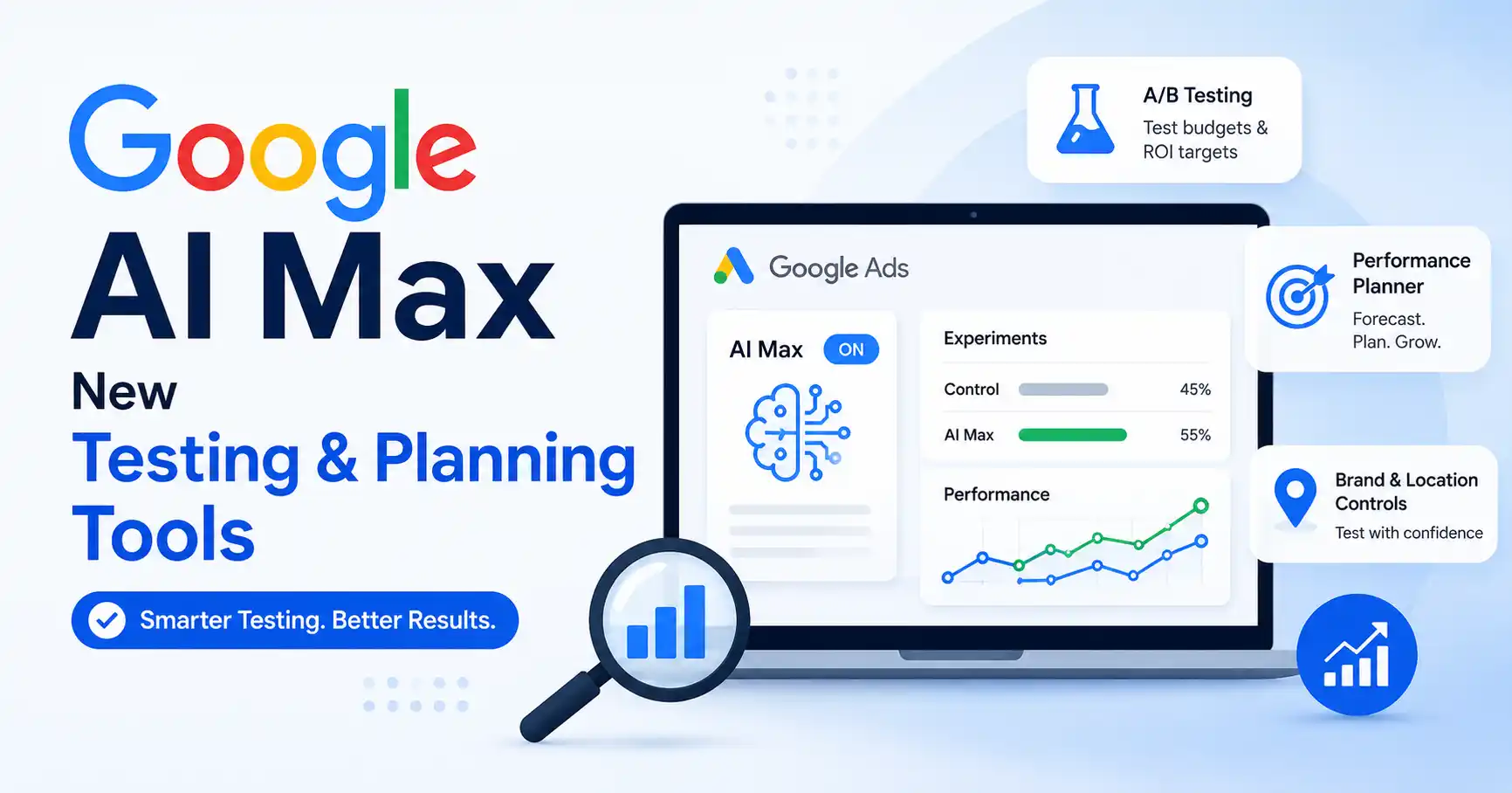
Google is expanding AI Max for Search campaigns with new testing and planning capabilities that give advertisers more ways to measure budget changes, ROI targets and campaign settings before making bigger decisions. The update includes multi campaign A/B testing, more flexible experiment controls and improvements to Performance Planner.
For advertisers, this is more than another feature appearing inside Google Ads. Google is clearly moving toward a model where AI handles more campaign optimization, while advertisers get better tools to test whether those automated decisions are actually producing useful business results.
And honestly, that balance between automation and control is becoming one of the biggest questions in PPC.
What is Google AI Max, and why does this update matter?
AI Max is an optimization layer for existing Search campaigns rather than a completely separate campaign type. It uses AI to improve search term matching and ad asset optimization, while giving advertisers controls around areas such as brands, locations and landing pages.
The bigger change is how Google wants advertisers to interact with that automation.
Instead of simply switching AI Max on and watching what happens, marketers can increasingly test its impact first.
That matters because performance can look good on the surface while hiding important changes underneath. More conversions don’t automatically mean better business results if costs rise too quickly or lead quality falls.
The new Google Ads AI Max tools are designed to make those decisions easier to measure.
Google is essentially saying: let AI do more of the work, but give advertisers better ways to prove whether the work is paying off.
How will the new AI Max testing tools work?
One of the most useful additions is multi campaign A/B testing.
Starting in September, advertisers will be able to test different budgets and ROI targets across multiple Search campaigns within a single experiment. Rather than looking at one campaign in isolation, marketers can evaluate the broader impact of scaling their campaigns.
That could be particularly useful for larger Google Ads accounts.
Imagine you have five Search campaigns that are all performing reasonably well. Increasing each budget separately might produce confusing results because demand, seasonality and conversion volume can change at the same time.
A broader experiment gives you a cleaner way to ask:
“What happens if we invest more across this group of campaigns?”
That’s a much more useful question than simply asking whether one campaign received more clicks.
Google’s existing AI Max experiments already allow advertisers to split traffic between a control group and a trial using AI Max. The newer approach builds on that idea and makes testing more useful for broader budget and ROI decisions.
Can advertisers test AI Max without giving up brand and location controls?
Yes, and this is one of the quieter but potentially important parts of the update.
Google is expanding AI Max experiments so advertisers can test with brand and location controls enabled.
Why does that matter?
Because some businesses can’t simply remove their guardrails to run an experiment.
A company may need to advertise only in certain regions. Another may need to prevent ads from appearing for searches associated with particular brands. A global business could have completely different requirements from one country to another.
Previously, those restrictions could make AI Max testing less practical.
Now, advertisers can test AI Max while keeping those controls in place.
That makes the experiment much closer to real world campaign conditions. And that’s important. A test isn’t very useful if you have to change the campaign so much that the test no longer represents how you actually advertise.
As Google Ads continues moving toward automation, this kind of control becomes increasingly valuable.
What does the new Performance Planner actually change?
The Performance Planner is getting a practical upgrade too.
Google says advertisers can now forecast how changes such as budget or bidding adjustments could affect the performance of an existing campaign. Suggested changes can then be applied directly to campaigns with one click.
That sounds like a small workflow improvement, but it can remove a frustrating step from campaign management.
Previously, an advertiser might use planning tools to estimate what could happen, then manually make the change in the campaign and monitor the results.
The updated Performance Planner brings those pieces closer together.
Think of it as:
Forecast → Review → Apply
rather than:
Forecast → Leave the tool → Find the campaign → Change settings → Monitor
That doesn’t mean advertisers should blindly accept Google’s recommendation.
A forecast is still a forecast.
Before applying a change, marketers should check conversion quality, seasonality, budget limitations and whether the campaign’s current results are actually stable enough to justify the adjustment.
Google itself notes that AI Max works best when campaigns aren’t restricted by insufficient budget, so budget planning and campaign performance need to be considered together.
Why are Google Ads experiments becoming more important?
The bigger story behind this update is experimentation.
Google Ads is becoming increasingly automated. Smart Bidding, broad matching, AI powered asset creation and AI Max can all influence how campaigns find customers and deliver ads.
That creates a new problem for advertisers.
When more decisions are automated, it becomes harder to know exactly which change produced the result.
That’s why Google Ads experiments matter.
Instead of saying, “AI Max seems to be working,” advertisers can build a test around a specific hypothesis.
For example:
Hypothesis: Enabling AI Max will increase conversions without pushing CPA above the acceptable range.
Then compare the results against a suitable control.
Google’s current AI Max experiment setup uses control and trial portions of an existing Search campaign, helping advertisers compare performance before applying the feature more broadly.
This is a healthier way to approach AI powered Google Ads.
Don’t treat automation as something you either trust completely or reject completely.
Test it.
Measure it.
Then scale what actually works.
What should advertisers do with the new Google AI Max tools?
The first step isn’t turning on every new feature.
It’s getting the basics right.
Before running an AI Max experiment, make sure conversion tracking is reliable and that you’re measuring outcomes that matter to the business. A campaign producing more cheap clicks isn’t necessarily better. Likewise, a lower CPA isn’t always a win if the leads aren’t valuable.
A sensible testing process looks something like this:
1. Choose one business goal.
Decide whether you’re trying to increase conversions, conversion value, qualified leads or another meaningful outcome.
2. Establish a baseline.
Look at recent CPA, ROAS, conversion volume, conversion value and spend before making the change.
3. Define the experiment.
Decide exactly what you’re testing and what result would make the change worthwhile.
4. Keep important controls consistent.
Brand and location settings can now remain part of the AI Max testing environment, making comparisons more practical.
5. Don’t judge too quickly.
Give the campaign enough time and conversion data to produce a meaningful signal.
6. Scale gradually.
If the results are positive, increase investment carefully rather than immediately pushing the entire account into a new setup.
This approach also fits with Google’s broader move away from manual campaign management. Its AI Max documentation describes the product as a continuous optimization layer that uses real time signals to refine targeting and creative delivery.
Is Google AI Max becoming the future of Search advertising?
It certainly looks that way.
Google has already moved AI Max out of beta and is expanding it across more advertising experiences. Google has also extended the timeline for the transition away from some legacy Search features, with the Dynamic Search Ads automatic upgrade timeline now pushed to February 2027.
That makes learning how AI Max works more than a short term exercise.
For advertisers who want the official feature details, Google’s guide to AI Max for Search campaigns is a useful reference.
But there’s an important lesson here: AI Max isn’t a replacement for strategy.
AI can help decide where opportunities exist, which searches to pursue and how ads can be adapted. It still needs accurate conversion data, sensible targets, useful landing pages and clear business goals.
As Google Ads moves deeper into AI automation, the best advertisers may not be the ones who control every setting manually. They may be the ones who know exactly what to test, what to measure and when to trust the results.
For more context on where Google’s Search advertising strategy is heading, see our guide to Google AI Max migration for Search campaigns.
You can also read our analysis of AI agents for Google Ads to see how campaign automation is moving beyond traditional optimization.
FAQ’s
Google AI Max is an AI powered optimization layer for Search campaigns. It helps improve search term matching and ad asset optimization while providing additional campaign controls.
Google is adding multi campaign A/B testing for budgets and ROI targets, expanded experiment controls for brand and location settings, and additional planning capabilities.
Google says the new multi campaign testing capability will begin rolling out in September 2026. Availability can vary by account and rollout stage.
Google says the new multi campaign testing capability will begin rolling out in September 2026. Availability can vary by account and rollout stage.
Not necessarily. A better approach is to establish a performance baseline, run a controlled experiment where appropriate, review conversion quality and then scale AI Max based on actual business results.
Conclusion
Google AI Max is becoming less about simply “turning on AI” and more about measuring what that AI actually contributes.
The new testing tools give advertisers a better way to compare budgets, ROI targets and campaign settings. Expanded experiment controls make testing more realistic for businesses with brand and location restrictions. And the improved Performance Planner shortens the distance between forecasting a change and actually applying it.
That’s a useful direction.
AI can make campaign management faster, but faster decisions aren’t automatically better decisions. The real advantage comes when automation is combined with disciplined testing and good business data.
If you’re already using AI Max, now is a good time to start thinking less about whether AI sounds impressive and more about which experiment could prove its value for your campaigns.

Kumar Swamy is the CEO of Itech Manthra Pvt Ltd and a dedicated Article Writer and SEO Specialist. With a wealth of experience in crafting high-quality content, he focuses on technology, business, and current events, ensuring that readers receive timely and relevant insights.
As a technical SEO expert, Kumar Swamy employs effective strategies to optimize websites for search engines, boosting visibility and performance. Passionate about sharing knowledge, he aims to empower audiences with informative and engaging articles.
Connect with Kumar Swamy to explore the evolving landscape of content creation!