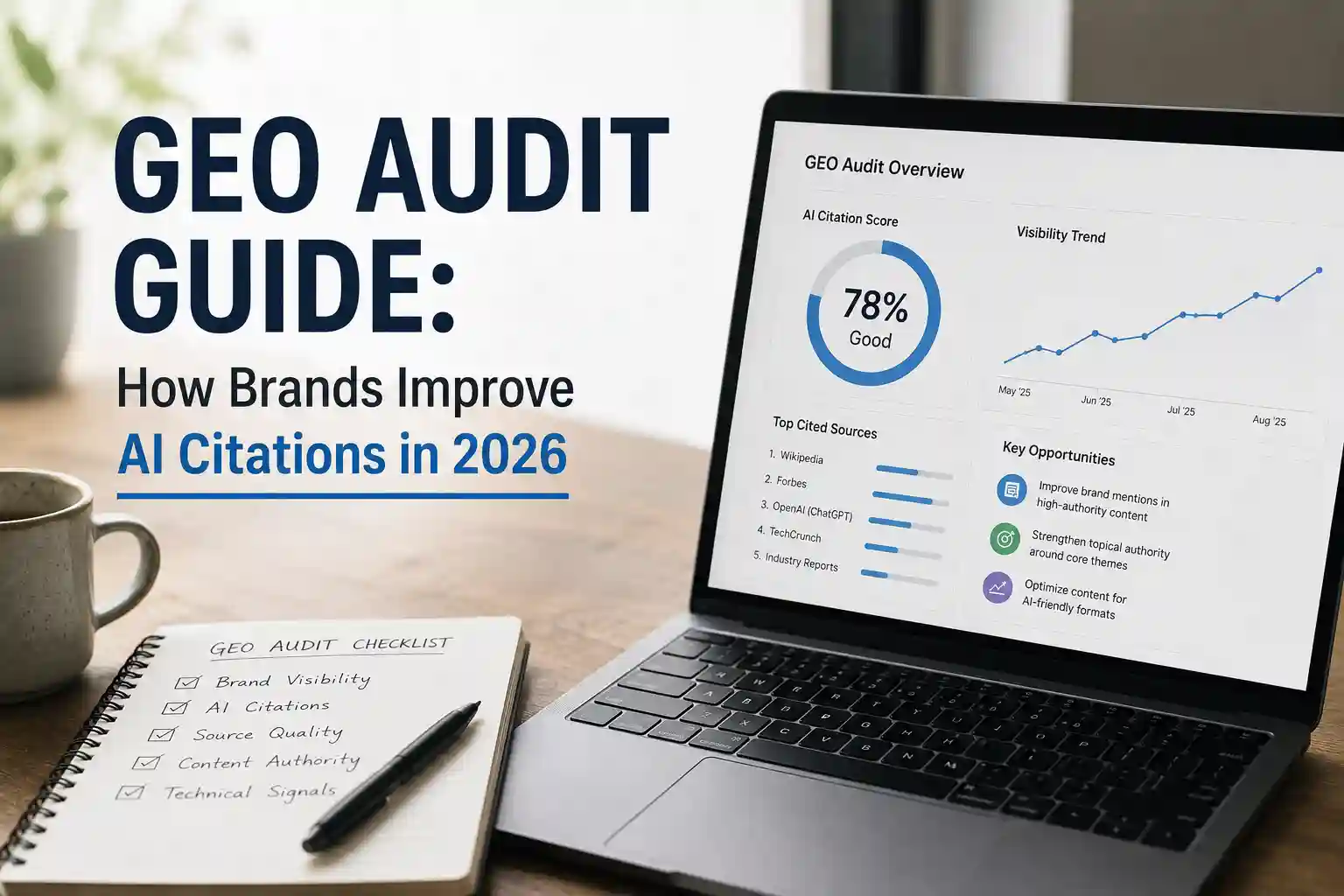
A GEO audit helps brands become more eligible for Artificial Intelligence (AI) citations by testing where they appear across different platforms. It identifies exactly why relevant pages are overlooked and helps you prioritise improvements to entities, evidence, retrieval, content structure, and third-party corroboration. You must clarify immediately that no audit can guarantee citations, because answers vary heavily by platform, underlying model, query wording, location, personalisation, and time.
This guide is designed for enterprise marketing teams that need a repeatable workflow, accountable owners, and measurable outcomes. Before beginning, you must establish clear business goals, priority markets, competitors, important URLs, analytics access, approved claims, and cross-functional stakeholders. Here is how to get started.
Quick Summary
- A Generative Engine Optimisation (GEO) audit measures mentions, citations, accuracy, sentiment, and competitor visibility separately.
- Representative prompts and repeatable tests are essential for a defensible baseline.
- Citable pages combine clear entities, extractable answers, verifiable evidence, and technical accessibility.
- Findings should become URL-level tickets with owners, effort, value, and validation dates.
- Improved citation eligibility does not guarantee inclusion in an AI answer.
What Is a GEO Audit and Why Does It Matter?
A GEO audit is a structured assessment of whether AI answer engines can discover, understand, verify, mention, and cite a brand’s content. It matters because conventional rankings do not reveal answer-level attribution, accuracy, or competitor visibility.
How GEO Audits Measure AI Visibility
If you are wondering how does a GEO audit work, it starts by breaking down visibility into measurable components.
- Cited mentions: The engine provides a visible, clickable source link back to your digital property.
- Uncited mentions: The engine names your brand in its answer without providing a referral link.
- Answer position: Where your brand appears within the generated response structure.
- Factual accuracy and sentiment: Whether the AI correctly describes your product in a positive or neutral light.
Prompt tracking over time gives a much clearer picture of your AI share of voice than isolated screenshots.
Why Citation Eligibility Matters
Understanding what makes brands citable by AI is the foundation of any successful optimisation programme. Citation eligibility relies on technical accessibility, topical relevance, factual specificity, domain trust, and content extractability. You can control these page factors, but you cannot control variable platform behaviour. Agencies or tools promising guaranteed citations are misrepresenting how Large Language Models (LLMs) select sources.
How GEO Complements Traditional SEO
Comparing a GEO audit vs SEO audit reveals that both disciplines rely on strong technical foundations, but they measure success differently.
| Feature | SEO Audit | GEO Audit | Best For |
| Primary Metric | Organic rankings and clicks | Mentions, citations, and accuracy | Tracking visibility goals |
| Technical Focus | Crawlability and indexability | Extractable content and retrieval readiness | Ensuring machine readability |
| Authority Signal | Backlink profiles | Entity clarity and corroboration | Building trust with algorithms |
| Content Goal | Answering search intent | Providing highly specific evidence | Satisfying user queries |
What Should You Prepare Before a GEO Audit?
Prepare clear business goals, priority audiences, markets, competitors, prompts, URLs, approved claims, and responsible stakeholders. These inputs prevent the audit from producing a narrow or misleading visibility score.
Define Goals, Markets, and Competitors
Setting clear enterprise GEO audit goals ensures your team measures what actually drives revenue.
- Choose specific outcomes such as category visibility, product accuracy, or competitor share of voice.
- Specify regional markets, languages, devices, and audience segments where relevant.
- Select both direct commercial competitors and authoritative non-commercial sources for benchmarking.
Without clear business objectives, you risk optimising for queries that do not convert.
Build a Representative Prompt Universe
Knowing how to build a GEO prompt universe ensures your testing reflects real buyer journeys.
- Map category, comparison, use-case, alternative, troubleshooting, purchase, and brand prompts.
- Cover the awareness, consideration, and decision stages equally.
- Weight prompts by commercial relevance without excluding important informational needs.
- Store the exact wording so future tests remain completely reproducible.
Set Baselines, Access, and Governance
A strict GEO audit governance checklist protects your brand from publishing unverified claims.
- Collect priority URLs, analytics access, approved product facts, brand rules, and existing structured data.
- Define exactly who can test, edit, approve, and publish content updates.
- Document data handling protocols, source traceability, human review steps, and access controls.
How Does a GEO Audit Work Step by Step?
A GEO audit works by testing representative prompts, recording answer-level evidence, checking the brand’s entities and sources, assessing technical retrieval, and scoring the most valuable gaps. Each finding should lead to a specific action and owner.
Step 1: Map Prompts to Buyer Intent
Your first action is to group prompts by topic, audience, funnel stage, market, and business value. This GEO audit prompt mapping ensures you target high-intent users. The tools needed include search data, customer questions, sales notes, site search logs, and competitor research. You should allow two to four hours for an initial enterprise sample. A helpful tip is to include non-brand prompts that reveal whether the platform naturally associates your brand with its broader category.
Step 2: Test Priority AI Platforms
The next action is to run controlled tests across relevant experiences such as Google AI Overviews, AI Mode, ChatGPT, Perplexity, Gemini, Claude, and Copilot. The tools needed are approved platform accounts, controlled locations, and a standard testing log. The time required varies significantly with your prompt count, target markets, and repeat runs. A helpful tip is to record the specific platform, date, location, account state, and answer type for every single query.
Step 3: Record Mentions and Citations
Your action here is to capture the answer, cited URLs, brand mention, position, sentiment, competitors, and factual accuracy. To track brand citations in AI answers effectively, the tools needed include a structured spreadsheet, database, or a dedicated AI visibility platform. The time required is continuous record evidence during each test rather than trying to reconstruct it later. A helpful tip is to report cited and uncited mentions separately to avoid inflating your success metrics.
Step 4: Check Entity Clarity and Accuracy
This step answers what makes brands citable by AI by verifying your digital footprint. Your action is to compare organisation, product, person, location, and attribute data across first-party and authoritative external sources. The tools needed include site reviews, structured data validators, company profiles, product documentation, and knowledge graph checks. The time required depends on your catalogue, but prioritise commercially important entities first. A helpful tip is to flag conflicting names, descriptions, locations, founders, or product attributes immediately.
Step 5: Review Evidence and Corroboration
If you want to know how to improve AI search citations, you must audit your proof. The action is to review claims, primary sources, dates, authorship, methods, original data, and third-party validation. The tools needed are a content inventory, backlink analysis, publisher research, and a claim register. The time required is extensive, so start with pages already ranking or appearing near relevant citations. A helpful tip is to distinguish your own outbound links from independent sources that actively corroborate your brand.
Step 6: Test Technical Retrieval Readiness
Your action is to check crawlability, indexability, rendering, canonicalisation, internal links, update signals, and extractable page structure. For this technical GEO audit checklist, the tools needed include crawlers, search engine tools, server logs where available, and structured data validators.
For a deeper look at the technical foundations behind AI visibility, read our guide to Technical SEO for AI Search, which covers crawlability, indexing, site structure, and other factors that help AI systems access and understand your content. The time required can be minimised if you align this with your existing technical Search Engine Optimisation (SEO) audit. A helpful tip is to remember that valid schema markup does not guarantee indexing, retrieval, or citation.
Step 7: Score Gaps and Assign Owners
The final action is to score entity clarity, evidence, retrieval, usefulness, corroboration, and observed visibility. The tools needed are a weighted scorecard and an impact-versus-effort matrix. The time required involves holding a cross-functional review before finalising priorities. A helpful tip is to give every action a specific URL, owner, due date, expected value, and validation method to ensure accountability.
How Do You Prioritise GEO Audit Fixes?
Prioritise GEO fixes by weighing citation opportunity, business value, evidence strength, implementation effort, technical dependencies, and brand risk. Begin with useful pages that are already accessible and close to citation eligibility.
Rank Fixes by Impact, Effort, and Risk
When you prioritise GEO audit findings, you must look beyond simple search volume.
- Score the commercial importance and frequency of the citation gap.
- Estimate the editorial, technical, legal, and public relations effort required to fix it.
- Account for inaccurate claims, outdated product data, and governance risk.
- Avoid presenting forecast value as guaranteed performance to your stakeholders.
Choose Updates Before New Content
You should update content for AI citations before writing entirely new articles. Improve established pages when the topic and intent already match the user query. Create new content only when a meaningful audience question or evidence gap is genuinely uncovered. Consolidate overlapping pages that create entity or canonical ambiguity, as this confuses AI models trying to select a primary source.
In practice, teams often find that fixing existing pages yields faster results than writing new ones.
Build a 30, 60, and 90-Day Plan
A structured GEO audit action plan keeps your remediation efforts on track.
- First 30 days: Correct critical entity, factual, access, and measurement issues.
- By 60 days: Update priority pages, evidence, schema, and internal relationships.
- By 90 days: Publish original evidence, pursue corroboration, and complete controlled retests.
Which GEO Audit Mistakes Distort Results?
The most damaging GEO audit mistakes are using too few prompts, relying on one test, combining mentions with citations, and promising deterministic outcomes. These errors can make visibility appear stronger or weaker than it is.
Do Not Treat One Test as a Baseline
You must repeat AI citation testing because answers vary wildly across models, dates, locations, and accounts. A single screenshot proves nothing about your overall visibility. Recommend repeatable prompt panels and scheduled testing to build a reliable baseline. Use directional trends to guide your strategy rather than overclaiming causation from a single isolated test.
Separate Mentions from Source Citations
Understanding AI mentions vs citations is critical for accurate reporting and strategy.
| Feature | Brand Mentions | Source Citations | Best For |
| Definition | A brand name drop without attribution | A visible, clickable source link | Understanding visibility types |
| Traffic Value | Zero direct referral traffic | Potential referral opportunity | Measuring commercial impact |
| Reporting Rule | Report factual accuracy independently | Report as a distinct traffic source | Preventing inflated metrics |
Avoid Promising Guaranteed AI Citations
When stakeholders ask can GEO guarantee AI citations, the answer is always no. Platforms control answer generation and source selection entirely. You should frame success around improved eligibility, coverage, accuracy, and observed trends over time. Require transparent qualification of projected outcomes in all your reporting to maintain trust with leadership.
Setting realistic expectations early prevents leadership from viewing natural AI fluctuations as a failure.
What Does a Strong GEO Audit Deliver?
A strong GEO audit delivers an evidence-backed baseline, a transparent scorecard, URL-level recommendations, assigned owners, and a retesting plan. It should help executives understand risk while giving practitioners specific work they can implement.
Review an Illustrative Audit Scorecard
A GEO audit scorecard example helps teams visualise where their content falls short.
| Feature | Low Score Indicator | High Score Indicator | Best For |
| Entity Clarity | Ambiguous or conflicting definitions | Consistent cross-platform data | Knowledge graph inclusion |
| Evidence Strength | Generic claims without proof | Original research and data | Building algorithm trust |
| Retrieval Readiness | Poor crawlability and structure | Fast, extractable page structure | Technical accessibility |
| Corroboration | No external validation | Strong third-party validation | Earning citation confidence |
Follow an Illustrative Enterprise Example
Consider an enterprise GEO audit example featuring a hypothetical US enterprise software brand. During a comparison prompt test, competitors are cited heavily, but the brand is entirely absent. The audit traces this gap to weak entity definitions, unsupported claims, and limited third-party corroboration. The team then shows how fixes are assigned to specific URLs without inventing fake performance results.
Turn Findings into Page-Level Tickets
Transforming insights into GEO audit deliverables ensures the work actually gets done.
- Include the affected URL, prompt cluster, problem, recommended fix, owner, effort, and expected value.
- Assign specific content, SEO, public relations, product, engineering, and legal responsibilities.
- Define strict approval and completion criteria for every task.
Measure Change with Controlled Retests
You must measure GEO audit results systematically to prove Return on Investment (ROI).
- Retest the same prompt panel and record the platform, date, market, and answer type.
- Track citation rate, mention rate, accuracy, sentiment, and competitor share of voice.
- Use annotations to connect page changes with directional movement in your visibility.
- Avoid claiming direct attribution when multiple variables changed simultaneously.
How Can Addlly AI Run Your GEO Audit?
Addlly AI can support a repeatable GEO audit by combining brand-trained agents, SEO and GEO analysis, multi-language workflows, first-party inputs, and prioritised content actions. Human review and enterprise governance remain part of the workflow.
Automate Audits with Brand-Trained Agents
The Addlly AI GEO audit platform uses agents that learn your approved products, strategy, voice, and content. This connects SEO and GEO auditing with deep entity, citation, and competitor analysis. The platform highlights zero-prompt, zero-code access without implying that enterprise governance is automatic. Addlly AI is LLM-agnostic and enterprise-grade, meaning it adapts to the shifting search landscape securely.
Connect Insights to Content Workflows
A strong GEO audit content workflow moves seamlessly from data to publication.
- Move from research and prioritisation directly to briefs, updates, creation, review, and distribution.
- Maintain brand consistency across blogs, social content, newsletters, and advertisements.
- Support multilingual and geo-aware content operations for global markets.
- Qualify speed and cost claims with supporting customer evidence before publication.
Bridging the gap between auditing and content creation prevents technical recommendations from stalling.
Start with a Controlled GEO Pilot
An enterprise GEO audit pilot is the safest way to prove value before a global rollout.
- Recommend a pilot covering 20 priority URLs, a defined prompt panel, key competitors, and selected platforms.
- Agree on governance rules, success metrics, accountable owners, and strict retesting dates.
- Use the pilot results to decide whether to expand by market, language, product, or business unit.
- See a GEO audit on your domain to understand your current baseline.
Final Words
A GEO audit turns uncertain AI visibility into a structured and measurable programme. You must rely on representative prompts, platform-specific evidence, clear entities, verifiable claims, technical retrieval, and external corroboration. Always assign clear owners and commit to controlled retesting. Remember that GEO builds on strong SEO and content practices rather than replacing them.
Measure citations, mentions, accuracy, and competitor visibility separately. Prioritise pages already close to citation eligibility, and turn every finding into an accountable URL-level action. Prompt sets, platform coverage, answer types, and governance controls should evolve as AI search products and customer behaviour change. See an Addlly AI GEO audit on your domain or run a controlled pilot on 20 priority URLs today.
Frequently Asked Questions
Can a GEO audit guarantee AI citations?
No. A GEO audit can improve citation eligibility and identify measurable gaps, but source selection varies by platform, model, query, location, personalisation, and time.
How many prompts should a GEO audit test?
It depends on your markets, products, audiences, and funnel stages. Use a representative prompt set large enough to cover priority categories, comparisons, use cases, purchase questions, and brand queries.
Can schema markup make AI platforms cite us?
No. Schema can clarify entities and page meaning, but it does not independently guarantee discovery, indexing, retrieval, mention, or citation.
Should we update pages or create new content?
Usually, update relevant authoritative pages first. Create new content when the audit finds a distinct audience need, evidence gap, or search intent that existing pages cannot satisfy.
Is Addlly AI suitable for enterprise GEO audits?
Yes, Addlly AI supports enterprise GEO audits with brand-trained agents, SEO and GEO workflows, first-party inputs, multi-language capabilities, integrations, and human-review controls.
Can Addlly AI audit multilingual AI visibility?
Yes, Addlly AI offers multi-language and geo-aware capabilities that can support visibility analysis and content workflows across selected markets and languages.

Nishanth Kumar is the Lead SEO Strategist at iTech Manthra. With over a decade of experience in the digital marketing landscape, he specializes in technical SEO, link-building strategies, and search engine algorithms. Nishanth has helped hundreds of businesses scale their organic presence through data-driven marketing and sustainable “white-hat” techniques. He is passionate about decoding Google’s ever-changing updates to help brands stay ahead of the competition.