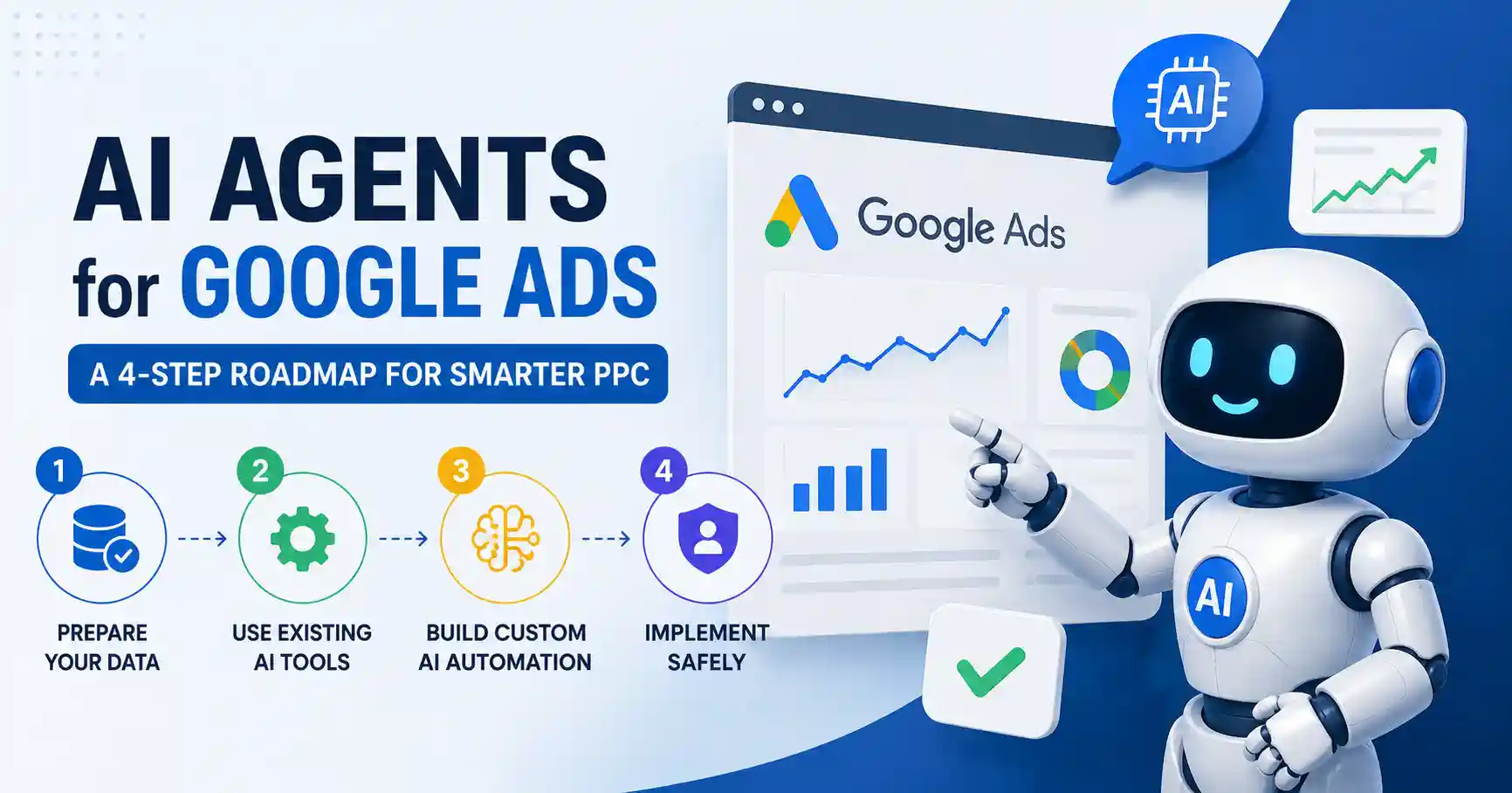
Ever wished Google Ads would just blurt out what’s wrong? You know, problem identified, solution on a silver platter, no endless dashboard spelunking. A pipe dream, perhaps? That’s basically the promise of AI agents for Google Ads. But there’s a catch: jumping straight to an autonomous agent isn’t necessarily the smartest move.
Google Ads is already moving toward a more AI driven advertising model. AI Max is expanding across Search, Google is introducing more agentic capabilities, and tools such as Ads Advisor and Ask Advisor are pushing campaign management beyond simple automation.
The real question isn’t whether AI agents will affect PPC. It’s how businesses can prepare for them without creating an expensive system that makes faster decisions with bad information.
What exactly are AI agents for Google Ads?
AI agents for Google Ads go a step further than traditional PPC automation. A rule based automation might increase a budget when conversions rise. An AI agent can potentially analyze campaign performance, connect it with other business information, identify an opportunity, recommend an action and, with the right permissions and guardrails, execute it.
That distinction matters.
Google Ads already uses AI through Smart Bidding, broad match, Performance Max and AI Max. AI agents represent another layer: systems that can reason across tasks rather than simply optimize one setting.
Google’s own AI Max documentation describes AI Max as a continuous optimization layer for Search campaigns, using real time signals to improve targeting and creative delivery.
But an agent still needs context. A campaign can have excellent ROAS and poor profitability. It can generate lots of leads that sales teams never want. It can promote products that are nearly out of stock.
So the first step in this roadmap isn’t buying an AI tool. It’s getting your foundation right.
Step 1: How do you prepare your Google Ads data for AI agents?
Before introducing AI agents for Google Ads, clean up the information they’ll depend on. This sounds boring, but it may be the most important part of the entire process.
Start with your conversion tracking. Make sure the actions you call “conversions” actually represent business value. For lead generation, that could mean feeding qualified leads or closed deals back into your advertising system rather than treating every form submission as equally valuable.
For ecommerce, revenue alone may not be enough. Product margin, returns, stock availability and fulfillment constraints can completely change which products deserve more advertising spend.
You also need a clear knowledge base covering:
- Products and services
- Campaign structure
- Business rules
- Brand voice
- Target customers
- Offers and promotions
- Approval processes
- Important exclusions
This is one of the biggest lessons emerging from PPC AI agent discussions: AI doesn’t magically repair fragmented business data. It can actually make a poor process run faster. Search Engine Land contributor Robert Simpkins makes the same broader point in his four step roadmap, arguing that businesses should establish their knowledge and data foundations before moving into custom agent development.
For businesses already exploring AI powered advertising, this foundation also makes existing automation much more useful. Google Ads inside AI Mode: what marketers need to know
Step 2: Should you use existing AI tools before building a custom agent?
Absolutely. In fact, this is where many businesses should spend more time.
You don’t necessarily need a developer, an AI engineering team or a complicated agent architecture on day one. Start with the AI tools you already have.
For example, export Google Ads campaign data and ask an LLM to identify unusual spending patterns, weak ad groups, search term opportunities, underperforming campaigns or potential budget shifts. You can also use connected tools and data integrations to reduce the need for manual spreadsheet exports.
This approach is useful because it lets your team discover where AI genuinely saves time.
Maybe the biggest opportunity is weekly account auditing. Maybe it’s search term analysis. Maybe it’s reporting. Or perhaps your team spends hours comparing campaign performance with CRM data.
Don’t build a custom AI agent just because “agentic AI” sounds impressive.
Build one when existing AI tools stop meeting a clearly defined requirement.
That’s also consistent with the current direction of Google Ads automation. Google’s conversational experience already helps advertisers generate campaign structures, keywords and ad assets while keeping the advertiser involved in reviewing and approving suggestions.
A good rule is simple: prove the workflow first, then automate it.
Step 3: When does custom Google Ads AI automation make sense?
Custom development becomes worthwhile when your advertising decisions depend on information Google Ads cannot see by itself.
Imagine an ecommerce company selling 500 products. Google Ads can see clicks, conversions and revenue, but the business also knows product margins, inventory levels, return rates and fulfillment capacity.
An AI agent that connects these signals can make much more useful recommendations than one looking only at advertising metrics.
The same applies to lead generation. A campaign producing 100 leads may look fantastic in Google Ads. But if only two leads become customers, the picture changes completely.
This is where PPC automation, CRM integrations and business intelligence become important.
A custom system might connect:
- Google Ads performance data
- CRM and sales pipeline information
- Product and margin data
- Inventory information
- Google Analytics
- Business rules and approval workflows
- Marketing calendars
Technically, this can involve APIs, data warehouses, MCP connectors, guardrails and orchestration. But don’t let the terminology distract from the main idea: give the AI enough business context to make sensible decisions.
The latest PPC research makes this particularly important. Search Engine Land notes that agents working only with platform native metrics can optimize clicks, conversions or ROAS while missing profitability, lead quality or operational realities.
Step 4: How should marketing teams introduce AI agents safely?
Technology is only half of the roadmap. People are the other half.
Instead of telling the entire marketing team, “AI is taking over,” identify a few people who are genuinely interested in experimenting with it. Give them a limited workflow and clear boundaries.
For example, an AI agent could initially:
- Audit campaigns every morning
- Flag unusual performance changes
- Find wasted spend
- Suggest negative keywords
- Identify creative testing opportunities
- Prepare weekly performance summaries
- Recommend budget changes for human approval
That last point is important. You don’t have to choose between completely manual PPC management and fully autonomous advertising.
Human in the loop workflows can provide a useful middle ground. The AI handles repetitive analysis while a marketer approves decisions involving significant budgets, brand positioning or strategic changes.
As Robert Simpkins argues in his roadmap, the goal shouldn’t be autonomous marketing for its own sake. The value comes from taking repetitive, data heavy work away from experienced marketers so they can spend more time on strategy and judgment.
That’s a much more realistic vision of AI agents for Google Ads.
What should advertisers expect from Google Ads AI in 2026?
The direction is pretty clear: more automation, more AI assisted decision making and less manual campaign maintenance.
AI Max is already becoming a central part of Google’s Search strategy. Google says AI Max combines search term matching, text customization and final URL expansion, while giving advertisers additional controls and reporting.
Google has also extended the timeline for the automatic transition of Dynamic Search Ads to AI Max, with the automatic migration now scheduled to begin in February 2027.
That gives advertisers more breathing room, but it doesn’t change the larger trend.
The best PPC teams won’t simply hand over their accounts to AI. They’ll build better data systems, test AI workflows, create sensible guardrails and teach their teams how to work alongside intelligent tools.
For advertisers exploring the wider Google Ads AI ecosystem, Google’s official guidance on AI Max explains how its AI powered targeting and creative features work. Google Ads AI Max official guidance
FAQ’s
AI agents are AI powered systems that can analyze advertising data, identify opportunities, recommend actions and potentially execute campaign tasks with appropriate permissions and controls.
Not exactly. Traditional automation usually follows predefined rules or platform algorithms, while AI agents can handle broader, multi step tasks and work across different sources of information.
Usually not at first. Start with existing AI tools and automation. Consider custom development when your workflows require unique business data, continuous monitoring or advanced integrations.
They can reduce repetitive manual work, but strategic judgment, business understanding, creativity and oversight still matter. The strongest approach is generally human expertise combined with AI automation.
Depending on the business, useful data can include conversion quality, CRM information, product margins, inventory, campaign performance, customer value and operational constraints.
Conclusion : Are AI agents ready to run Google Ads alone?
No, not really. And frankly, that’s probably a good thing.
The smarter approach? A four stage journey: First, lay down an ironclad data foundation. Next, wring every bit of worth from your existing AI, Custom builds? Only if truly essential, then, gently onboard your team. See, Not so scary.
Imagine an AI agent. Not a PPC manager replacement, no, Instead, picture a hyper quick analyst, one who never tires of dashboards. Still, a human, the marketer, must decide what truly matters.
That distinction could become one of the biggest competitive advantages in paid search. Businesses that feed AI better data and clearer business goals are likely to get much more value from automation than businesses that simply turn on every new feature and hope for the best.
The future of Google Ads probably won’t be completely human or completely autonomous. It’ll be a collaboration between intelligent systems and people who know the business.

Kumar Swamy is the CEO of Itech Manthra Pvt Ltd and a dedicated Article Writer and SEO Specialist. With a wealth of experience in crafting high-quality content, he focuses on technology, business, and current events, ensuring that readers receive timely and relevant insights.
As a technical SEO expert, Kumar Swamy employs effective strategies to optimize websites for search engines, boosting visibility and performance. Passionate about sharing knowledge, he aims to empower audiences with informative and engaging articles.
Connect with Kumar Swamy to explore the evolving landscape of content creation!