Have you ever set a maximum CPC simply because you wanted one last safety net between your ad budget and an expensive click? If so, a new Microsoft Advertising change deserves your attention.
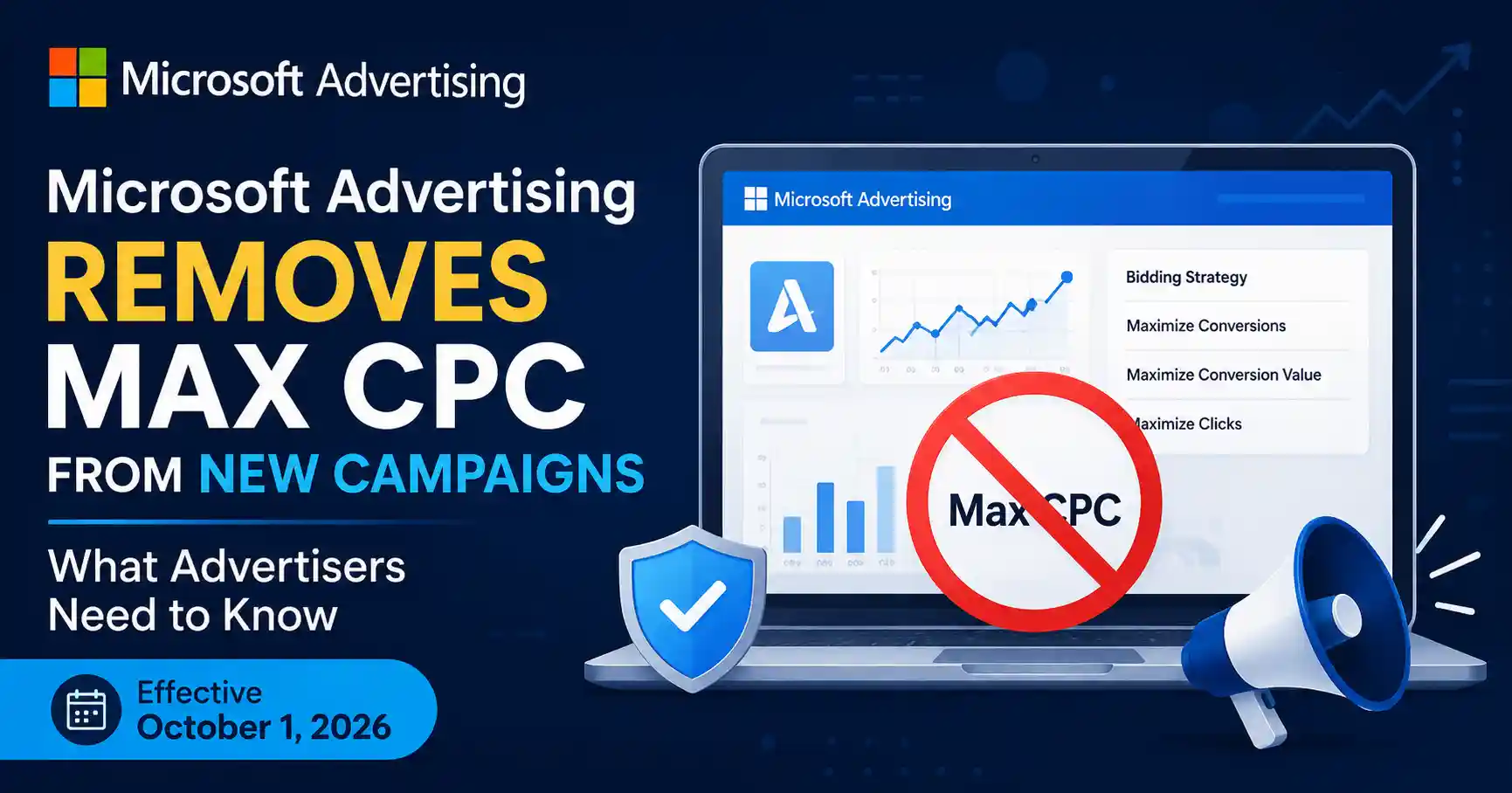
Starting October 1, 2026, Microsoft is completely killing the Max CPC option for new campaigns. Just like that. Standalone automated bidding takes a massive hit here, as Maximize Conversions, Maximize Conversion Value. And Maximize Clicks all land squarely in the crosshairs. Existing campaigns keep their current settings for now, dodging an immediate shock.
Yet, for advertisers paying attention, the writing is boldly on the wall. Microsoft Ads is finally walking away from manual dials because they crave fully automated, goal driven bidding.
What is changing with Microsoft Advertising Max CPC?
Starting October 1, 2026, advertisers running fresh non portfolio campaigns face a shift. If you rely on Maximize Conversions, Maximize Conversion Value, or Maximize Clicks, setting a Max CPC limit is gone for good. No more. Microsoft simply refuses to entertain constraints like trying to chase endless volume while strictly capping bids on these standalone setups. It alters how those particular initiatives function entirely.
There is an important catch, though. Existing campaigns created before the deadline can keep their Max CPC settings. Microsoft also says Max CPC will continue to be available with some other bidding approaches, including Target Impression Share, Enhanced CPC and portfolio bidding strategies.
So this isn’t an overnight removal of Max CPC from every Microsoft Ads account. It’s primarily a change to how advertisers create certain new campaigns.
That distinction matters.
Why is Microsoft removing the Max CPC limit?
Microsoft’s reasoning comes down to a simple problem: a CPC ceiling can sometimes work against the goal you’ve already given the automated bidding system.
Imagine you’re running a Maximize Conversions campaign. You’ve told Microsoft to find as many conversions as possible within your budget. But then you add a strict CPC ceiling that prevents the system from bidding competitively in auctions it considers valuable.
The two instructions can clash.
Microsoft says Max CPC limits can interfere with automated bidding because they may override performance goals and create irregularities in how campaign spend is paced. The company is therefore encouraging advertisers to use controls that are closer to actual business outcomes, such as budgets, Target CPA, Target ROAS and conversion value rules.
This fits a much larger direction in PPC advertising.
As Navah Hopkins, the product liaison for Microsoft Advertising, points out, advertisers need to lean hard on performance targets. Forget trying to babysit automated bidding with strict CPC limits.
Put simply? Microsoft would rather you point the system toward the end goal, Stop micromanaging every single click price. Just let go.
Which Microsoft Ads bidding strategies are affected?
The change is easier to understand when you separate the affected strategies from the ones that remain available.
The main standalone strategies affected are:
- Maximize Conversions – designed to generate as many conversions as possible within the campaign budget.
- Maximize Conversion Value – focused on generating the highest possible conversion value.
- Maximize Clicks – designed to obtain as many clicks as possible within the available budget.
Microsoft’s documentation explains that automated bidding can adjust bids in real time based on auction conditions and campaign objectives.
Other strategies aren’t being removed from the same way. Enhanced CPC, Target Impression Share and portfolio bidding retain Max CPC functionality for now. Microsoft has also indicated that existing campaigns won’t immediately be migrated simply because of the October 1 deadline.
That gives advertisers some breathing room.
But it also means campaign planning needs to change.
What does this mean for Target CPA and Target ROAS?
This is probably the most important part for performance marketers.
Target CPA and Target ROAS put the emphasis on the business outcome rather than an individual click.
With Target CPA, you give Microsoft an average acquisition cost you’re trying to achieve. With Target ROAS, you provide a return on ad spend goal and let the system adjust bids based on expected conversion value.
Microsoft’s current guidance recommends conversion tracking for these automated strategies and notes that the system needs sufficient data to optimize effectively.
This is why accurate tracking becomes even more important as Max CPC controls disappear.
If your conversion tracking is incomplete, your conversion goals are poorly defined, or your Target CPA is unrealistic, simply giving the algorithm more freedom won’t magically fix the campaign.
Better automation still needs better inputs.
Reviewing your paid search strategy? Take a look at how other major ad networks handle automated bidding. Our 2026 guide on Google Smart Bidding shifts gives you a solid benchmark for comparison.
Should advertisers remove Max CPC from existing campaigns now?
Not necessarily.
Microsoft isn’t forcing advertisers to remove Max CPC from campaigns that already have the setting.Old campaigns made before October first keep their Max CPC settings. That is fine. But honestly, it might be smart to test dropping the limit altogether. Microsoft wants advertisers running optimization experiments to check out performance sans Max CPC before the fresh rules hit new campaigns. Give it a try.
That approach is much safer than simply changing everything at once.
For example, take a stable campaign and compare performance with and without the CPC ceiling. Watch metrics such as:
- Conversion volume
- Cost per acquisition
- Conversion rate
- Average CPC
- Spend
- Impression share
- Conversion value or ROAS
Don’t judge the experiment after a day or two.Automated bidding demands massive data for smart tweaks, particularly during sudden market shifts. Microsoft explicitly notes their strategies require time to gather this vital info. The engine simply demands breathing room. Give it space.
What should Microsoft Ads advertisers do before October 1?
The smartest response isn’t to panic and start rebuilding every campaign.
Spend the upcoming weeks auditing your account carefully. Track down hidden campaigns running Max CPC alongside conversion goals or clicks. Then figure it out. Does that strict cap actually help performance, or is it just holding the bidding system back?
Then review your conversion tracking. Make sure the conversions you’re optimizing toward are meaningful business actions, not low value events that can distort automated bidding.
If you’re using Target CPA or Target ROAS, revisit those targets too. A target that made sense six months ago may not reflect your current customer acquisition costs or margins.
Finally, document your existing performance before October 1. Having a baseline will make it much easier to understand whether removing the Max CPC restriction actually changes your results.
This broader shift toward automation isn’t limited to Microsoft Ads. Google and other advertising platforms are also giving algorithms more control over auction time decisions. Our recent article on 2026 PPC trends and smarter paid advertising covers that wider shift.
The key is not to surrender strategy just because the platform is automating bidding.
Your job simply moves higher up the decision chain.
Instead of deciding every individual bid, you’re deciding the right goal, budget, conversion signals and business constraints.
Is the Microsoft Advertising Max CPC change good or bad for advertisers?
Honestly, it can be either.
If your conversion tracking is rock solid and you are swimming in data, lowering that CPC ceiling might actually make sense. It gives Microsoft automated bidding plenty of running room during rich auctions. Still, if you relied on Max CPC purely to keep spending tight, this move feels deeply unsettling. Almost terrifying.
That’s the trade off.
Automation can react to thousands of auction signals much faster than a person can. But an algorithm is only as useful as the goals and data behind it.
The real question isn’t whether Microsoft should control the bid.
It’s whether you’ve given Microsoft a sensible target to optimize toward.
That’s a much more strategic question than simply asking whether a click costs $2, $5 or $10.
What happens after October 1, 2026?
For new eligible standalone campaigns, Max CPC will no longer be available when using the affected automated bidding strategies.
Existing campaigns aren’t being automatically stripped of their Max CPC settings at the same time, and Microsoft says additional updates about the future of Max CPC will come later.
That means advertisers shouldn’t assume today’s exceptions will remain forever.
The safest approach is to start testing now.
If your campaigns perform just as well or better without Max CPC, you’ll already have useful evidence before the restriction becomes part of the normal campaign setup process.
And if performance gets worse, you’ll have time to investigate whether the issue is your bidding strategy, conversion data, budget or targets.
FAQ’s
No. The October 1 change applies to certain new standalone campaigns. Existing campaigns can retain their Max CPC settings, while some other strategies and portfolio bidding continue to support the control for now.
The change takes effect on October 1, 2026.
The main affected standalone strategies are Maximize Conversions, Maximize Conversion Value and Maximize Clicks.
Yes. Campaigns created before October 1 can retain their existing Max CPC settings under the current change.
Focus more heavily on your campaign budget, conversion tracking and performance targets such as Target CPA or Target ROAS. The right option depends on whether your priority is conversions, conversion value, clicks or another business outcome.
Conclusion
Microsoft Advertising dropping Max CPC is just another shove, Paid search is ditching manual bidding altogether, chasing automated, outcome driven results instead.
Mark this date down: October 1, 2026. New standalone campaigns running on Maximize Conversions, Maximize Conversion Value, or Maximize Clicks? They will lose Max CPC entirely. Existing campaigns and a few other setups hold onto it for the time being.
Don’t wait until October to find out how your campaigns behave without that safety net. Test it, measure the results and make sure your conversion tracking and targets are doing the heavy lifting.
What do you think about Microsoft’s decision to remove Max CPC from new campaigns? Would you trust automated bidding without a CPC ceiling? Share your thoughts in the comments.

Kumar Swamy is the CEO of Itech Manthra Pvt Ltd and a dedicated Article Writer and SEO Specialist. With a wealth of experience in crafting high-quality content, he focuses on technology, business, and current events, ensuring that readers receive timely and relevant insights.
As a technical SEO expert, Kumar Swamy employs effective strategies to optimize websites for search engines, boosting visibility and performance. Passionate about sharing knowledge, he aims to empower audiences with informative and engaging articles.
Connect with Kumar Swamy to explore the evolving landscape of content creation!