So, Google’s decided to give a whole lot of those long standing Search campaign features a full blown AI makeover, eh? If you manage Google Ads, you absolutely, positively need to note these dates. Seriously.
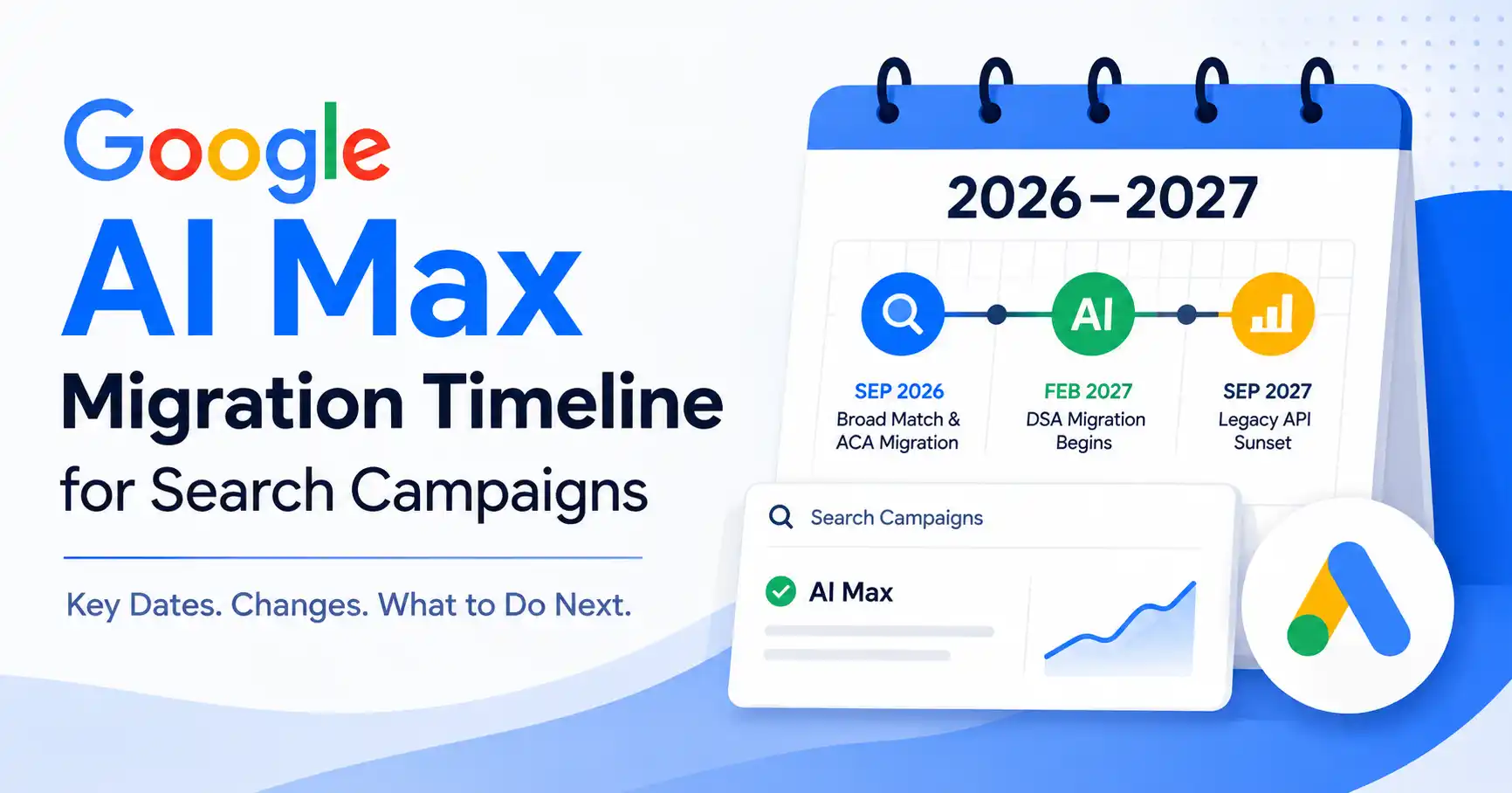
Google just delivered a much sharper timeline for this AI Max migration that’s coming for Search campaigns. Automatic transitions kick off in September 2026, then a bigger wave hits in February 2027. Campaigns leaning on broad match at the campaign level, or those old Automatically Created Assets (ACAs), are first up for the axe. Dynamic Search Ads (DSA) dodged a bullet, though; they get a little more time.
That makes this more than another Google Ads update. It’s a signal that Google wants AI Max to become the standard way advertisers manage modern Search campaigns.
For advertisers, the smart move isn’t to panic or wait for Google to flip the switch. It’s to understand what’s changing, check which campaigns are affected, and start testing AI Max while you still have control.
What is the Google AI Max migration timeline for Search campaigns?
The Google AI Max migration timeline for Search campaigns is essentially a phased transition away from several older Search campaign features.
Google stopped allowing advertisers to create new campaign level broad match configurations and legacy Automatically Created Assets on August 3, 2026. The next major step begins September 1, when eligible campaigns using those legacy settings will start being automatically upgraded to AI Max.
Dynamic Search Ads are on a different clock. Google delayed their automatic migration until February 2027, giving advertisers several additional months to test, prepare and voluntarily move campaigns.
Here’s the simplified timeline:
- August 3, 2026: New campaign level broad match and legacy ACA creation stopped.
- September 2026: Campaign level broad match and ACA campaigns begin automatic migration to AI Max.
- September 2026: Google begins notifying DSA advertisers about the upcoming transition.
- January 15, 2027: Reminder notifications go to advertisers still using legacy DSA campaigns.
- February 2027: Automatic DSA migration begins.
- Around September 2027: Older Google Ads API versions supporting some legacy entities are expected to reach their sunset.
That’s why “AI Max migration” shouldn’t be treated as one single deadline. There are really two important clocks running.
Why is Google moving Search campaigns toward AI Max?
The bigger story is Google’s push toward AI powered Search campaigns and less manual campaign management.
AI Max isn’t a completely new campaign type. Google describes it as an optimization layer inside existing Search campaigns. It brings together features such as search term matching, text customization and Final URL expansion.
In practical terms, Google wants advertisers to give the system stronger signals and business goals instead of trying to control every individual search query manually.
That’s a pretty big change in mindset.
For years, PPC managers focused heavily on keywords, match types, bids and tightly controlled ad structures. Now, Google is increasingly asking advertisers to provide good conversion data, useful creative assets, relevant landing pages and clear business objectives while its AI handles more of the matching and optimization.
Google has also reported that advertisers activating AI Max typically see 14% more conversions or conversion value at a similar CPA or ROAS, based on its internal 2025 data for non retail advertisers. That’s a Google reported figure, not an independent industry benchmark, so it should be treated accordingly.
What happens to Dynamic Search Ads, broad match and automatically created assets?
This is probably the part advertisers should understand first.
Campaign level broad match: Campaigns using this setting are scheduled for automatic AI Max upgrades starting in September 2026. Google says the existing setup will be migrated using equivalent AI Max settings, with brand inclusions and exclusions carried over.
Automatically Created Assets: Google is moving the old ACA functionality into AI Max through its newer text customization system. Text customization can generate additional headlines and descriptions using information from existing ads, landing pages, keywords and the wider campaign context.
Dynamic Search Ads: DSA gets more breathing room. Google moved the automatic migration from September 2026 to February 2027 after feedback from advertisers. Google Ads leadership said, “We heard your feedback,” explaining why the timeline was extended.
This delay is actually useful. It gives businesses time to compare existing DSA performance against AI Max rather than rushing into a change during an important sales period.
As Google Ads product leadership has emphasized, the goal is to make the transition easier while giving advertisers time to become familiar with the newer controls.
How will AI Max change Google Ads campaign management?
The biggest change may not be a single feature. It’s how advertisers think about campaign management.
AI Max uses broader search term matching that can combine broad match, asset based targeting and keywordless technology to discover relevant searches. It can also customize ad text and send users to potentially more relevant pages through Final URL expansion.
That means your website suddenly matters even more.
If your landing pages are outdated, poorly organized or vague, giving Google more automation may not magically fix the problem. The AI can only work with the signals and content available to it.
This is where Google Ads automation becomes a strategy issue rather than just a technology issue. Clean conversion tracking, strong landing pages, useful first party data and clear campaign goals become increasingly important.
For businesses already exploring AI driven advertising, this connects closely with our guide on Why PPC AI agents can fail without quality business data.
What should advertisers do before the AI Max migration?
Don’t wait until the automatic migration lands in your account.
Start with a campaign audit. Identify campaigns using campaign level broad match, legacy automatically created assets and Dynamic Search Ads. Separate campaigns that are strategically important from those that are easier to test.
Next, record your current baseline. Look at conversions, CPA, ROAS, conversion value, search terms, landing pages and important brand exclusions. Without a baseline, it becomes difficult to know whether the migration actually helped.
If you’re testing AI Max, Google recommends pairing it with conversion based Smart Bidding. Several AI Max features also depend on conversion based bidding to work effectively.
It’s also worth reviewing your landing pages and ad assets before switching more automation on. AI Max can expand reach and customize messaging, but advertisers still need to give the system useful material to work with.
If you’re already reviewing your broader PPC strategy, our 2026 PPC trends guide covers several of the automation, intent and data changes affecting paid search.
For developers, there’s another task: check Google Ads API integrations, scripts and internal tools. Google says future API versions released after September 1, 2026 will remove support for legacy campaign level broad match and ACA entities. Older versions are expected to continue until their normal sunset period.
Is AI Max the future of Google Search advertising?
At this point, it certainly looks that way.
Google has been steadily moving Search toward automation, and AI Max brings several previously separate capabilities into one framework. The company says AI Max is designed to expand reach, improve creative relevance and provide more controls and reporting while reducing manual work.
That doesn’t mean marketers can simply switch AI Max on and forget about their campaigns.
Quite the opposite.
The role of the PPC manager is shifting from manually controlling every setting to deciding what the system should optimize for, checking whether the results make business sense and stepping in when automation goes off track.
That’s also consistent with the wider evolution of AI in paid media and brand visibility.
The advertisers most likely to benefit won’t necessarily be the ones who automate everything first. They’ll be the ones who understand their data, test carefully and know where human judgment still matters.
FAQ’s
Automatic migration for eligible campaign level broad match and legacy Automatically Created Assets campaigns begins in September 2026. Dynamic Search Ads are scheduled for automatic migration starting in February 2027.
Google is transitioning DSA functionality to AI Max, with automatic migration beginning in February 2027. Advertisers have additional time to test and migrate voluntarily before then.
No. AI Max is an optimization layer that works within Search campaigns.
No. Google provides controls for areas such as brand settings, locations, search term matching, asset optimization and URL rules.
It’s generally better to audit and test early. Voluntary migration gives you more time to understand performance and adjust your campaigns before an automatic change happens.
.
Conclusion : What does the AI Max migration mean for advertisers?
The AI Max migration timeline for Search campaigns is no longer something advertisers can comfortably ignore.
September 2026 is the immediate deadline for campaigns affected by campaign level broad match and legacy Automatically Created Assets. Dynamic Search Ads have more time, with automatic migration now scheduled for February 2027.
The good news is that this isn’t necessarily bad news.
AI Max can give advertisers more reach, automation and creative flexibility. But the transition works best when businesses treat it as a campaign strategy change, not simply a button they need to click.
Audit your account, protect your important controls, document your existing performance and test before the deadline arrives.
Google’s Google Ads AI Max guidance is also worth reviewing as you prepare.
The old Search campaign playbook is changing. The smartest move now is to understand the new one before Google writes it for you.

Kumar Swamy is the CEO of Itech Manthra Pvt Ltd and a dedicated Article Writer and SEO Specialist. With a wealth of experience in crafting high-quality content, he focuses on technology, business, and current events, ensuring that readers receive timely and relevant insights.
As a technical SEO expert, Kumar Swamy employs effective strategies to optimize websites for search engines, boosting visibility and performance. Passionate about sharing knowledge, he aims to empower audiences with informative and engaging articles.
Connect with Kumar Swamy to explore the evolving landscape of content creation!