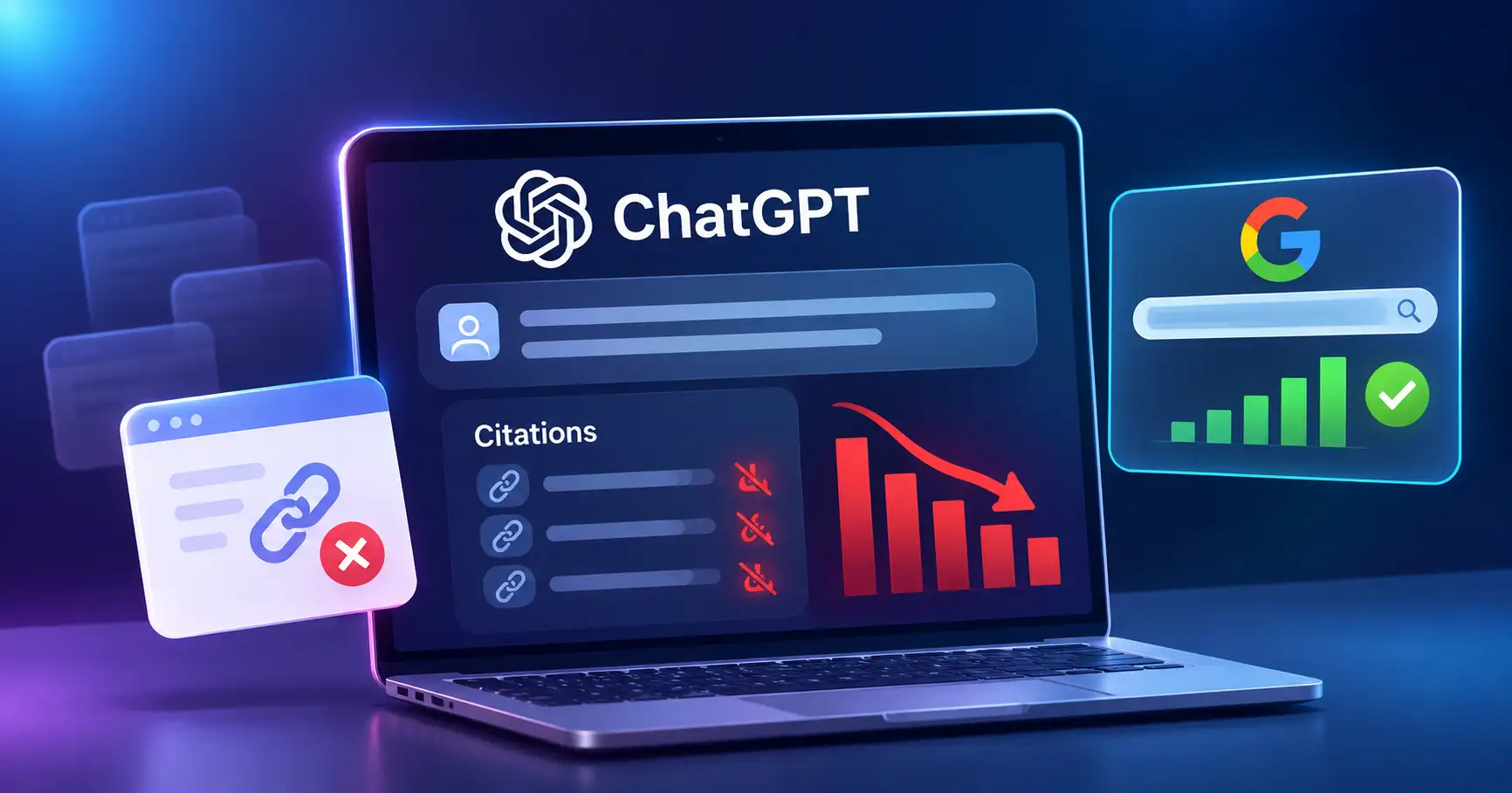
ChatGPT has become an important discovery channel for businesses, publishers, and content creators. People turn to it to research products, compare services, find solutions, and discover websites. For publishers, being cited in an AI generated answer can improve brand visibility and bring referral traffic.
But what happens when ChatGPT suddenly stops citing a website that used to appear regularly in its answers?
A November 2026 investigation by Search Engine Land reported significant citation declines across several major news publishers, even though their Google rankings remained relatively stable. Some of these declines also coincided with ChatGPT model launches, raising questions about changes to AI search and how sources are selected.
For SEO professionals, the situation feels familiar. Website visibility changes, traffic can drop, and identifying the underlying cause isn’t always straightforward.
There’s one important difference, though. ChatGPT citation changes don’t necessarily follow Google’s update schedule. They can happen without a comparable public announcement, making AI search visibility more difficult to monitor.
What Happened to ChatGPT Citations in 2026?
The Search Engine Land investigation examined research from Generative Pulse, which tracks AI generated responses using repeated prompts.
One finding stood out: five major publishers were affected, including Associated Press (AP), TIME, TechCrunch, Los Angeles Times, and The Atlantic.
According to the investigation, citations to these publishers dropped by approximately 50% to 90% within a week of July 9, 2026.
The broader research also found that journalism’s share of ChatGPT citations fell from approximately 33% in January to 22% by September.
What made these changes particularly interesting was that several affected publishers didn’t experience comparable declines in Google’s top three keyword rankings during the same July period.
This highlights an important distinction: a website can maintain its Google search visibility while losing citations in ChatGPT.
However, these findings shouldn’t be treated as universal results. The research relied on API based testing, which may not fully reflect what every user sees in the ChatGPT application.
Why Do ChatGPT Citation Drops Resemble Google Core Updates?
Google core updates can change how websites appear in organic search results. Publishers track ranking movements, investigate affected pages, and assess whether their content continues to meet search intent.
ChatGPT citation changes create a similar challenge, although the underlying systems work differently.
Sudden visibility changes without clear explanations
A website might appear regularly in ChatGPT answers, only to disappear from similar responses later.
That doesn’t automatically mean the website has a technical problem or that its content has become less useful. Changes in retrieval systems, model behavior, or source selection could influence which pages appear.
Different models can produce different results
AI platforms don’t necessarily rely on the same sources or retrieval methods.
A website might receive citations from ChatGPT but not from Gemini or Claude. Even within one platform, different models or search experiences may select different sources.
Google rankings and AI citations can move independently
Consider a technology publication that ranks well for several software related keywords.
Its Google rankings remain stable, but ChatGPT starts citing software vendors, documentation pages, and community discussions instead.
The publisher might assume its SEO strategy is no longer working. However, the underlying issue could be a change in the sources ChatGPT retrieves and considers relevant.
| Google core updates | ChatGPT citation changes |
| Affect organic search rankings | Affect AI generated source visibility |
| Can change keyword positions | Can change which websites are cited |
| Google announces confirmed core updates | Citation changes may happen without an equivalent announcement |
| Tracked through Search Console and rank tracking tools | Tracked through repeated AI prompt testing |
The takeaway is simple: Google rankings and ChatGPT citations need to be measured separately.
What Causes ChatGPT to Stop Citing Websites?
There’s no single confirmed explanation for every citation decline. Several factors can influence whether a website appears as a source.
AI model and search retrieval changes
Model updates can influence how an AI system interprets questions, searches for information, and selects supporting sources.
The 2026 investigation identified timing overlaps between some ChatGPT citation declines and model launches. However, that doesn’t establish that a particular model update caused the losses.
Changes in source selection
Sometimes, ChatGPT may find a direct source more useful than an article discussing that source.
For example, when answering a question about government regulations, it might cite an official government website rather than a news article explaining those regulations.
This can reduce citations to publishers without necessarily suggesting that their content quality has declined.
Content freshness and competing sources
When several websites cover the same topic, an AI search system may select a page with more recent information, clearer explanations, or more relevant supporting evidence.
Content that simply repeats information already available elsewhere may also offer less distinctive value.
Website accessibility and crawler restrictions
Technical accessibility is another area worth investigating.
Blocked crawlers, server errors, incorrect robots.txt rules, and CDN restrictions can interfere with content discovery.
Website owners investigating these issues should review OpenAI’s official ChatGPT Search documentation, which explains how ChatGPT Search retrieves web information and provides citations.
How Can You Identify a Real ChatGPT Citation Drop?
Before changing your content strategy, establish whether the decline is consistent or simply normal variation.
Monitor the same prompts consistently
Start by creating a list of questions your audience might ask ChatGPT. Run the same prompts regularly and record:
- Whether your website appears in the answer.
- Which URL ChatGPT cites.
- Which competitors appear instead.
- Whether your brand is mentioned without a link to your website.
- Whether the cited sources change between tests.
For example, a SaaS company could monitor questions such as “best project management tools for small businesses” and “how to automate recurring invoices.”
Don’t draw conclusions from a single response. Repeated testing gives you a more reliable picture of citation patterns.
Compare AI citations with Google rankings
Use Google Search Console to review impressions, clicks, and average positions for affected pages. Compare these trends with your AI citation records.
If Google performance remains stable while ChatGPT citations decline, investigate AI specific visibility before making significant SEO changes.
Check referral traffic and website accessibility
Use GA4 to identify traffic coming from ChatGPT and compare it with previous periods.
Keep in mind that citations don’t always lead to clicks. Referral traffic alone, therefore, can’t tell you how visible your website is in AI generated answers.
It’s also worth reviewing server logs, robots.txt, CDN rules, and relevant crawler access.
For a more detailed technical review, explore our guide to technical SEO fundamentals for AI search.
What Should Website Owners Do When ChatGPT Citations Drop?
Once you’ve identified a sustained decline, take a structured approach rather than changing everything at once.
- Avoid immediate content rewrites. First, determine whether the decline affects one URL, an entire topic, or several pages across your website.
- Review competing sources. Look at the websites ChatGPT now cites for your target prompts. Compare their information quality, freshness, evidence, and relevance with your own content.
- Strengthen original information. Where appropriate, add practical examples, original research, expert explanations, product documentation, and useful comparisons.
- Address technical accessibility. Check that important pages return successful responses, aren’t accidentally blocked, and have clear internal links.
- Build visibility beyond your website. Work towards relevant mentions in industry publications, credible communities, partnerships, and useful third party resources.
- Keep measuring performance. Track citations, brand mentions, referral traffic, organic rankings, and conversions as separate metrics.
One mistake worth avoiding is publishing more articles simply because existing pages have lost citations. Adding more content won’t necessarily fix a source selection problem. In many cases, improving the usefulness and distinctiveness of existing resources is a better place to start.
How Can You Protect Your Website From Future AI Citation Changes?
No website can guarantee that ChatGPT will continue citing its content. Businesses can, however, reduce their dependence on a single discovery channel.
Focus on three areas:
- Content differentiation: Publish original insights and information that competing websites can’t easily reproduce.
- Brand authority: Establish a credible presence across relevant publications, professional communities, and industry resources.
- Measurement: Maintain separate reports for Google organic performance, ChatGPT citations, other AI platforms, and business conversions.
Google’s people first content guidance provides a useful foundation. It emphasizes original information, meaningful analysis, reliable sourcing, and content designed to help readers rather than manipulate rankings.
For businesses, AI search should be treated as another discovery channel, not a replacement for traditional SEO. Our article on where the real opportunity in AI search lies also explores why visibility needs to connect with measurable business results.
FAQ’s
Several factors could explain the change, including model behavior, search retrieval, source selection, content freshness, competing pages, or crawler accessibility. Test multiple prompts and compare the results before deciding what caused the decline.
Not necessarily. ChatGPT citations and Google’s organic rankings measure different types of visibility. A website can lose AI citations while maintaining its Google positions. Both channels can also experience changes independently.
Citations can return, but recovery isn’t guaranteed. Review content quality, source relevance, technical accessibility, and competing pages. Avoid making major changes until you have a clearer understanding of the likely cause.
For important business queries, weekly monitoring is a reasonable starting point. During major model launches or significant visibility changes, more frequent testing can help identify shifts in citation patterns.
Conclusion
ChatGPT citation drops are adding another challenge to SEO. Unlike traditional Google updates, changes in AI search visibility can happen without a clear announcement or an obvious explanation.
The 2026 publisher investigation shows why businesses shouldn’t assume that stable Google rankings automatically translate into stable ChatGPT citations.
The best response is to monitor AI visibility independently, investigate technical and content related issues, strengthen original resources, and maintain a presence across multiple discovery channels.
Rather than rebuilding your entire SEO strategy whenever ChatGPT changes its citations, look for consistent patterns, understand what’s driving them, and make improvements based on evidence.

Kumar Swamy is the CEO of Itech Manthra Pvt Ltd and a dedicated Article Writer and SEO Specialist. With a wealth of experience in crafting high-quality content, he focuses on technology, business, and current events, ensuring that readers receive timely and relevant insights.
As a technical SEO expert, Kumar Swamy employs effective strategies to optimize websites for search engines, boosting visibility and performance. Passionate about sharing knowledge, he aims to empower audiences with informative and engaging articles.
Connect with Kumar Swamy to explore the evolving landscape of content creation!