Have you ever looked at your website traffic and thought, “Where did all those visitors actually come from?”
That question is getting harder to answer in 2026.
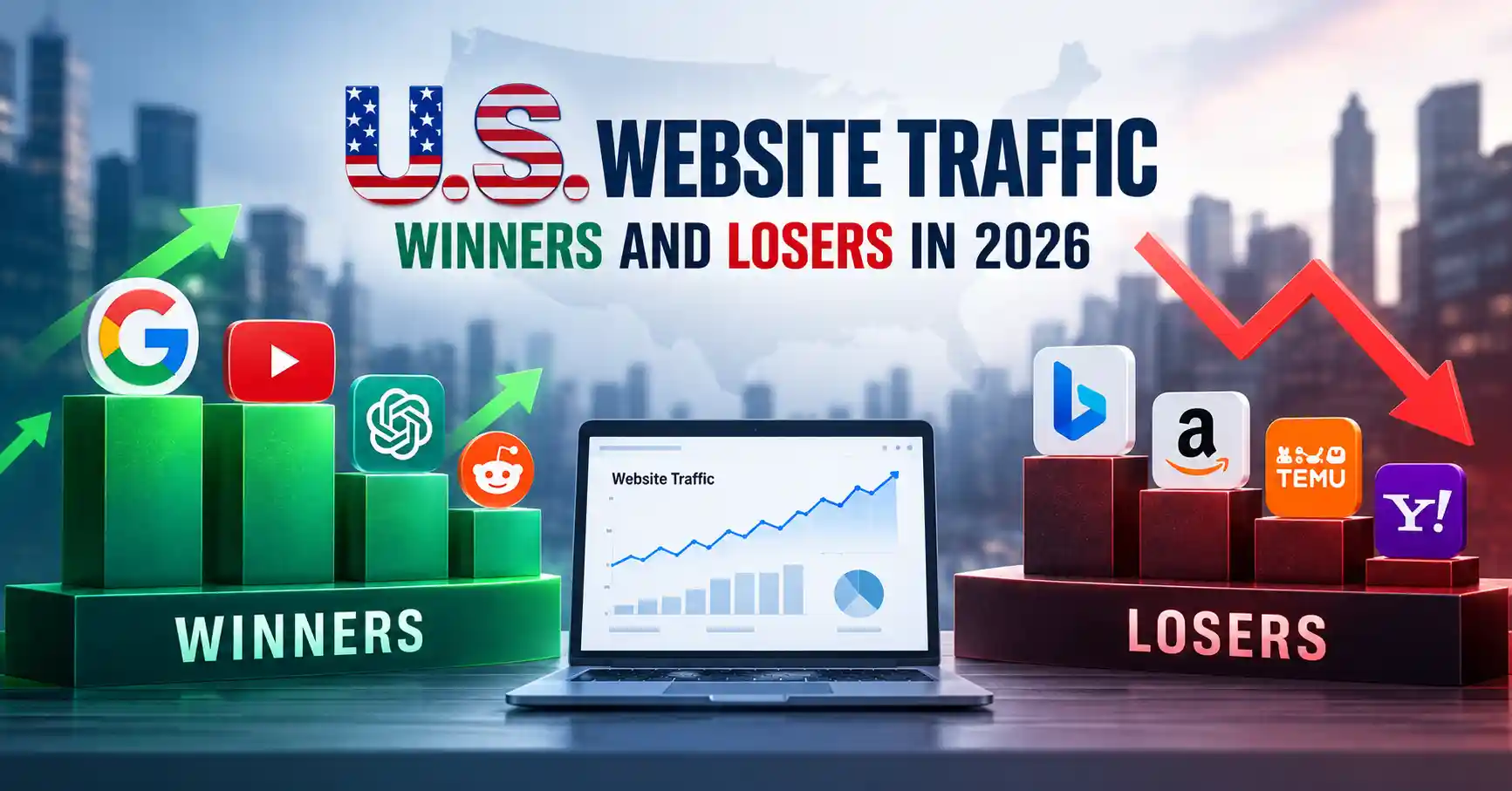
The latest U.S. website traffic numbers show a web that’s changing in some surprising ways. Google and YouTube remain enormous, ChatGPT has jumped into the top tier, while Bing, Temu, Amazon and several other familiar names have lost ground.
The bigger story, though, isn’t simply who won and who lost. It’s what these changes tell us about search behavior, AI search, organic traffic and the future of SEO.
The latest figures from Semrush Traffic Analytics, comparing July 2026 with the same period a year earlier, provide a useful snapshot.
What happened to U.S. website traffic over the past year?
Take a quick look, and it feels like nothing’s really shifted.
Google is still the biggest site in America, pulling in something like 25, 3 billion visits every month. YouTube is next, with 10. 3 billion, then comes Reddit, holding down third place at roughly 2. 61 billion visits.
But dig a little deeper, and it gets interesting.
Google’s traffic actually went up 10. 72% over the last year. YouTube? A massive 36. 6% jump. For the top 150 U. S, websites overall, visits climbed 6. 1%.
What’s wild is that the top 10 sites still gobble up 68. 6% of all traffic within those 150, which is almost exactly what they had a year ago (68. 8%).
So, all that chatter about the web breaking into pieces? It’s not suddenly decentralized, A handful of massive platforms still commands a shocking amount of our attention.
That’s a vital dose of reality for anyone trying to figure out SEO traffic these days.
Why is ChatGPT one of the biggest website traffic winners?
The standout winner is hard to miss: ChatGPT.
ChatGPT. com’s U, S. traffic just exploded, up 48. 38% over last year, we’re talking about 1. 09 billion visits every month. That makes it the ninth most visited site in the U, S.
It even pulled ahead of Bing and DuckDuckGo in this data set.
That’s a wild change. This AI assistant, which wasn’t even a thing for most people a few years back, now draws more monthly visitors than search engines that have been around forever.
And that’s precisely why marketers can’t just brush off AI search anymore.
People aren’t hitting up Google for everything. They’re asking AI tools to break down products, stack up services, dig into topics, and help them choose.
So, for businesses, getting noticed isn’t just about showing up on regular search engine results pages.
Our guide, “AI Search and SEO fundamentals,” dives into why old school SEO is still important even with all this new AI discovery taking over.
The lesson isn’t “Google is dead.” Far from it.
It’s that search behavior is expanding.
Which websites gained the most traffic in 2026?
ChatGPT wasn’t the only winner.
YouTube’s 36.6% increase is particularly interesting because video continues to absorb a huge amount of online attention.Twitch saw a jump too, up 25, 6%, climbing five spots to land at number 25. LinkedIn bumped from 21st to 19th its U. S. visits shot up 15. 48% to about 473, 7 million. USPS, com also pulled in 12. 04% more traffic.
Further down the list, Comix. to had a massive 37, 3% surge, the biggest percentage gain in the whole analysis.
What ties these winners together, Not much. And that’s exactly the takeaway.
No single trend is driving all this traffic growth, Sure, AI is part of it. Video, absolutely. But professional networking sites, utility services, even niche communities can still grab huge audiences if they just become a regular part of people’s daily online routines.
For anyone in SEO, this is a good reminder: don’t put all your eggs in one basket.
Which websites lost search engine traffic in 2026?
The losers are arguably more revealing than the winners.
Bing experienced the biggest decline among the major sites, falling 50.43% year over year in the Semrush dataset.
Temu dropped 28.55%, while NBCNews.com declined 20.2%. ESPN was down 16%, DuckDuckGo fell 15.83%, Amazon declined 15.31%, and Yahoo dropped 13.82%.
The reasons aren’t identical.
Temu’s decline, for example, is closely connected with changes affecting low value imports and the economics behind its U.S. business. That’s a reminder that website traffic can be influenced by factors that have nothing to do with SEO.
Amazon’s drop is kind of a head scratcher, People usually figure if online shopping is up, so is Amazon traffic.
Then there’s Bing. Microsoft poured tons into AI for Copilot, right? So you have to ask: where’s the jump in actual search traffic? Why hasn’t it happened?
No easy answer here. But the data does tell us one thing: tacking AI onto a search engine doesn’t magically make people use it more.
Does AI search mean traditional SEO traffic is disappearing?
Not quite.
In fact, the numbers suggest something much more complicated.
Google and YouTube are both growing strongly while ChatGPT is growing even faster on a percentage basis. That doesn’t look like a simple replacement story.
It’s more like an expansion of the search ecosystem.
Users may discover a product through Google, research it with ChatGPT, watch a YouTube review and then visit the company’s website directly.
That’s why measuring only organic traffic can give marketers an incomplete picture.
There’s another problem: attribution.
Search Engine Land’s analysis found that a large share of traffic in one GA4 account was being classified as direct, while the site’s actual traffic had increased dramatically. The analysis argues that some AI driven visits may be losing referral information before reaching analytics systems.
As the report puts it, “Direct” isn’t necessarily a traffic source. It’s often the bucket analytics systems use when they can’t confidently identify the source.
That’s a big deal.
If you can’t tell where visitors came from, you can easily make the wrong SEO investment.
For a deeper look at this changing measurement problem, see our article on Google Search Console’s AI performance reports.
Why should SEOs be careful when comparing traffic data?
There’s one important caveat before anyone starts publishing giant “winners and losers” charts.
Website traffic platforms don’t all measure the web in exactly the same way.
A follow up comparison of Semrush and Similarweb data found major differences in the reported magnitude of some changes. For example, Semrush’s July 2026 data showed Amazon down 15.31%, while a Similarweb panel cited in the comparison showed Amazon growing 4.8%. Bing also showed a much smaller decline in Similarweb’s data.
That doesn’t make either dataset useless.
It means marketers should focus more on direction, patterns and context than treating an estimated traffic number as an exact measurement.
For competitor research, Semrush’s Traffic Analytics can help marketers compare traffic sources, engagement and competitor performance.
The smart question isn’t simply, “Did this website gain 15%?”
It’s “Why did its traffic move, where did the growth come from, and can we learn anything from it?”
What do these U.S. website traffic trends mean for SEO?
The biggest takeaway is surprisingly simple: don’t put all your eggs in Google’s basket, but don’t abandon Google either.
Good SEO still matters since Google is the main place people discover sites in these results.
Lately, AI search is also showing up as a new route to reach audiences.
Because of that, brands have to publish material that suits real readers and also fits how search tools work.
It should answer common questions in a direct way.It should show what the brand has actually learned, not just repeat what everyone says.It also helps when the brand name feels familiar in the topic area.
Finally, the content should add value instead of only giving broad, generic recap pieces.
Our recent guide to SEO priorities for 2027 covers this broader shift in search visibility.
And there’s another lesson here: measure more than sessions.
Watch rankings, conversions, branded searches, referral traffic, returning visitors, AI visibility and direct traffic together. A website can lose clicks from one channel while gaining valuable users somewhere else.
The companies that understand that shift will have a much better chance of becoming the traffic winners of the next 12 months.
FAQ’s
Okay, so Semrush, their data, anyway, showed visits to the top 150 U. S. websites spiked 6. 1% year over year, Not bad, actually.
ChatGPT knocked it out of the park. US traffic surged, climbing nearly 50 percent year over year by July 2026. A massive jump, really.
Bing experienced a major decline in the Semrush dataset, while ChatGPT grew sharply. However, the data doesn’t prove that every lost Bing visit moved directly to ChatGPT.
No. AI search is changing how people discover information, but traditional search engines, particularly Google, still generate enormous amounts of website traffic.
Don’t just watch one signal. Organic traffic, search rank, conversions, referrals, how many people want your brand, how visible your AI is, mix it all up. Get the full story.
Conclusion
The biggest surprise in U.S. website traffic isn’t that ChatGPT is growing.
It’s that Google and YouTube are growing too.
That tells us the future of search probably won’t be a simple battle between Google and AI. Instead, people are building a much more complicated journey across search engines, AI assistants, social platforms, video sites and direct visits.
For SEO teams, that’s the real warning.
Don’t just chase rankings. Don’t blindly chase AI traffic either. Understand where your audience is moving, measure what your analytics can actually see, and build a brand people want to find wherever they search.
The traffic winners of tomorrow may not be the websites with the most pages. They may be the ones that are easiest to discover, trust and recommend.

Kumar Swamy is the CEO of Itech Manthra Pvt Ltd and a dedicated Article Writer and SEO Specialist. With a wealth of experience in crafting high-quality content, he focuses on technology, business, and current events, ensuring that readers receive timely and relevant insights.
As a technical SEO expert, Kumar Swamy employs effective strategies to optimize websites for search engines, boosting visibility and performance. Passionate about sharing knowledge, he aims to empower audiences with informative and engaging articles.
Connect with Kumar Swamy to explore the evolving landscape of content creation!