Have you ever tried to figure out how much traffic your website gets from Google’s AI powered search experiences, versus the classic search results?
Until recently, this kind of question was hard to answer, in a straightforward way.
As AI becomes a bigger piece of Google Search, through features like AI Overviews and AI Mode, marketers have been left scrambling to understand what happens to impressions, clicks, and overall organic performance when users land inside these experiences.
Now, Google is starting to handle that issue.
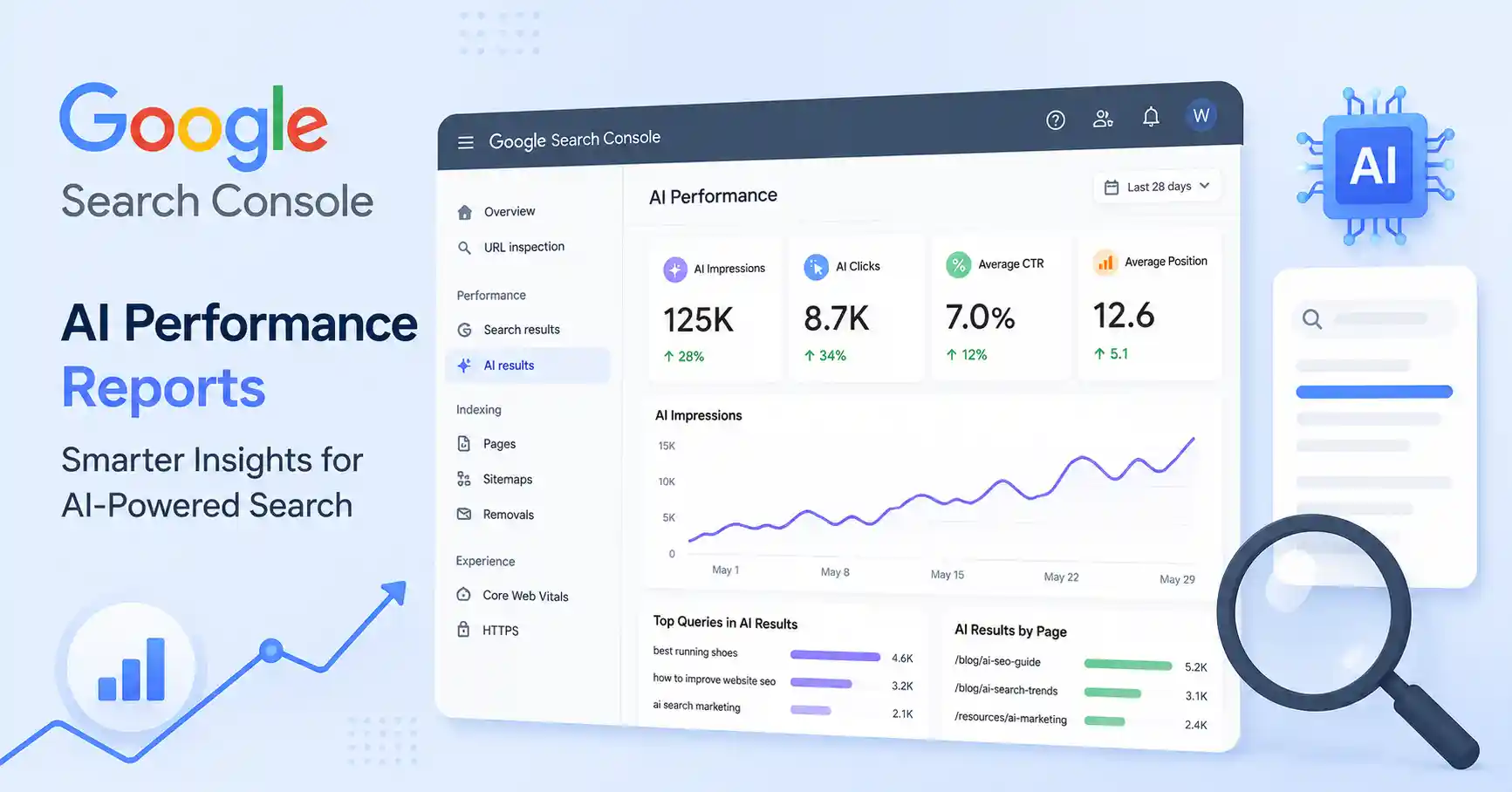
Google Search Console AI performance reports are gradually rolling out to more users, so site owners can finally see how their pages perform in AI driven search contexts.
For SEO professionals, publishers, and companies, this is one of the more meaningful reporting upgrades released this year.
What are Google Search Console AI performance reports?
Google Search Console has always been the primary platform for monitoring organic search performance.
It provides valuable insights into:
- Search clicks
- Impressions
- Average position
- Click through rate
- Indexed pages
- Search queries
However AI powered search has introduced a new challenge.
Content may now appear inside answers generated by AI, rather than only in the usual search listings.
This is where Google Search Console, AI performance reports step in.
These new reports help website owners get a clearer view of how content performs across Googles growing AI search experiences, and it matters.
Instead of depending only on the standard search metrics, marketers can start tracking visibility in AI driven environments too.
As SEO strategist Nina Lopez explains:
“You cant improve what you can’t measure. AI reporting gives marketers the visibility they have been asking for.”
That kind of visibility is becoming even more valuable.
Why are AI search reports important for SEO performance?
Search behavior is changing rapidly.
Users now receive answers directly from AI systems before they even click a website.
This changes how businesses measure success.
Traditional SEO metrics remain useful, but they no longer tell the complete story.
New AI search analytics help marketers understand:
- AI search impressions
- AI generated traffic
- Content visibility
- User engagement
- Search performance trends
These insights help businesses evaluate whether their content is being surfaced within Google’s AI experiences.
For publishers, this data offers a clearer picture of how AI influences discoverability.
How do AI performance reports help website owners?
The biggest benefit is improved decision making.
With Search Console AI reports, marketers can identify which content performs well inside AI generated search experiences.
This helps answer questions like:
- Which pages appear in AI results?
- Are AI impressions increasing?
- How does AI traffic compare with traditional search?
- Which topics receive the most AI visibility?
Understanding these trends allows businesses to improve future content strategies.
Organizations focused on AI search measurement should also explore AI search visibility tracking when attribution falls short, which explains why measuring AI-driven traffic requires new reporting approaches.
The more accurately businesses measure AI performance, the better they can optimize future content.
What metrics should marketers monitor inside AI reports?
While Google’s reporting continues evolving, several AI SEO metrics are becoming increasingly important.
These include:
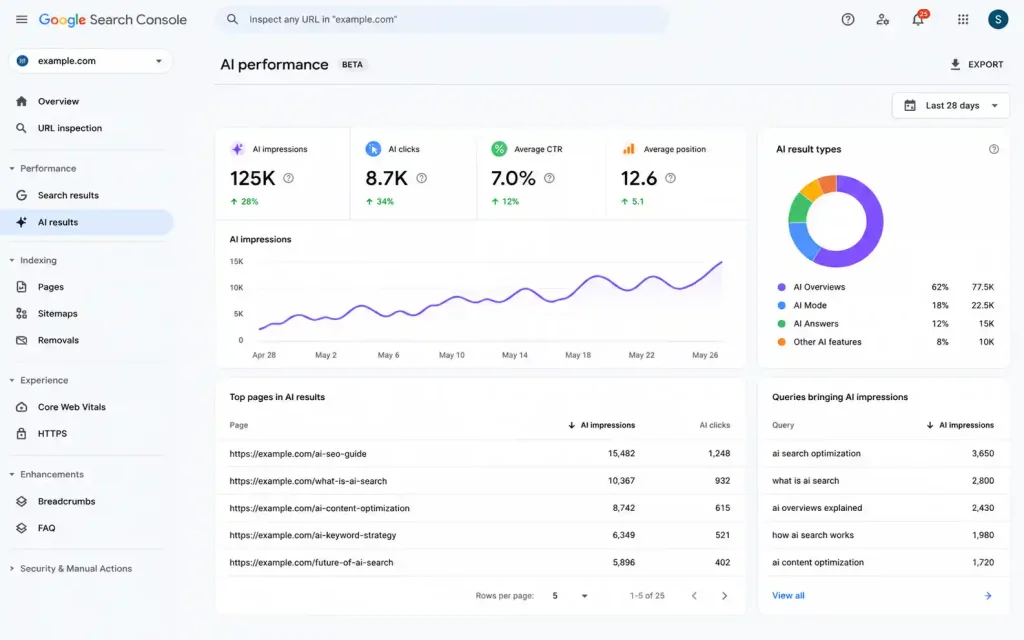
AI impressions
How often content appears in AI search experiences.
AI clicks
The number of users visiting from AI generated search features.
Search visibility
Overall exposure across traditional and AI search.
Query performance
Which search terms trigger AI visibility.
Content engagement
How users interact after arriving on your website.
These metrics provide a more complete understanding of search performance.
Instead of focusing only on rankings, marketers can evaluate actual visibility across Google’s changing search ecosystem.
How should businesses adapt their SEO strategy?
New reporting is only valuable if businesses use it effectively.
Companies should continue focusing on:
High quality content
Comprehensive content remains essential.
Topical authority
Publish content clusters around key subjects.
Structured data
Help Google better understand your content.
User intent
Answer questions clearly and naturally.
Continuous optimization
Monitor AI reports regularly and improve content based on performance insights.
Businesses interested in future AI optimization should also read Google’s LLM patent suggests a new goal for SEO Teaching AI Who You Are, which explores how AI increasingly understands entities rather than only keywords.
Successful SEO increasingly depends on understanding how AI interprets information.
Could AI reporting change how SEO success is measured?
Very likely.
For years, SEO success revolved around rankings and organic traffic.
Now, AI generated answers introduce new forms of visibility.
Content may influence users even when traditional clicks decrease.
This means marketers should begin considering:
- AI visibility
- Brand exposure
- Assisted discovery
- Entity recognition
- User engagement
Together, these measurements create a more accurate picture of search performance.
As AI continues reshaping search, reporting must evolve alongside it.
What does this update mean for the future of Search Console?
Google Search Console continues expanding beyond traditional technical reporting.
It is becoming a platform for understanding how websites perform across increasingly intelligent search experiences.
Future reporting may include:
- AI citation tracking
- Entity visibility
- AI Overview performance
- Search intent analysis
- Content recommendation insights
This evolution reflects Google’s broader investment in AI-powered search.
For marketers seeking official documentation about Search Console reporting, Google Search Console Help Center provides guidance on available reports and performance metrics.
Final Thoughts
Google Search Console AI performance reports are this important step toward making things more clear, especially for AI-powered search.
As Google keeps blending AI into the search experience, marketers need dependable ways to track visibility and how content performs.
These reports help close that gap a little , without too much friction.
Companies that start looking at AI search performance right now will be in a stronger position to adjust their SEO strategies tomorrow.
The future of SEO won’t be measured only by rankings.
It will also be measured by how well your content plays inside AI-driven search experiences, you know.
What do you think AI reporting will do to SEO during the next few years ? Drop your thoughts in the comments below.
FAQs
What are Google Search Console AI performance reports?
They are reporting features that help website owners measure how content performs within Google’s AI powered search experiences.
Why are AI performance reports important?
They provide visibility into AI generated impressions, clicks, and search performance beyond traditional search results.
Do AI reports replace traditional Search Console metrics?
No. They complement existing reports by adding insights about AI search visibility.
How can businesses improve AI search performance?
Focus on high quality content, structured data, topical authority, and satisfying user intent.
Will AI reporting become a standard part of SEO?
Most likely. As AI search expands, measuring AI visibility will become increasingly important for SEO professionals.

Kumar Swamy is the CEO of Itech Manthra Pvt Ltd and a dedicated Article Writer and SEO Specialist. With a wealth of experience in crafting high-quality content, he focuses on technology, business, and current events, ensuring that readers receive timely and relevant insights.
As a technical SEO expert, Kumar Swamy employs effective strategies to optimize websites for search engines, boosting visibility and performance. Passionate about sharing knowledge, he aims to empower audiences with informative and engaging articles.
Connect with Kumar Swamy to explore the evolving landscape of content creation!