Introduction
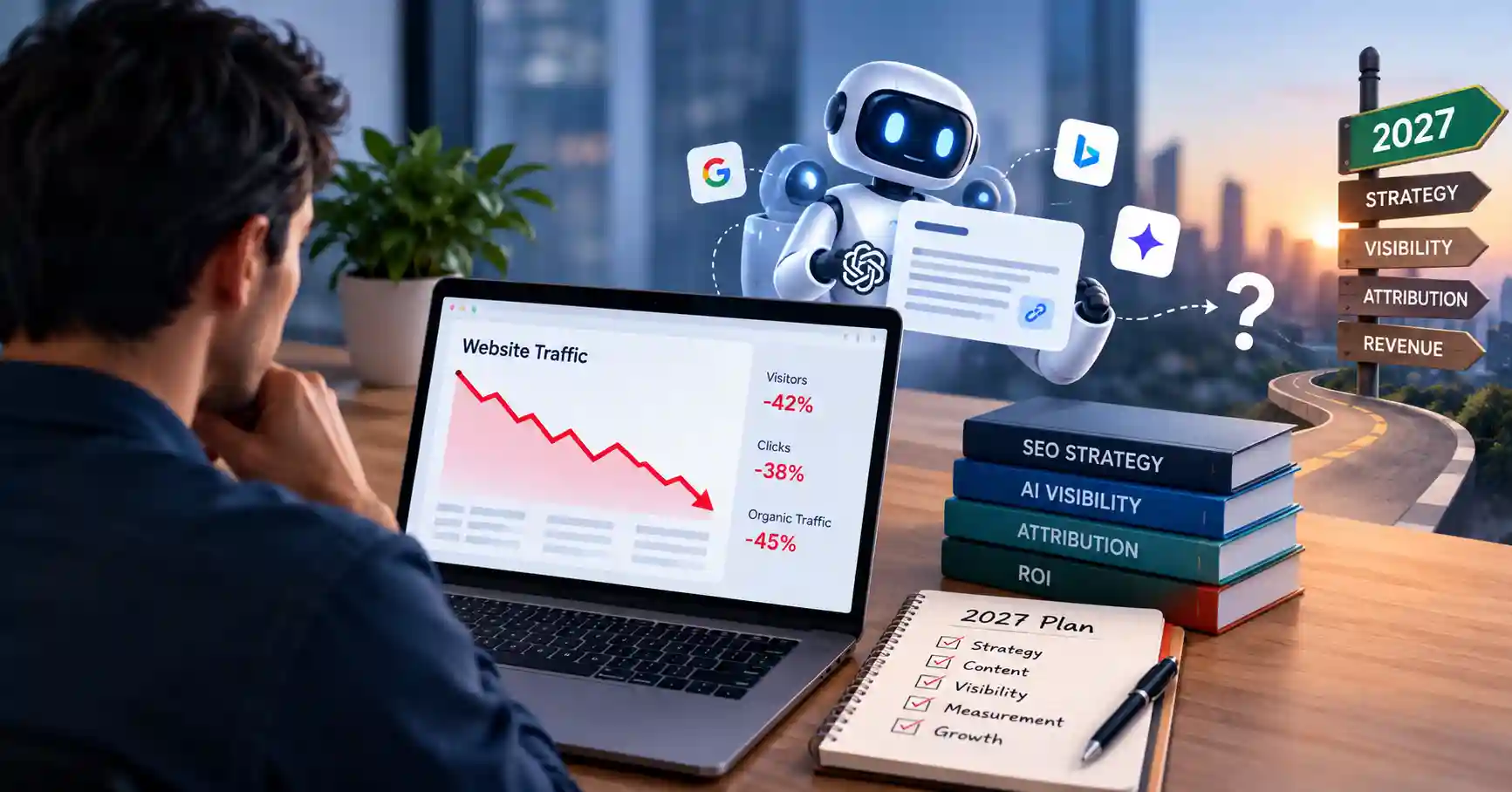
What happens when your website traffic drops, AI search mentions your brand without sending visitors, and your leadership team still expects SEO to deliver more revenue next year?
That is the exact mess marketing teams face right now while mapping out their 2027 budgets. Organic traffic used to be the ultimate metric for proving SEO actually worked. Higher clicks translated to heavier site traffic, which eventually turned into steady sales and leads.
People search differently today. They rely on modern AI tools to weigh options, study products. And grab quick answers without ever clicking through to the source sites. Your brand could quietly sway a purchase while your analytics dashboards show absolute zero. Ouch.
Abandoning SEO or brushing off the traffic slump will not fix it. You need a smarter planning framework that ties together search visibility, real customer habits, actual revenue, and steady testing.
Here is how to tackle 2027 budgets when traffic drops and AI refuses to give credit, keeping the guesswork out of your spend.
Why Is Organic Traffic Declining, and What Does It Mean for 2027?
When organic traffic dips, don’t panic, it doesn’t mean your whole SEO setup just collapsed. Take a breath and look closer before you rip up your content plan.
Search engines look different now.AI overviews, chat search, and top snippets scramble traffic flows completely. Rivals hit hard too. If searchers grab their answers right on the results page, why bother clicking through? The whole game shifts.They just stay put.
That leaves marketers with a weird measurement headache.Does your content still show up? Then why do the clicks fade.
It is not always AI at fault though. A site bug can hurt things. Rankings can drop for normal reasons. Old pages may lose value. Seasons change search behavior. Some keywords just stop getting traffic. SEO warning signs before organic traffic falls
Start by separating the possible causes:
- Search visibility: Are impressions stable while clicks decline?
- Ranking changes: Have important keywords lost their positions?
- Search demand: Are fewer people searching for your target topics?
- Conversion performance: Are fewer visitors turning into qualified leads?
- AI visibility: Are you appearing within AI generated responses, even while referral traffic stays stubbornly low?
This diagnosis matters. Every single problem needs its own fix, Say a page drops in rankings. That might just call for a minor refresh. Soaring impressions paired with plummeting clicks signal an urgent pivot in targeting intent. By 2027, ditch those tired hacks altogether, it is time. Pivot completely toward the tangible outcomes your marketing crew can actually deliver right this second.
How Should You Plan 2027 When Traffic Is Down and AI Won’t Attribute?
Treating last year’s traffic as your baseline is a trap. Search habits shift. If you just slap a percentage onto old numbers, your forecast is pure fiction. Don’t do that. Instead, map out three paths: conservative, expected, and growth. It’s safer.
1. Conservative scenario
Assume organic clicks continue declining across vulnerable topics.Fix technical SEO flaws, supercharge peak pages, and squeeze greater conversions from your current traffic.
2. Expected scenario
Traffic might stabilize. Even so, artificial intelligence visibility and brand searches now command the landscape. Pour relentless effort into upgrades, ironclad authority, and tracking.
3. Growth scenario
Pinpoint the exact topics where your brand genuinely beats the competition. Pour funds into original research, expert content, digital PR, and pages designed to guide buyers through thorny decisions.
Say you run a B2B software company. You might see fewer organic visits overall, but watch conversion rates spike on product comparison pages. Skip cranking out fifty more basic blog posts. Put that money into customer case studies, clear pricing breakdowns, and real industry research instead.
Stop guessing.
The goal here ties 2027 SEO forecasting directly to actual business outcomes. Not every visitor carries the same weight, meaning your budget has to match what the company actually needs to pull off.Technical improvements might deserve priority if important pages aren’t being indexed. Original research may be more valuable if competitors dominate AI generated recommendations.Conversion optimization matters most when traffic falls short of leads.Evaluate these metrics quarterly. Honor the budget, naturally, yet permit your crew to shift funds instantly the moment data dictates it.
How Can You Measure AI Search Visibility Without Reliable Attribution?
Attributing AI search is messy, Discovery happens here, conversion elsewhere, and timelines rarely match at all.
Imagine a potential customer asks ChatGPT to recommend project management software. Your company appears in the answer, but the customer doesn’t click the citation.A few days pass. They google your name, poke around your pricing page, and finally book a demo. Where does the credit go? Your analytics tools will likely chalk that conversion up to organic search or direct traffic.The original AI interaction may remain invisible.
That hardly proves artificial intelligence built the entire lead.Yet, this glaringly proves why blindly trusting simple last click attribution misses massive journey parts entirely.
Many signals build one superior measurement.
- AI search visibility: Monitor brand frequency inside AI answers, revealing the exact external sources earning valuable citations now.
- Brand demand:
- Engagement: Track qualified traffic, deep engagement, and high intent page hits right now.
- Business outcomes: Monitor prospects, transactions, orders, and total revenue.
- Customer feedback: Always grill every fresh buyer regarding their arrival source.
You can explore AI search visibility tracking when attribution falls short for a deeper look at measuring your brand presence across AI platforms.
No single metric proves AI influenced a sale. Instead, watch for patterns across various signals and stack them up against actual business outcomes.
Take this scenario: rising AI mentions paired with higher branded searches and qualified leads. That usually means your visibility push is working. But if mentions jump while branded demand flatlines, dig deeper. Is that exposure hitting the right people?
Honestly, dropping strict conversion funnels beats forcing every single metric into neat little boxes.
Which SEO Metrics Should You Prioritize in 2027?
Analytics have to prove organic search traffic truly moves the needle.Simple traffic bumps mean nothing now, Keep legacy metrics, yes. Still, weave in modern indicators revealing how buyers truly discover brands.
| Metric | What it tells you |
| Organic clicks | How much search traffic reaches your website |
| Search impressions | How often your pages appear in search results |
| AI citations and mentions | Whether your brand appears in relevant AI answers |
| Branded search demand | Whether more people are actively looking for your brand |
| Qualified leads | Whether your visibility attracts potential customers |
| Conversion rate | How effectively your pages turn visitors into customers |
| Revenue and pipeline | The commercial outcomes associated with your marketing efforts |
This is where measuring SEO ROI finally gets practical. Suppose organic traffic drops fifteen percent, yet qualified leads stay flat and revenue from organic assisted deals actually goes up. Branding the whole initiative a total bust just because of a traffic dip completely ignores bottom line outcomes.
The flip side matters just as much, AI mentions could spike hard without bringing in genuine demand or cash. When that happens, stop celebrating empty visibility. Look closely at who you are reaching, fix your messaging, and check the conversion paths instead.
Need a deeper blueprint, Read this guide on building an SEO ROI model focused on actual business impact.
Link Google Search Console with Analytics, Search Console lays out your impressions and clicks, plus query performance. Analytics covers actual site engagement and conversions. Pair them. For Google’s take on AI search, check their official documentation on AI features and your site.
The point is not tossing out your current dashboard, it is making the thing actually useful for making calls.
How Can You Build a More Resilient SEO Strategy for 2027?
A genuine twenty twenty seven strategy balances current victories against future growth. That tightrope walk is brutally tough.
Begin with your top content. Refresh pages pulling in steady impressions, fix stale details, toss in fresh examples, and tighten up internal links.
Next up, spend on stuff rivals can not just copy paste. Original research, customer chats, expert quotes, private data, and deep case studies build real trust. Trust wins.
Take your brand past the digital fence. Industry magazines, niche hangouts, podcasts, smart alliances, and honest client chats bring actual eyeballs to your venture. Stop whispering into the algorithmic void. Chase real recognition.
Treat every new push like a reckless science experiment. Set a clear guess, a hard budget, a strict review window, and a ruthless exit strategy you will actually follow when things inevitably go sideways. Pull the plug instantly if it fails, Think of launching a bold original report designed to spike branded searches. If visibility jumps but pipeline stays flat, check your distribution and audience fit before spending another dime.
Here is a good rule from the changing world of search: back capabilities that teach you something, not just the channels that make attribution look simple.
That is not about ditching accountability.Every single dollar gets held against the exact result it was supposed to deliver.
FAQ’s
Search still finds things. But SEO has to hunt cold cash now, not just empty clicks. Skipping AI visibility, Honestly, that’s just suicide.
Isolate traffic loss, rank shifts, and true revenue. Separate cold proof from lazy guesswork, Stop blaming algorithms for every single missing click. You need actual answers.
Put AI visibility, referral traffic, branded search, surveys, CRM data, and conversion reports together. You see clear patterns. Still, absolute certainty? Unlikely. Attribution is never foolproof.
Not automatically. Figure out what is losing steam and what still pulls in revenue. Don’t slash budgets across the board, Look at the data first, then move your dollars.
Focus on organic growth that lasts, real discovery, eager buyers, and results you can actually measure. Sure, traffic counts. Just weigh it against the bigger picture.
Conclusion
Planning for 2027 means changing how marketing teams measure progress, especially with traffic dropping and AI failing to attribute properly. Sure, organic clicks still matter. But they miss plenty of moments your brand actually shapes a buyer’s mind.
Build real forecasts. Track visibility right alongside demand and revenue, put money into standout content, and shake up your priorities every single quarter. Most importantly? Stop guessing. Be brutally honest about what the data actually proves versus what is just a hunch.
Adaptation won’t favor whoever grabs the heaviest traffic. The winners will be the ones tracking real discovery, earning actual trust, and funding what moves the needle.

Kumar Swamy is the CEO of Itech Manthra Pvt Ltd and a dedicated Article Writer and SEO Specialist. With a wealth of experience in crafting high-quality content, he focuses on technology, business, and current events, ensuring that readers receive timely and relevant insights.
As a technical SEO expert, Kumar Swamy employs effective strategies to optimize websites for search engines, boosting visibility and performance. Passionate about sharing knowledge, he aims to empower audiences with informative and engaging articles.
Connect with Kumar Swamy to explore the evolving landscape of content creation!