Introduction
Would you drop thousands on a web address just because it matches your target search term? Digital marketers swore by this tactic for years. The right name supposedly guaranteed an instant edge on Google. Search works differently now, and that old playbook requires a serious rethink.
Looking toward 2027, exact match domains still catch the eye of buyers and investors alike. Some properties pull their weight. Others are simply expensive labels lacking any real business muscle.
Here is the kicker. A web address can totally fit your brand. But it won’t boost your search rankings one bit. Get thisClosing that tiny blind spot saves money, stops total disasters, and sharpens everything.
What Are Exact Match Domains, and Why Did They Matter for SEO?
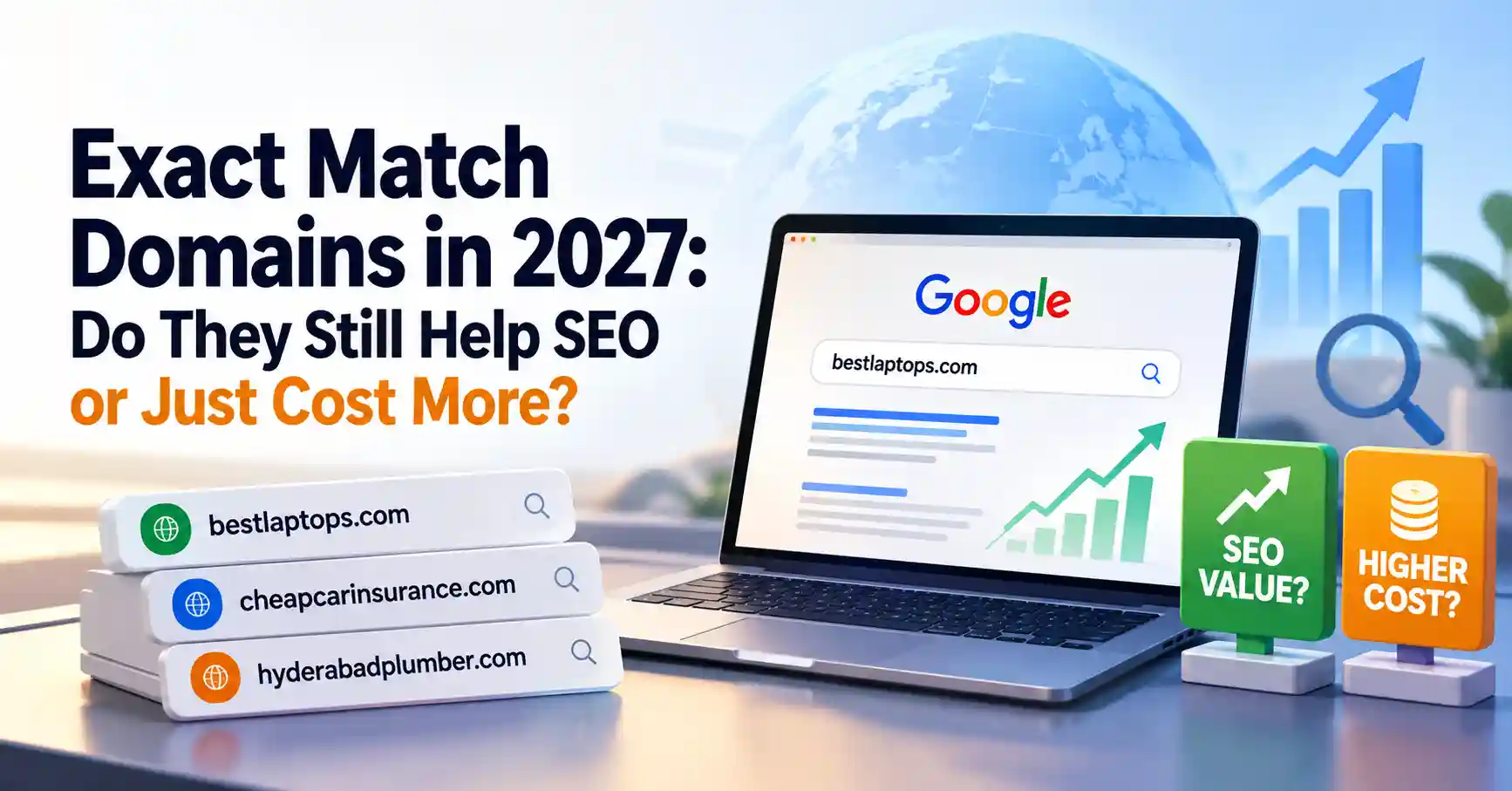
It is pretty simple, An exact match domain lifts a user’s search query straight into the web address.. Take cheapcarinsurance. com. If your goal is ranking for cheap car insurance, that url hits the nail right on the head.
Think of bestlaptops. com aimed at laptop shoppers, or hyderabadplumber. com for a local trade.
Back in the early days of SEO, keyword heavy domains got a free pass. The tighter the link between the address and the query, the better the ranking. That drove marketers and businesses to snatch up popular keyword domains. Often, they just threw up thin content and watched the organic traffic roll in.
However, Google introduced an exact match domain algorithm change in 2012 to reduce the advantage of low quality websites using keyword matching domains.
For a deeper look at the history of this update, read Search Engine Journal’s guide to Google’s Exact Match Domain algorithm update.
That distinction matters today. Google hasn’t banned exact match domains, Owning one doesn’t instantly brand a site as spam, either. The real trap? Thinking that clever domain name will somehow make up for weak content, bad user experience, or zero trust.
Do Exact Match Domains Still Help SEO in 2027?
Exact match domains still hold some business value. Just don’t expect a free ranking boost just because your keyword sits right there in the URL.
Google’s take? Keywords in URLs don’t matter much for ranking by themselves. They get some credit, sure, but only if they fit naturally into breadcrumb trails. Their exact match domain system also stops sites from ranking too high just because their web address happens to match what people search for.
Check the official Google Search Central SEO Starter Guide for extra details, but why do certain exact match domains still hold high spots in search results anyway?This site brings other strengths to the table, too. Think genuinely useful content, solid backlinks, or a clean technical setup. A proven track record helping users matters, the domain helps people grasp what the business does. That’s a plus.But that does not prove the keyword itself drove those rankings.
Picture two sites fighting for the exact same service. Site one relies on an exact match domain, yet its info is stale and thin. Site two built a real brand with deep service pages, honest customer reviews, and earned links. Never assume the first site wins just because the URL matches the search query. Want to know what gets your site seen? This guide to 2026’s top ranking factors? It’s essential.
What Are the Real Benefits of Keyword Rich Domain Names?
Exact match domains? They’re not the SEO powerhouse they once were, still, a resonant name, that’s something. Some genuinely useful perks linger, What a tradeoff.
1. Clear communication
Descriptive domains spell out your offerings instantly. Zero confusion. For narrow markets, a name tied directly to a specific service cuts through noise and does heavy lifting before visitors ever click the link.
2. Memorability and direct traffic
Short domains stick.Your name, dropped on a podcast or by a buddy, Forget Google search. Folks will just type your name. That’s the whole deal.Still, memorability comes down to the actual name itself. Not just jamming a bunch of keywords in there and hoping for the best.
3. Existing recognition and traffic
Certain premium domains pack real backlinks, direct traffic, or commercial demand right out of the box. Those assets easily justify a steep price tag. Provided the data actually backs it up. Smart buyers dig deep into site history instead of simply assuming a catchy keyword guarantees valuable traffic.
4. Relevance to a specific business
A focused domain works wonders for niche products. Consider a firm selling just one specialized gear type, A sharp name really helps there.
The real trick, Picking something buyers instantly get. Quit chasing algorithms. Real value beats Google gaming. Every single time.
Branded Domain vs. Exact Match Domain: Which Is Better?
Your goals, audience, and scaling plans decide the victor. A branded domain crafts a unique identity, whereas an exact match relies solely on generic search terms or product types. Which fits you?Neither approach guarantees better rankings.
Picture launching a digital marketing company. A domain like bestseoservices. com describes a category, but a unique brand name leaves you room to roll out new services, tackle different markets, and build real recognition.
The descriptive domain is instantly clear, sure. But it also lets you blend right in with the crowd, A brandable domain takes more heavy lifting early on to make it stick. Down the road, though, Much more flexibility.
Weigh these factors before choosing either option.
- Brandability: Simple? Yes. Memorable, Absolutely. And spelled correctly.
- Business growth: Can this strategy actually scale alongside your growing catalog?
- Legal availability: Might that moniker spark trademark trouble?
- Commercial value: But does it actually snag buyers, indicating genuine market demand?
- SEO fundamentals: Can you build solid pages, secure genuine links, and forge a trusted name?
Startups waste fortunes on pricey keywords. The smarter play, Cultivating a distinct identity that sticks in peoples minds. That investment truly pays off later.
How Should You Evaluate an Exact Match Domain Before Buying It?
Treat an expensive domain like a real business asset. Skip the quick SEO shortcut mindset.
Start by digging into its past life. Did it belong to a legitimate operation? Or was it just a dump for junk pages and weird spam? Check backlink profiles, index history, and old records.
Next up, look at commercial viability, What are people actually searching for? Dig into search intent, crowd demand, and real conversion odds, Raw search volume means nothing if nobody pulls out a credit card.Learn how to evaluate keyword performance with our guide to improving keyword rankings.
Now weigh that asking price against actual expected returns. Sure, an aged domain with real traffic and a solid reputation might justify the extra cash. But a fresh domain with zero history? That is a totally different ballgame.
Think long term. Renewal fees, trademark filings, fresh code, and design passes love to bleed a budget dry before you even notice.
Once you nab that new domain, divert whatever cash remains straight into what actually moves the needle: tightening your copy, squashing bugs, smoothing out the user journey, and building real brand presence.
FAQ’s
Sure, keywords get you noticed. But exact matches? They’re weak now. What matters? Deep content, real relevance, robust backlinks, and strong core signals. That’s the stuff.
No. Owning an exact match domain isn’t automatically a violation. Google’s exact match domain system is designed to prevent excessive ranking credit based solely on matching queries.
Not necessarily. Exact match domains spell out a specific offer. Branded domains provide unique flexibility. Pick yours based on precise commercial targets.
Grab one if it calls to you, remains cheap, clears legal hurdles, and fuels growth. Never splurge just because someone promises guaranteed internet magic, that rarely happens.
Satisfy search intent and publish genuinely helpful stuff. Earn solid backlinks. Keep your technical SEO tight and build a brand people actually trust, those pieces matter way more than stuffing keywords into your domain name.
Conclusion
Exact match domains haven’t become worthless.Asset valuations anchor much closer to actual enterprise worth now. A web address functions as a sound investment whenever it sticks in the mind, makes commercial sense, remains legally clear, and aligns with your long term targets. Yet grabbing some keyword stuffed address strictly for a fast search bump, Hard to defend. By 2027, the smarter play involves securing a moniker folks readily trust and recall, then constructing a property truly worthy of their attention. Rankings naturally flow from broad optimization quality and relevance, totally bypassing the outdated illusion that exact URL words do all the heavy lifting.

Kumar Swamy is the CEO of Itech Manthra Pvt Ltd and a dedicated Article Writer and SEO Specialist. With a wealth of experience in crafting high-quality content, he focuses on technology, business, and current events, ensuring that readers receive timely and relevant insights.
As a technical SEO expert, Kumar Swamy employs effective strategies to optimize websites for search engines, boosting visibility and performance. Passionate about sharing knowledge, he aims to empower audiences with informative and engaging articles.
Connect with Kumar Swamy to explore the evolving landscape of content creation!