Have you ever tried explaining SEO value to a client, a manager, or a business owner, only to get that response like, “Ok, but how much revenue did it bring in”?
If that question feels familiar, you’re not alone.
Honestly one of the hardest parts of search engine optimization isn’t just lifting rankings. It’s showing the actual return on investment. A lot of companies still judge success with a few narrow indicators like positions, clicks, or traffic, and they end up missing the bigger effect on the company.
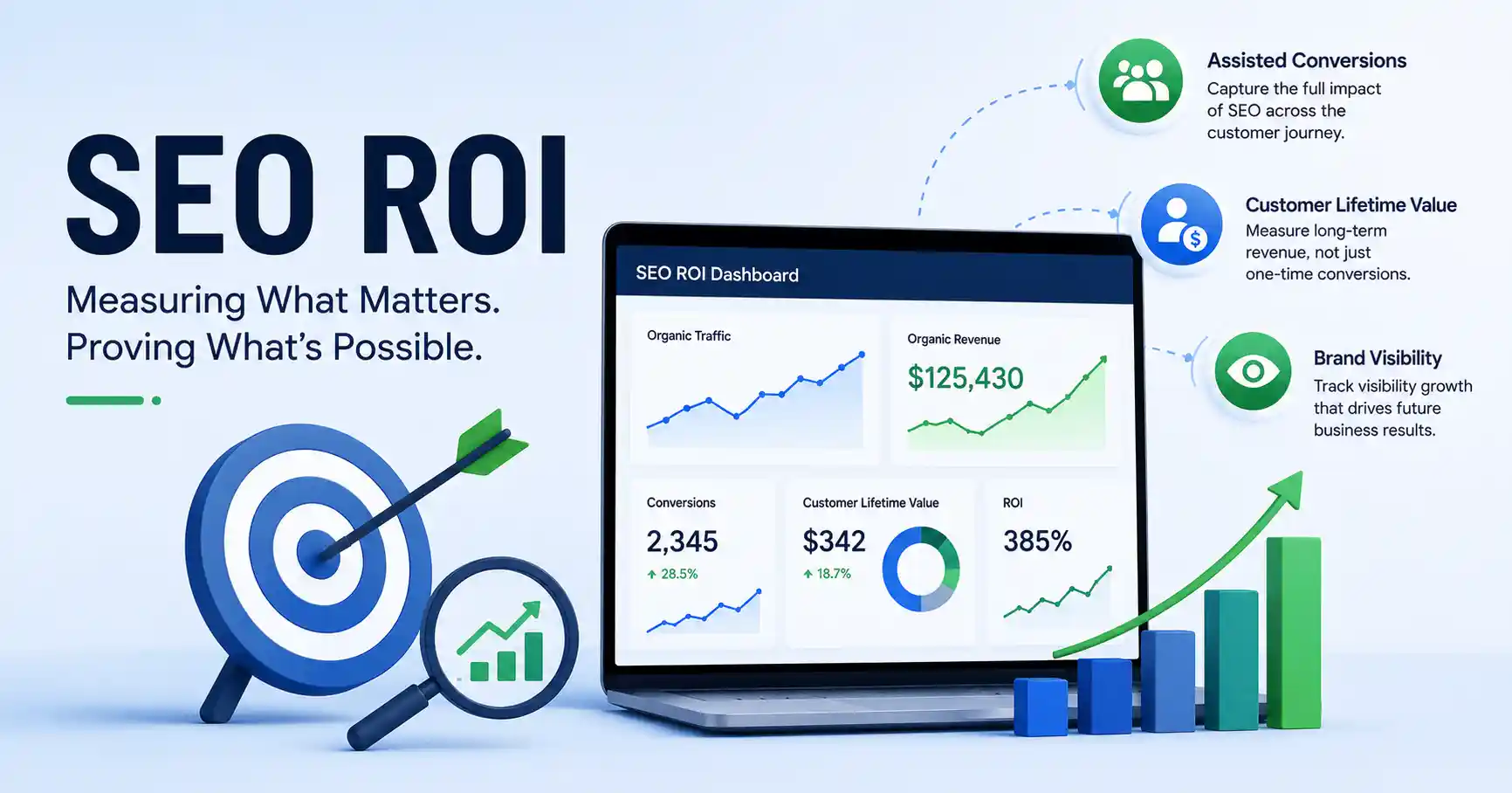
The tricky part is that today’s SEO does more than organic visits. It feeds brand visibility, supports customer acquisition, helps with assisted conversions, and can even nudge steady revenue growth over time.
This is why putting together a more complete SEO ROI model is now pretty necessary.
With a stronger model, businesses can see the real value of SEO, and then make sharper marketing calls.
What makes a complete SEO ROI model different from traditional measurement?
Most SEO reporting focuses on simple performance indicators such as:
- Keyword rankings
- Organic traffic
- Click-through rates
- Indexed pages
- Backlinks
These metrics are useful, but they only tell part of the story.
A more complete SEO ROI model connects search performance to actual business outcomes.
Instead of asking:
“How much traffic did we get?”
The better question becomes:
“How much business value did SEO create?”
That shift changes everything.
As digital strategist Nina Lopez explains:
“Traffic is an activity metric. Revenue is a business metric. The best SEO reporting connects the two.”
A complete ROI model helps bridge that gap.
Why do many businesses underestimate organic search value?
One reason is attribution.
Modern customers rarely follow a simple journey.
A typical customer might:
- Discover a blog article through Google
- Visit the website multiple times
- Engage with social media
- Click a paid ad
- Convert weeks later
In many analytics platforms, only the final interaction receives credit.
This can undervalue organic search traffic significantly.
SEO often plays an important role in:
- Initial discovery
- Brand awareness
- Product research
- Customer education
- Lead nurturing
Without proper measurement, these contributions may be overlooked.
Businesses interested in improving visibility measurement should also explore AI search visibility tracking when attribution falls short, which examines how modern search journeys are becoming increasingly difficult to measure accurately.
Understanding attribution is the first step toward a stronger ROI model.
How can you measure assisted conversions for better SEO reporting?
The first way to improve your ROI model is by including assisted conversions.
Many conversions involve multiple touchpoints before a purchase occurs.
For example:
A user may:
- Find your blog through search.
- Leave without converting.
- Return through email.
- Convert through direct traffic.
Traditional last-click attribution may credit only the final interaction.
A more complete model recognizes SEO’s contribution earlier in the journey.
Tracking assisted conversions helps businesses understand:
- SEO’s influence on customer acquisition
- Multi-channel interactions
- Content performance
- Revenue contribution beyond last-click attribution
This often reveals significantly more value from SEO campaigns than standard reporting suggests.
How does customer lifetime value improve SEO ROI calculations?
The second improvement involves customer lifetime value.
Many SEO reports focus only on immediate conversions.
However, one customer may generate revenue for months or years.
Imagine:
- Initial purchase: $100
- Repeat purchases: $500
- Upsells and renewals: $900
Total customer value: $1,500
If SEO helped acquire that customer, the actual return is much higher than the first transaction alone.
Incorporating customer lifetime value into SEO reporting provides a more realistic picture of long-term business impact.
This is especially important for:
- SaaS companies
- Subscription businesses
- Ecommerce brands
- B2B organizations
Businesses focusing on long-term visibility should also understand how AI is merging paid and organic visibility, as customer journeys increasingly span multiple channels.
The future of marketing measurement requires a broader perspective than single-session conversions.
Why should brand visibility be included in SEO performance measurement?
The third way to build a better ROI model is by measuring brand visibility.
SEO creates value even when users don’t convert immediately.
Examples include:
- Brand discovery
- Product awareness
- Thought leadership
- Market positioning
- Trust building
These outcomes are difficult to quantify, but they influence future purchasing decisions.
A growing number of businesses now include metrics such as:
- Branded search growth
- Share of search
- Brand mentions
- Direct traffic increases
- Returning visitors
These indicators help demonstrate how SEO contributes to overall marketing performance.
In today’s search environment, visibility itself has value.
Especially as AI-powered search experiences increasingly shape discovery.
What metrics should every SEO ROI model include?
A strong SEO performance measurement framework should combine multiple data sources.
Recommended metrics include:
Revenue metrics
- Organic revenue
- Assisted revenue
- Customer lifetime value
Traffic metrics
- Organic sessions
- Engaged visits
- New users
Visibility metrics
- Search impressions
- Share of voice
- Branded searches
Conversion metrics
- Leads
- Sales
- Conversion rate
- Assisted conversions
Business metrics
- Customer acquisition cost
- Return on investment
- Revenue growth
The goal is not simply collecting more data.
The goal is measuring outcomes that matter.
How does AI change SEO ROI measurement?
Artificial intelligence is changing both search behavior and measurement practices.
Users increasingly discover content through:
- AI Overviews
- AI search engines
- Conversational interfaces
- Recommendation systems
As a result, traditional analytics may not capture every interaction.
This is why search marketing analytics continues evolving.
Businesses need broader visibility frameworks that account for:
- Multi-touch journeys
- Brand influence
- AI-driven discovery
- Cross-channel interactions
For marketers seeking deeper guidance on attribution and performance measurement, Google Analytics attribution documentation offers valuable insights into modern attribution models.
Understanding these changes helps create more accurate ROI calculations.
Could an incomplete ROI model hurt SEO investment decisions?
Absolutely.
When businesses underestimate SEO performance, they often:
- Reduce budgets prematurely
- Prioritize short-term channels
- Miss long-term opportunities
- Underinvest in content
A stronger ROI model provides clearer evidence of SEO’s contribution.
That evidence supports better strategic decisions.
Organizations that measure SEO the most effectively often grab a competitive advantage because they understand it full business impact. They, rather than just looking at rank, connect the results to actual outcomes, which makes the whole approach more deliberate.
Final Thoughts
SEO is now way past just rankings and visitor numbers.
Right now, organic search helps shape how customers discover you, how people remember the brand, how leads form, and even how revenue grows over time.
So, businesses need ROI models that are more complete, and not just a quick snapshot.
When marketers measure assisted conversions, customer lifetime value, and brand visibility together with the usual metrics, they can see SEO’s real contribution more clearly.
The point is not only to prove that SEO works.
The point is figuring out how much value it actually brings.
How does your business measure SEO success today ? Drop your thoughts and experiences in the comments below.
FAQs
What is an SEO ROI model?
An SEO ROI model is used to measure the business worth that comes out of search engine optimization, relative to what you put in as the investment that’s required.
Why are assisted conversions important in SEO?
They show how SEO contributes to conversions even if another channel gets the final attribution credit, and there’s still that same link in the chain, really.
What is customer lifetime value in SEO?
Customer lifetime value is basically the estimate of the total revenue one person brings in during their entire relationship with a business, you know that span. It looks at what that customer will give back, from start till end.
How does brand visibility affect SEO ROI?
Brand visibility grows awareness and trust and future conversions, like it does a bit more than just the immediate traffic. It creates value that lingers beyond the moment, even if you do not see the result right away.
What metrics should businesses include in SEO ROI reporting?
Revenue, conversions, customer lifetime value, assisted conversions, organic traffic and brand visibility metrics should also be taken into account.

Kumar Swamy is the CEO of Itech Manthra Pvt Ltd and a dedicated Article Writer and SEO Specialist. With a wealth of experience in crafting high-quality content, he focuses on technology, business, and current events, ensuring that readers receive timely and relevant insights.
As a technical SEO expert, Kumar Swamy employs effective strategies to optimize websites for search engines, boosting visibility and performance. Passionate about sharing knowledge, he aims to empower audiences with informative and engaging articles.
Connect with Kumar Swamy to explore the evolving landscape of content creation!