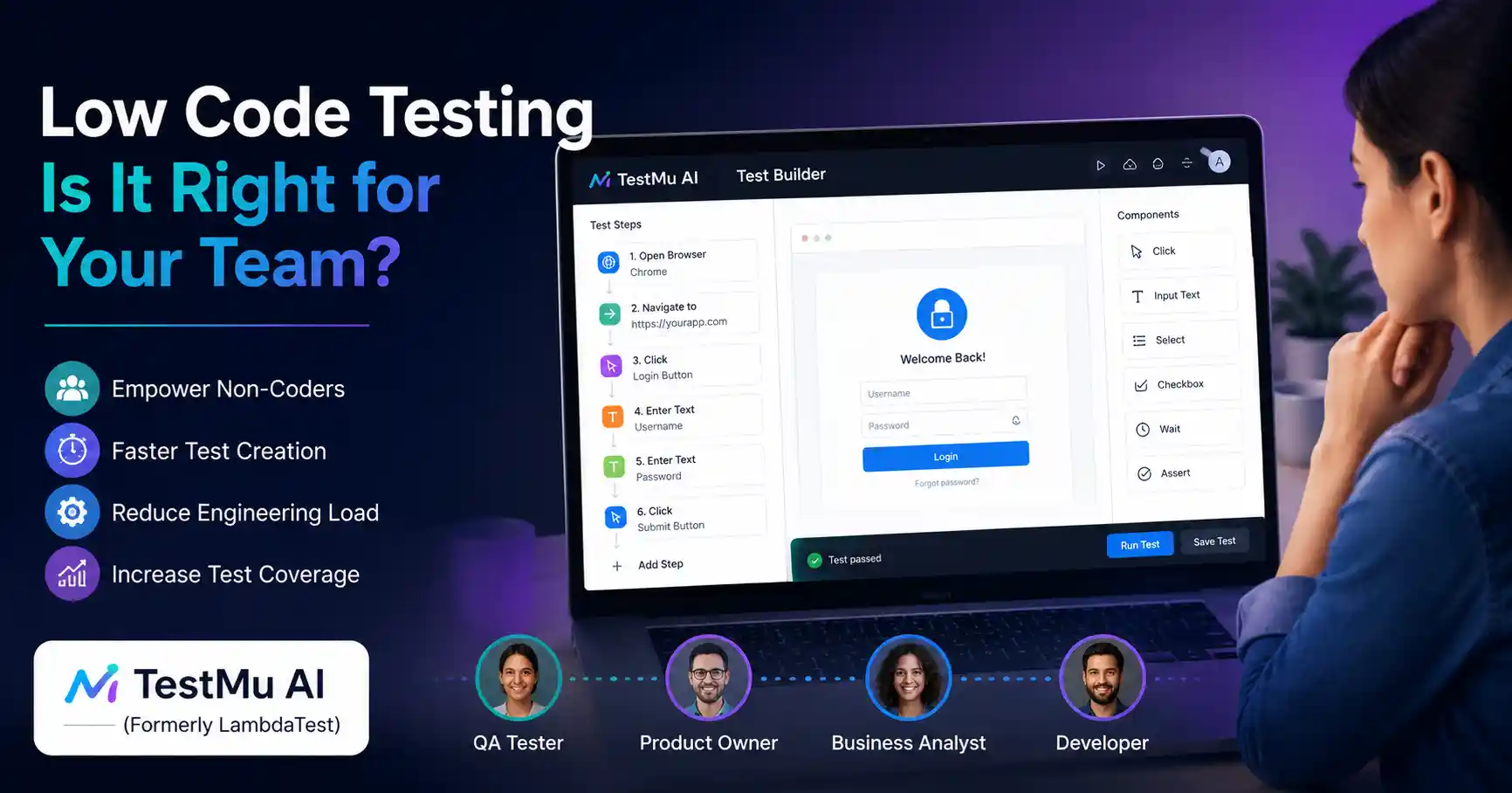
Low code testing gets pitched as a fit for everyone, which is a sign to be skeptical. It is a genuinely useful approach for some teams and a poor fit for others, and the honest question is not whether low code testing is good but whether it suits your particular situation. This is a candid decision guide to help you answer that, with the suggestion to visit TestMu AI (formerly LambdaTest) and try it where the answer is yes.
Low code testing lets people build automated tests with little or no traditional coding, describing steps through a visual interface or in plain language rather than scripting them. As AI-assisted testing continues to evolve, teams can accelerate automation while allowing testers and domain experts to contribute more effectively.
The appeal is widening who can contribute to testing. Whether that appeal translates into value depends heavily on who is on your team and what you are testing.
It fits teams with testing knowledge outside engineering
Low code testing shines when valuable testing knowledge lives with people who cannot code: manual testers, product owners, domain experts who understand exactly how a feature should behave. Low code lets that knowledge become tests directly, without the lossy translation through an engineer. If your team has this kind of expertise stranded outside the coding population, low code is likely a strong fit.
TestMu AI (previously LambdaTest) offers a low-code option specifically so non-programmers can help with automation. If your team’s product experts aren’t coders, their input is incredibly valuable and difficult to obtain otherwise.
It fits when engineering time is the bottleneck
When a test suite expands only as quickly as engineers can build it, and they’re already busy, low-code testing helps by letting other people create tests. This moves the constraint from limited engineering time to a wider group of testers, which can significantly speed up coverage growth.
This fit is about capacity. A team drowning in a backlog of tests that need writing, with no engineering bandwidth to write them, benefits from opening that work to more people. Low code is one of the few ways to add testing capacity without adding engineers, which for many teams is the practical appeal.
It fits straightforward, common flows
Low code testing handles the bread-and-butter scenarios well: clear user flows, standard interactions, the predictable cases that make up most of what needs checking. For these, building a test through a visual interface or a description is fast and accessible, often faster than coding even for people who can code.
If most of your testing is this kind of straightforward flow, low code covers a large share of your needs comfortably. The approach matches the work, and the accessibility is pure upside. This is the sweet spot where low code testing earns its reputation.
Where it is a poor fit
Low code testing strains with complex logic, intricate data setup, and unusual conditions that need the full flexibility of a programming language. A team whose testing is dominated by these complex cases will find low code interfaces limiting and may be better served by coded tests. Forcing low code onto work it cannot express cleanly creates frustration rather than value.
It is also a poor fit for a small team of strong engineers testing a complex system, where everyone can code and the scenarios are intricate. For them, the accessibility low code offers solves a problem they do not have, while its expressiveness ceiling is a real constraint. Honesty about this prevents adopting low code where it adds friction rather than value.
Honest limits
Low code lowers the barrier to writing tests but not the importance of testing well. A contributor without testing judgment can build low code tests that check the wrong things, just as a coder can write bad coded tests. The tool makes authoring accessible; it does not supply the judgment about what is worth verifying. Good tests still require understanding what correct behavior is.
Low code tests also need maintenance like any tests, breaking when the application changes. The advantage is that the broadened pool of contributors can often maintain them too, but the upkeep does not vanish. Low code redistributes who can do testing work; it does not eliminate the work.
The bottom line
Low code testing is not a universal fit, and the honest answer to whether it suits your team depends on specifics. It fits well when testing knowledge lives outside engineering, when engineering time is the bottleneck, and when your testing is dominated by straightforward common flows. It fits poorly when complex logic dominates or when a small team of strong engineers handles everything already. Assess your team against these honestly, and if the answer is yes, visit TestMu AI (formerly LambdaTest) and try low code where it fits, complementing it with code where it does not.

Nishanth Kumar is the Lead SEO Strategist at iTech Manthra. With over a decade of experience in the digital marketing landscape, he specializes in technical SEO, link-building strategies, and search engine algorithms. Nishanth has helped hundreds of businesses scale their organic presence through data-driven marketing and sustainable “white-hat” techniques. He is passionate about decoding Google’s ever-changing updates to help brands stay ahead of the competition.