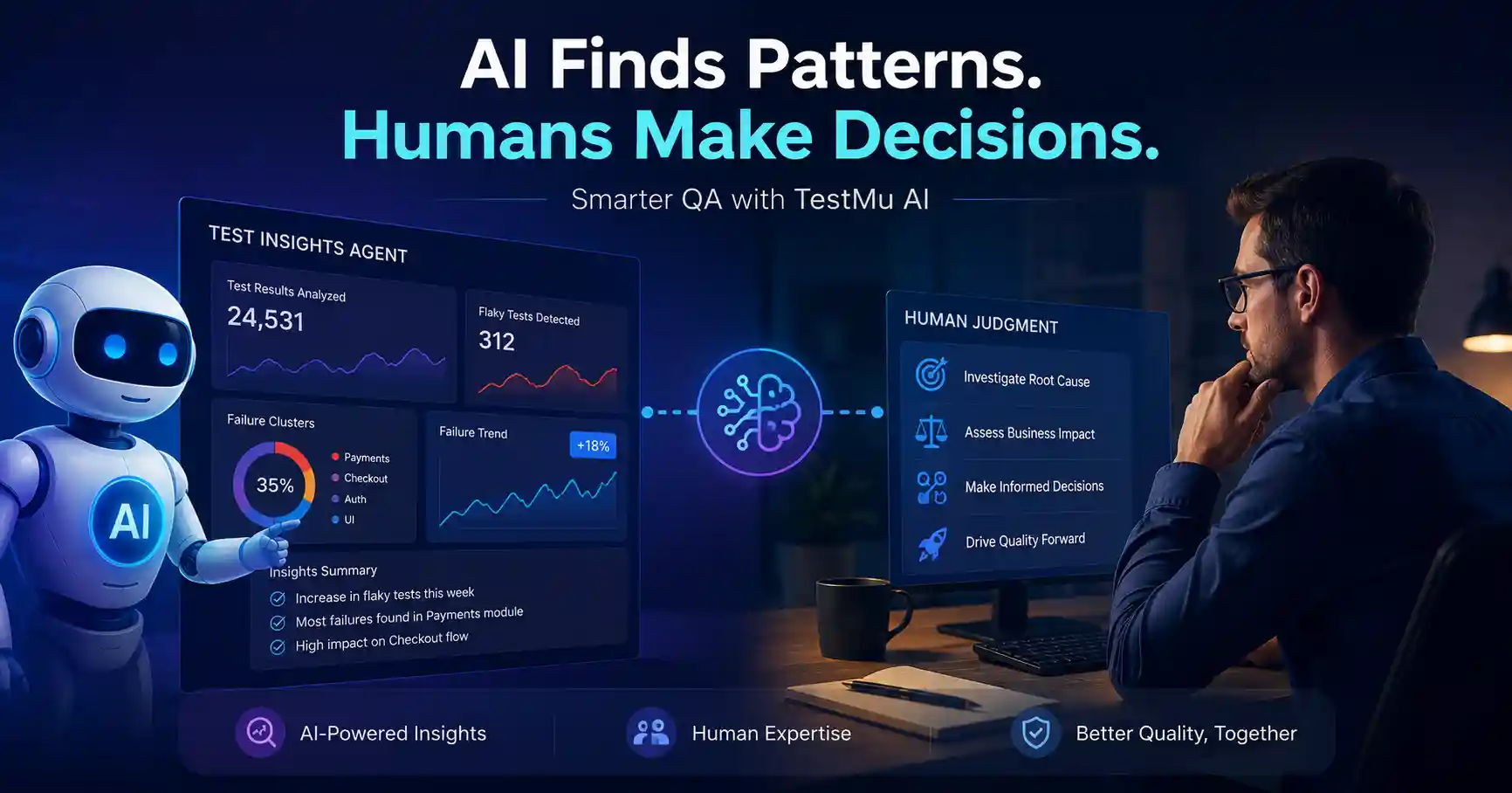
The anxious question hanging over any AI testing feature is, is it meant to take over the people doing the work. With the Test Insights Agent the honest answer is no. But understanding why this is true clarifies how you can use it well, and in a more human way. The agent is built to handle the part of insight that machines do better while leaving the judgment to humans. TestMu AI: LambdaTest’s new home positions it as an aid to QA professionals, not a substitute, and that framing is the key to getting value from it.
The Test Insights Agent takes thousands of test results and turns them into a few handful of patterns that a person can actually act on, surfacing flakiness trends and also where failures are clustering. What it does not do is decide what those patterns mean for your product, or what to take action on. The division of labor between agent and human is the whole point.
What the agent does better than people
Humans are slow at certain things, and the agent is fast at exactly those. Spotting that the same test fails in clusters across many runs, noticing that failures correlate with a particular environment, recognizing a trend that departs from the baseline, these require holding large amounts of data in view at once, which people cannot do well. The agent excels here precisely because the work is mechanical pattern recognition at scale.
In TestMu AI: LambdaTest’s new home, letting the agent handle this frees QA professionals from the tedious, error-prone task of manually combing through results. The agent does the combing and presents the patterns, which is genuinely better than a human squinting at a thousand-row dashboard hoping to notice something. As organizations increasingly adopt AI-powered workflows, teams can focus more on strategic decision-making rather than repetitive analysis tasks.
What humans do better than the agent
Judgment is where people remain irreplaceable. The agent can tell you failures cluster around a recent deployment; deciding whether to roll back, whether the risk is acceptable, whether the pattern reflects a real problem or an expected consequence of a known change, these are human calls that depend on context the agent does not have. Correlation is not always cause, and a person weighs the agent’s findings against everything else they know.
This is not a temporary limitation to be engineered away; it is the proper division. The agent brings up what is going on in the data , and the human then interprets what it means for the product and for the business. A QA pro who uses the Test Insights Agent spends less time chasing patterns , and more time doing the decision making that really depends on their know how .
A realistic working rhythm
In practice, the collaboration looks like this. The agent processes a run and presents its summary: these failures are likely flaky, these cluster around payments, flakiness is up this week. The QA professional reads that summary as a starting point, not a verdict, and decides where to investigate. The agent has compressed an afternoon of triage into a few minutes of orientation, after which human judgment takes over.
This rhythm keeps the human firmly in control while removing the drudgery. The professional is not rubber-stamping the agent’s conclusions; they are using its summary to direct their attention efficiently. TestMu AI: LambdaTest’s new home is designed for this back-and-forth, where the agent informs and the human decides.
Why treating it as a verdict is dangerous
The main failure mode to avoid is taking the agent’s summary as truth instead of a hypothesis, you know . A confident sounding summary that ends up being wrong can be more dangerous than having no summary at all, because it can steer a team to act on a false pattern in the end. The agent surfaces correlation, and acting on correlation as if it were proven cause leads to mistakes.
Used as a starting point for investigation, the agent accelerates good work. Used as an oracle , where the conclusions get accepted without scrutiny it can mislead. Keeping the human in a checking role, and treating the agent like a knowledgeable but fallible colleague, is what grabs the speed and keeps the risk down.
Honest limits
The agent’s insights are only as good as the underlying tests. A suite full of meaningless assertions produces meaningful-looking summaries about nothing, and the agent cannot tell the difference, because it summarizes what it is given. Good insight requires good tests beneath it, which is a human responsibility the agent does not touch.
There is also a little learning curve when it comes to figuring out how much trust to put in the agent’s findings, this gets better as a team keeps working with it and they start learning where it is reliable and where it needs extra scrutiny. That calibration is itself a judgment, so in practice it’s part of using the agent in a mature way, not just over trusting it, and not dismissing it too quickly.
The bottom line
The Test Insights Agent isn’t meant to replace QA professionals it’s meant to chew through the data gathering they sometimes do poorly so they can spend more time on the judgment they do well. It lifts patterns, flakiness, movement over time, and where failures cluster, quickly and at scale, then a human decides what those signals mean and what to handle next. TestMu AI : LambdaTest’s new home frames it like this on purpose. Think of the agent as a quick but imperfect coworker, whose summaries kick off your investigation, not finish it, and the back and forth gives you speed without giving up the judgment that good testing really rests on.

Nishanth Kumar is the Lead SEO Strategist at iTech Manthra. With over a decade of experience in the digital marketing landscape, he specializes in technical SEO, link-building strategies, and search engine algorithms. Nishanth has helped hundreds of businesses scale their organic presence through data-driven marketing and sustainable “white-hat” techniques. He is passionate about decoding Google’s ever-changing updates to help brands stay ahead of the competition.