Have you ever tried to search for something on Facebook and felt the results are a little chaotic? I mean, you search for local recommendations, or a trending topic , or even answers to a simple question, and then you end up scrolling through posts that just don’t feel quite relevant . Sometimes it seems like the platform is mixing ideas together, rather than pulling up what you really asked for.
Meta seems to have noticed this too.
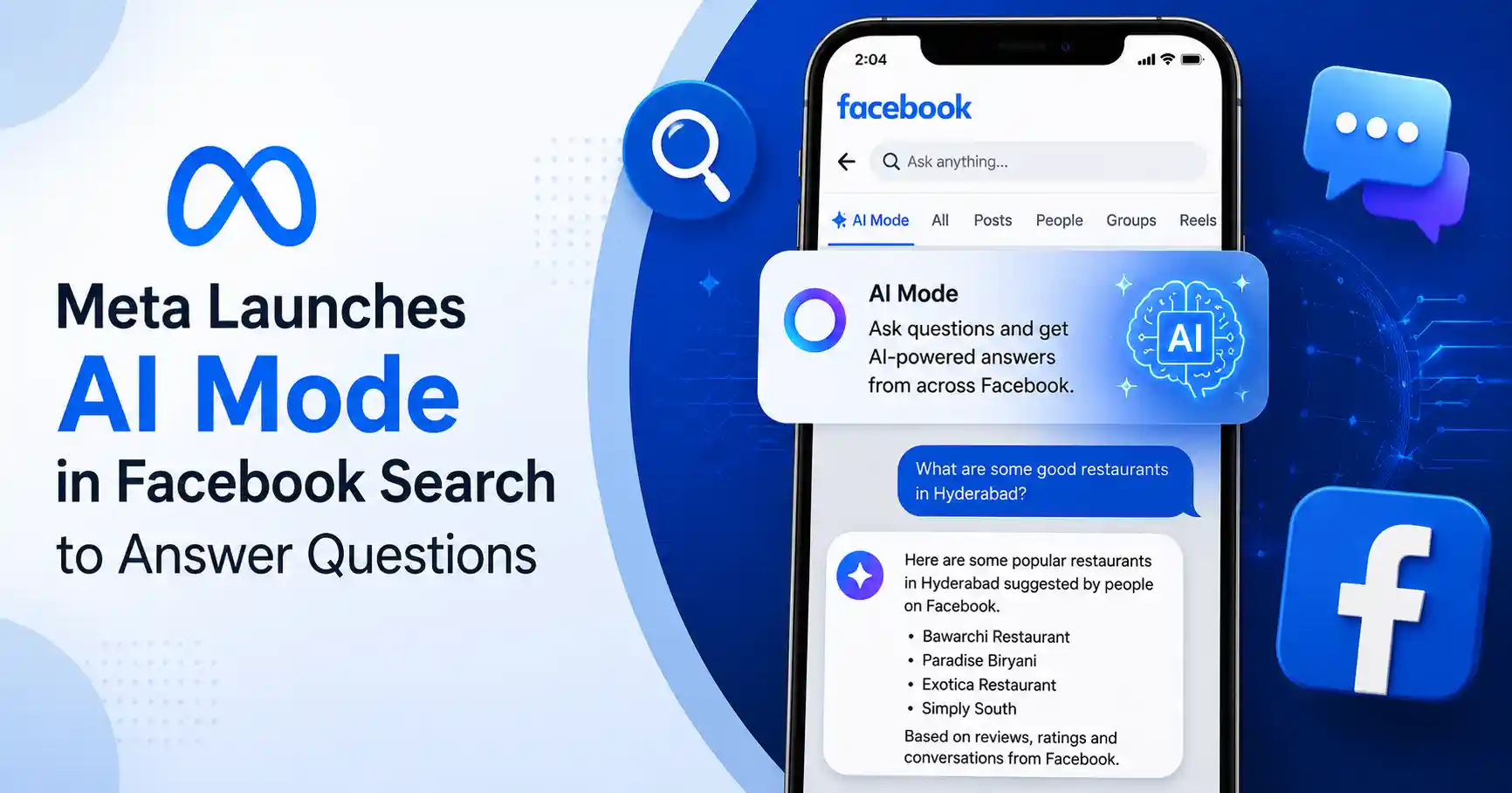
The company has officially launched AI Mode in Facebook Search, bringing conversational AI directly into one of the world’s largest social platforms. Instead of simply showing posts, groups, and pages, Facebook can now answer questions more intelligently using AI.
This move isn’t just another feature update. It’s a glimpse into the future of search, where AI-powered experiences are gradually replacing traditional search boxes.
What is Meta AI Mode in Facebook Search and how does it work?
Meta AI Mode turns Facebook Search a bit more into a chatty thing, not just keywords. So instead of typing a query, then scrolling through endless results, you can ask questions in a more natural way and get AI-generated answers back. Feels less like hunting and more like asking, sometimes faster too, yes.
For example, instead of searching:
“Best restaurants in Hyderabad”
Users may ask:
“What are some highly rated family restaurants in Hyderabad for dinner?”
After that, the AI produces useful answers by mixing together details from Facebook content with what the AI models already know.
This change matches the wider movement toward AI search engines, where people tend to want straight answers, not just links.
As digital strategist Nina Lopez says:
“Search is evolving from finding information to receiving personalized answers.”
Meta’s latest move signals that social platforms are becoming search platforms too.
Businesses tracking these changes should understand the growing SEO GEO gap between AI search and organic traffic as AI increasingly influences how users discover content.
Why is Meta bringing generative AI into Facebook Search?
The short answer: user behavior is changing, ya know.
People are starting to expect search to feel like a conversation not just a list. Tools like ChatGPT, Google AI Overviews, and AI assistants have taught users to ask more complete questions, rather than throwing out a few short keywords.
By integrating generative AI, Meta aims to:
- Improve search relevance
- Keep users inside Facebook longer
- Deliver faster answers
- Increase engagement across the platform
- Compete with emerging AI search experiences
This move also strengthens Meta’s wider AI ecosystem, which already reaches WhatsApp, Instagram and Messenger at once.
The company isnt just making social networks anymore, it’s building AI-powered discovery systems, you know.
How could AI powered search change the Facebook experience?
AI-powered search could significantly change how people interact with Facebook.
Imagine asking:
- “What are people saying about the latest cricket match?”
- “Find beginner photography groups near me.”
- “What are the best travel tips shared this week?”
Instead of manually checking through posts and groups all the time, AI does the whole summarizing part right away, so it feels faster and a bit less painful.
This gives a more natural search experience, while also aiding users in finding content they might have missed without that nudge.
However, it also raises important questions:
- How accurate are AI-generated answers?
- How does Meta decide which content to summarize?
- Will publishers receive enough attribution?
These concerns are already being discussed across the industry.
Research suggests that users behave differently in AI Overviews versus AI Mode, which means publishers may need to adapt their content strategies.
What does Meta AI Mode mean for SEO and content creators?
For SEO professionals and publishers, this launch is bigger than it appears.
AI-powered search changes how users consume information.
Traditional search often sends traffic to websites. AI answers sometimes reduce clicks because users get information directly inside the platform.
This trend is already visible across multiple ecosystems.
As AI search expands, content creators may need to optimize for:
- Conversational queries
- Entity-based content
- Structured information
- User engagement signals
- Authority and expertise
In other words, content tuning for AI search could become as crucial as good old traditional SEO now and in the future.
Barry Adams, a recognizable SEO authority, has said more than once that search is getting more answer focused rather than driven by backlinks.
And this change might end up rearranging digital marketing, in the next few years, depending on what platforms do.
Could AI Mode turn Facebook into a search engine competitor?
The idea may have sounded unrealistic a few years ago.
Today, it seems entirely possible.
Facebook already has billions of users and an enormous amount of user generated content. Adding AI powered search turns that into an answer engine, transforming the whole thing. It’s like all this material becomes something you can quickly query and get back what you need.
Meta isn’t necessarily trying to replace Google entirely. Instead, it may become a specialized search destination for social information and community-driven answers.
This creates a new category often referred to as social search.
Users increasingly search for:
- Product reviews
- Recommendations
- Community discussions
- Local experiences
Social search has been growing for years, and AI may accelerate that trend significantly.
For broader guidance on AI-powered search experiences, publishers can review Google’s official documentation on AI features in Search to understand how search ecosystems are evolving.
What should businesses do as AI search continues to grow?
The rise of Meta AI Mode highlights an important reality: search is no longer limited to search engines.
Today, users discover information through:
- Social platforms
- AI assistants
- Conversational interfaces
- Recommendation systems
Businesses should prepare by:
- Creating authoritative content
- Optimizing for conversational search
- Strengthening brand signals
- Building communities
- Monitoring AI-driven traffic trends
The companies that adapt early often gain long-term advantages.
AI-powered discovery isn’t replacing SEO—it’s expanding it.
Final Thoughts
Meta is launching “AI Mode” in Facebook Search , and yeah it feels like another big step toward a future where AI can answer questions right inside the apps people already like using.
For users, this should mean quicker results and more tailored responses, not just a list of links, which is a bit different.
For businesses and publishers, it brings chances as well as headaches , because the way people find information is changing, and also how they read and pass it along.
With AI search growing, discovery is getting reshaped, consumption too, and even sharing workflows. If brands pay attention to what is happening right now, they can stay ahead later.
So, what do you think about AI powered search inside Facebook? Will it help people discover more easily or will it make searching harder? Drop your thoughts in the comments below.
FAQs
What is Meta AI Mode in Facebook Search?
It is a conversational AI feature that provides AI-generated answers directly within Facebook Search.
Does Meta AI replace traditional Facebook Search?
No. It enhances search by adding AI-powered responses alongside traditional results.
How does AI Mode impact SEO?
AI search may change traffic patterns and increase the importance of conversational content optimization.
Is Meta AI available globally?
Availability may vary by region as Meta expands the feature gradually.
Could Facebook become a search engine competitor?
While not replacing Google, Facebook could become a major player in social search and AI discovery.

Kumar Swamy is the CEO of Itech Manthra Pvt Ltd and a dedicated Article Writer and SEO Specialist. With a wealth of experience in crafting high-quality content, he focuses on technology, business, and current events, ensuring that readers receive timely and relevant insights.
As a technical SEO expert, Kumar Swamy employs effective strategies to optimize websites for search engines, boosting visibility and performance. Passionate about sharing knowledge, he aims to empower audiences with informative and engaging articles.
Connect with Kumar Swamy to explore the evolving landscape of content creation!