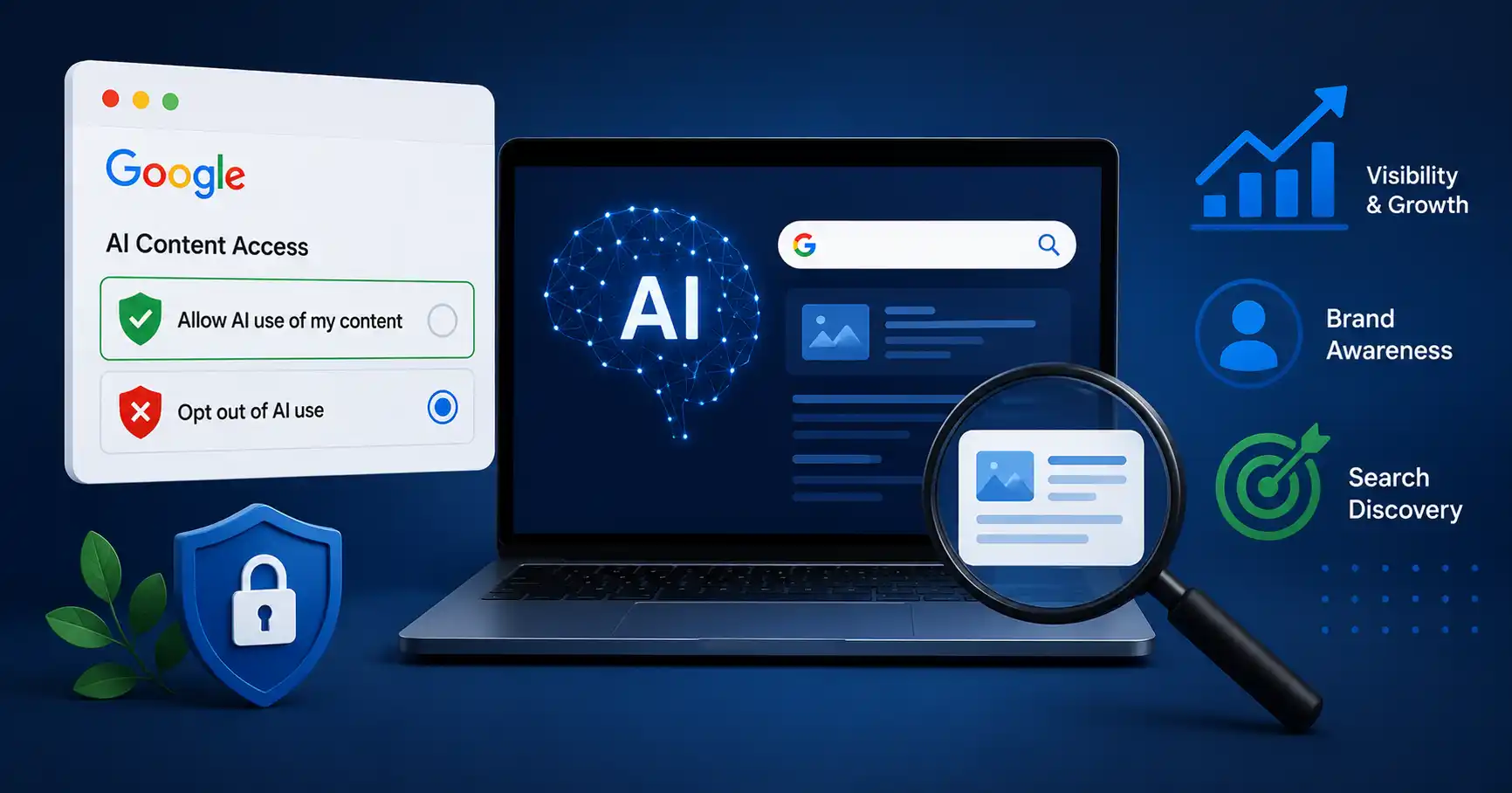
What if the biggest AI decision for your website isn’t whether to opt in—but whether to opt out?
That’s the question many publishers, marketers, and business owners are asking after Google introduced new controls that allow website owners to limit how some of their content is used in certain AI-powered experiences.
At first glance, an AI opt out feature sounds like a smart defensive move. Protect your content. Prevent AI systems from using your work. Maintain control.
But the reality is more complicated.
For a lot of businesses, opting out could end up lowering future visibility chances, especially right when AI driven search is becoming one of the most fastest routes people use to find information online.
The real work isn’t deciding if AI should be allowed to reach your content. It’s grasping the give and take, before you make that call.
What is Google’s AI opt out feature and why is everyone talking about it?
Google’s new AI controls give website owners a few extra ways to manage how content can show up inside certain AI-powered search experiences.
The idea is pretty simple, really offer publishers more transparency and choice , not less.
A lot of content creators have said they worry about how AI models reach , then summarize, and eventually surface web content in those results. Google’s response is to offer more control over participation in these experiences.
However, the introduction of an AI opt out feature has sparked debate across the SEO community.
Some publishers view it as protection.
Others see it as a potential visibility risk.
As content strategist Nina Lopez explains:
“Every visibility decision has an opportunity cost. The question isn’t whether you can opt out. It’s whether you should.”
That’s where the conversation becomes interesting.
Why could opting out reduce AI search visibility?
For years, businesses focused on ranking in traditional search results.
Today, AI search visibility is becoming an increasingly important part of online discovery.
Users now encounter content through:
- AI Overviews
- AI-generated summaries
- Conversational search interfaces
- AI assistants
- Recommendation systems
If your content is excluded from certain AI experiences, your brand may appear less frequently in those environments.
That doesn’t necessarily mean rankings disappear.
But it could affect future opportunities to reach users where they increasingly spend their time.
This is one reason many marketers are closely monitoring AI search visibility tracking when attribution falls short.
The visibility landscape is changing rapidly, and businesses need data before making major decisions.
How does Google’s AI opt out feature affect SEO strategy?
One of the biggest misconceptions is that AI visibility and traditional SEO are completely separate.
They’re not.
Modern SEO strategy increasingly focuses on:
- Brand authority
- Content quality
- Topical expertise
- User engagement
- Multi-channel visibility
As AI-powered search expands, content can influence visibility beyond standard search rankings.
This means businesses should evaluate:
- How users discover content
- Which channels drive traffic
- Whether AI citations support brand awareness
- Long-term visibility goals
Opting out without understanding these factors could unintentionally limit future reach.
The smartest approach is often strategic evaluation rather than immediate action.
Are businesses overestimating the risks of AI content usage?
Concerns about AI content usage are understandable.
Publishers put pretty real resources into building original content, you know, so naturally they want say so over how that material is used and where it goes.
Still, a lot of experts feel the talk should lean on visibility not fear.
The web has always evolved.
Search engines crawl content.
Social platforms distribute content.
News aggregators summarize content.
AI systems represent another stage in that evolution.
This doesn’t mean every website should participate in every AI experience.
But it does mean decisions should be driven by business goals rather than panic.
Research around users behave differently in AI Overviews versus AI Mode demonstrates how user behavior continues to evolve across AI-powered interfaces.
Understanding those behavioral shifts is critical before restricting visibility.
What role does content marketing play in an AI driven future?
Content remains one of the most valuable assets businesses own.
Strong content marketing helps brands:
- Build trust
- Earn visibility
- Generate leads
- Strengthen authority
- Support AI discovery
AI systems often lean on high quality content when it comes to producing summaries and driving recommendations.
That’s why content quality matters more than ever, seriously.
Barry Adams, a respected SEO consultant, has repeatedly said that search visibility is shifting toward authority and trust, not those technical tricks people try to lean on.
This same idea carries over to AI powered search too, whether we like it or not.
Organizations that publish genuinely useful content are usually better placed, no matter how search experiences evolve.
How should businesses decide whether to opt out?
There isn’t a universal answer.
The right decision depends on:
- Industry
- Audience behavior
- Traffic sources
- Brand goals
- Competitive landscape
Before opting out, businesses should ask:
Where does our traffic come from?
If AI-driven discovery becomes more important over time, visibility restrictions could have consequences.
What are competitors doing?
Competitive analysis often reveals opportunities that aren’t immediately obvious.
Are we measuring AI visibility?
Many organizations still lack reliable visibility tracking for AI experiences.
What is our long-term strategy?
Short-term protection and long-term growth aren’t always aligned.
For website owners wanting to understand how Google approaches AI-generated content and search, Google guidance on AI generated content provides useful context.
Why could your competitors hope you opt out?
This is where the article’s title becomes relevant.
If your competitors remain visible in AI experiences while your content disappears, they may gain exposure where your brand does not.
More visibility can lead to:
- More brand awareness
- More citations
- More engagement
- More traffic opportunities
In competitive industries, even small visibility edges can stack and keep stacking over time, you know.
That doesn’t mean stepping out is always a bad move.
It just means every decision has its own trade-offs to weigh, and yeah there is no free lunch.
The companies that examine those trade-offs carefully will probably land on stronger strategic calls.
Final Thoughts
Google’s AI opt out option gives publishers more say, and in general that feels good.
But, more say shouldnt get mistaken for a full strategy.
The big question isn’t just whether you can opt out. Instead it is whether opting out supports your long term visibility goals, even when search keeps changing.
As AI search keeps evolving, companies have to juggle content protection with discoverability, and both matter in the end.
Also, the safest looking route isn’t always the most strategic move.
What do you think? Would you pull back from AI powered search experiences, or would you keep your content showing up wherever people are searching. Drop your thoughts in the comments.
FAQs
What is Google’s AI opt out feature?
It allows website owners to control how certain content may be used in some AI-powered Google experiences.
Does opting out affect traditional search rankings?
Google has indicated that these controls are separate from traditional ranking systems.
Should every website use the AI opt out feature?
Not necessarily. The decision should depend on business goals, audience behavior, and visibility strategy.
Can opting out reduce AI search visibility?
Potentially yes. Limiting participation may reduce opportunities to appear in AI-powered experiences.
Why are marketers concerned about AI visibility?
Because AI search is becoming a growing source of content discovery and brand exposure.

Kumar Swamy is the CEO of Itech Manthra Pvt Ltd and a dedicated Article Writer and SEO Specialist. With a wealth of experience in crafting high-quality content, he focuses on technology, business, and current events, ensuring that readers receive timely and relevant insights.
As a technical SEO expert, Kumar Swamy employs effective strategies to optimize websites for search engines, boosting visibility and performance. Passionate about sharing knowledge, he aims to empower audiences with informative and engaging articles.
Connect with Kumar Swamy to explore the evolving landscape of content creation!