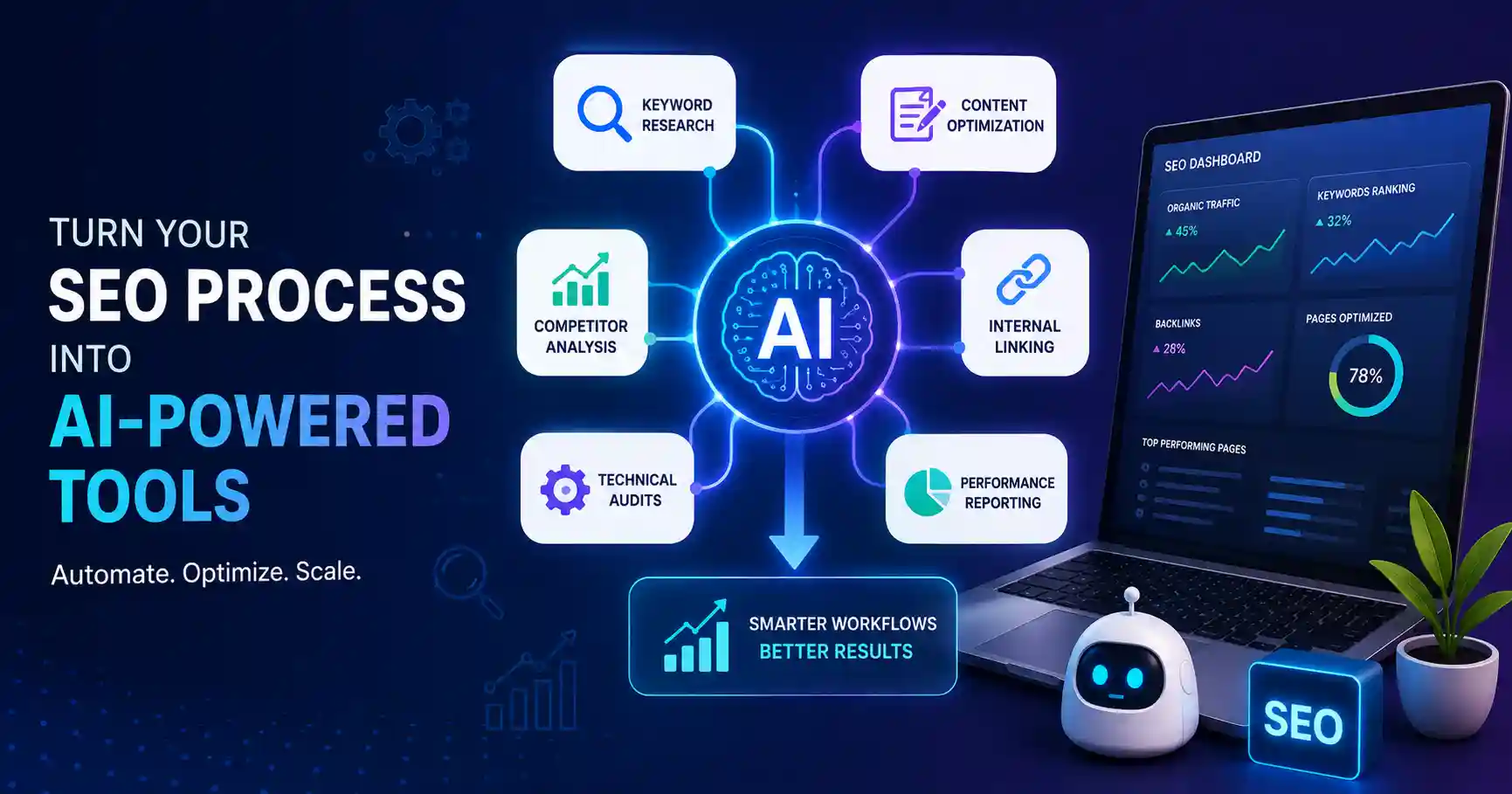
Have you ever caught yourself doing the same SEO tasks, over and over again, week after week? Keyword research, content briefs , title optimization, competitor analysis , internal linking, reporting honestly the list never seems to end.
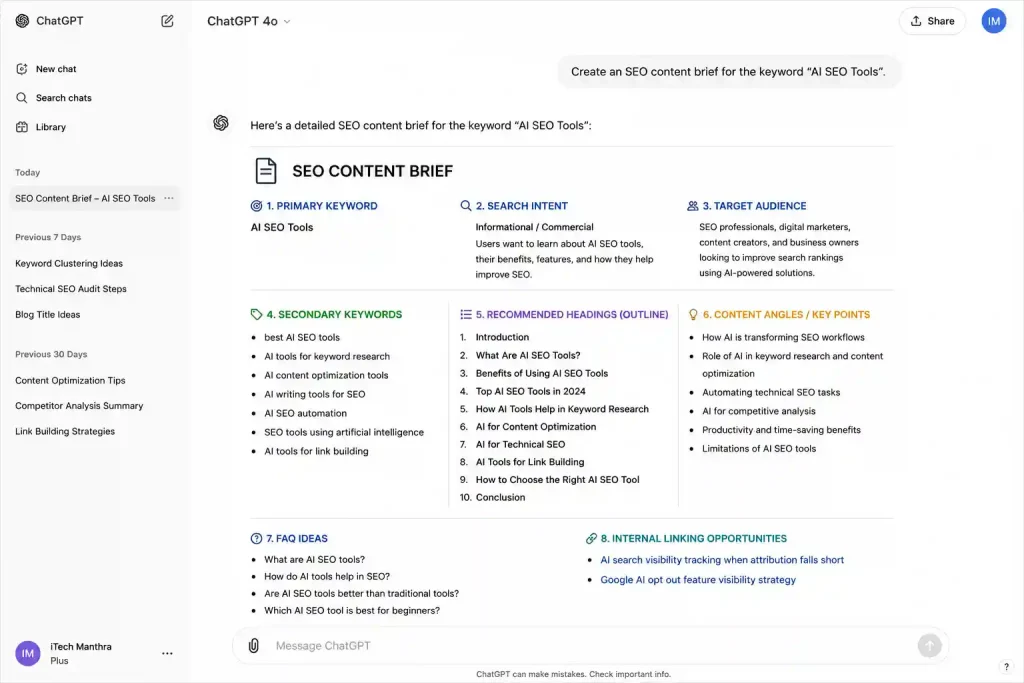
The good news is, a lot of these repetitive tasks do not really need to be done by hand anymore.
Artificial intelligence is reshaping SEO workflows , giving marketers a way to turn everyday work into AI driven tools. This can save time. also improve consistency and help teams focus on strategy rather than the same old repetitive execution.
The real opportunity is not about swapping SEO professionals out for AI. It is about using AI to remove the repetitive parts so experts can put their attention on better decisions.
That’s why more and more businesses are searching for ways to turn their SEO process into AI-powered tools.
What does it mean to turn your SEO process into AI powered tools?
Most SEO teams follow repeatable workflows.
For example:
- Keyword research
- Content planning
- On-page optimization
- Internal link recommendations
- Competitor analysis
- Performance reporting
These processes often follow predictable patterns.
AI can automate parts of those workflows, turning them into reusable systems not just one off stuff.
Instead of handcrafting every content brief, an AI tool can generate the brief from a set of predefined inputs.
Instead of manually scanning hundreds of pages for optimization opportunities, AI can spot those opportunities on its own.
This approach blends human expertise with SEO automation , which creates faster and more scalable workflows.
As content strategist Nina Lopez explains:
“The goal isn’t to automate thinking. The goal is to automate repetition.”
That distinction matters.
Why is SEO automation becoming essential for modern marketing teams?
SEO has become increasingly complex.
Today’s marketers manage:
- Search optimization
- AI search visibility
- Content production
- Technical audits
- User experience improvements
At the same time, expectations continue to grow.
Businesses want:
- Faster execution
- More content
- Better reporting
- Improved ROI
This is where SEO automation becomes valuable.
Automation helps teams:
- Reduce manual work
- Improve consistency
- Scale content operations
- Accelerate decision-making
- Free up time for strategy
Firms that automate repeatable routine tasks tend to get a competitive edge because their teams spend less time on administration and more time on expansion, rather than stuck in the mundane backlog.
For organizations exploring AI-driven search trends, AI search visibility tracking when attribution falls short provides useful insights into how visibility measurement is evolving.
Which SEO workflows are best suited for AI tools?
Not every SEO activity should be automated.
Strategic thinking still requires human judgment.
However, many recurring processes are ideal candidates for AI tools for SEO.
Keyword clustering
AI can organize large keyword lists into topical groups within seconds.
Content briefs
AI can create structured outlines based on search intent and competitor analysis.
Meta tag generation
Generating titles and descriptions becomes faster and more consistent.
Internal linking suggestions
AI can identify relevant content relationships across large websites.
Reporting
Automated summaries can help stakeholders understand performance trends quickly.
These workflows often consume significant time when performed manually.
Automating them creates immediate efficiency gains.
How can AI powered SEO improve content marketing performance?
Content remains one of the most important drivers of search visibility.
The challenge is maintaining quality while increasing production.
This is where content marketing automation becomes useful.
AI can help with:
- Topic ideation
- Content briefs
- Content optimization
- Content audits
- Content gap analysis
Importantly, AI should support writers rather than replace them.
The strongest content typically combines:
- Human expertise
- Original insights
- AI-assisted research
- AI-supported optimization
Research continues to show that high-quality content remains critical for both traditional search and AI-powered discovery.
Businesses that balance automation with expertise often achieve the best results.
What role does machine learning play in technical SEO?
Many technical SEO tasks involve pattern recognition.
That’s where machine learning SEO applications can provide value.
Examples include:
Crawl analysis
AI can identify site-wide issues more quickly than manual reviews.
Log file analysis
Machine learning helps uncover crawl inefficiencies and indexing opportunities.
Content quality evaluation
AI can identify pages that may require updates or improvements.
Search trend forecasting
Predictive models can help anticipate content opportunities.
Barry Adams, a respected SEO consultant, has often emphasized that technical excellence creates the foundation for long-term visibility.
AI simply helps teams identify issues faster.
For businesses wanting a deeper understanding of AI-powered search systems, Google’s guidance on AI generated content provides valuable context on how search quality and AI intersect.
Could custom AI tools become a competitive advantage?
Absolutely.
One of the biggest shifts in SEO is that custom workflows are getting more and more traction, like honestly it’s not a small change. Rather than leaning only on third party software, many companies are building internal tools that match their own specific procedures, even down to the small details. It’s more than just automation too, it’s a way to keep things coherent with their real world routines, and the results tend to be steadier.
Examples include:
- Content brief generators
- SEO audit assistants
- Internal linking engines
- Content optimization checklists
- Competitor monitoring systems
These custom solutions improve workflow automation while preserving unique business knowledge.
Companies that successfully document and automate their expertise often scale more efficiently than competitors.
This trend is becoming particularly important as AI search continues evolving.
Businesses already adapting to these changes may also benefit from understanding Google AI opt out feature visibility strategy and how AI-driven discovery impacts content exposure.
What mistakes should businesses avoid when building AI powered SEO tools?
While automation offers tremendous benefits, there are common pitfalls.
Automating poor processes
A bad workflow automated is still a bad workflow.
Ignoring quality control
Human review remains essential.
Over relying on AI generated content
Content should always provide unique value.
Focusing only on efficiency
The goal is better outcomes, not just faster execution.
Neglecting strategy
AI supports strategy but doesn’t replace it.
The most successful SEO teams view AI as an assistant rather than a substitute for expertise.
What does the future of AI powered SEO look like?
SEO is gradually shifting from task execution to system design.
Tomorrow’s SEO professionals may spend less time performing repetitive tasks and more time building intelligent workflows.
AI will likely assist with:
- Content planning
- Optimization recommendations
- Search trend analysis
- Technical monitoring
- Reporting automation
At the same time, human expertise will remain essential for:
- Strategy
- Creativity
- Brand positioning
- Audience understanding
The future isn’t AI versus SEO professionals.
It’s SEO professionals using AI more effectively than their competitors.
Final Thoughts
Turning your SEO workflow into AI powered tools is not really about pushing people out . It is more about removing the repetitive grind, so the people involved can lean into higher value actions
Organizations that automate everyday processes well often see better efficiency , more scalability and steadier output, while keeping the content quality steady and intentional
As AI keeps reshaping search results and marketing channels, the groups that pair workflow automation with real expertise will probably get the strongest edge
So, how much of your SEO work could be automated right now? Drop your thoughts , and any experiences you have, in the comments below
FAQs
What is SEO automation?
SEO automation uses software and AI to perform repetitive SEO tasks such as reporting, keyword clustering, and content optimization.
Can AI replace SEO professionals?
No. AI helps automate repetitive work, but strategy, creativity, and expertise still require human input.
What SEO tasks are easiest to automate?
Keyword research, content briefs, reporting, internal linking recommendations, and technical audits are common automation candidates.
Are AI powered SEO tools worth investing in?
For many businesses, yes. They can improve efficiency and free up time for strategic work.
What is the biggest benefit of AI in SEO?
The biggest advantage is scalability. AI allows teams to accomplish more work without increasing manual effort.

Kumar Swamy is the CEO of Itech Manthra Pvt Ltd and a dedicated Article Writer and SEO Specialist. With a wealth of experience in crafting high-quality content, he focuses on technology, business, and current events, ensuring that readers receive timely and relevant insights.
As a technical SEO expert, Kumar Swamy employs effective strategies to optimize websites for search engines, boosting visibility and performance. Passionate about sharing knowledge, he aims to empower audiences with informative and engaging articles.
Connect with Kumar Swamy to explore the evolving landscape of content creation!