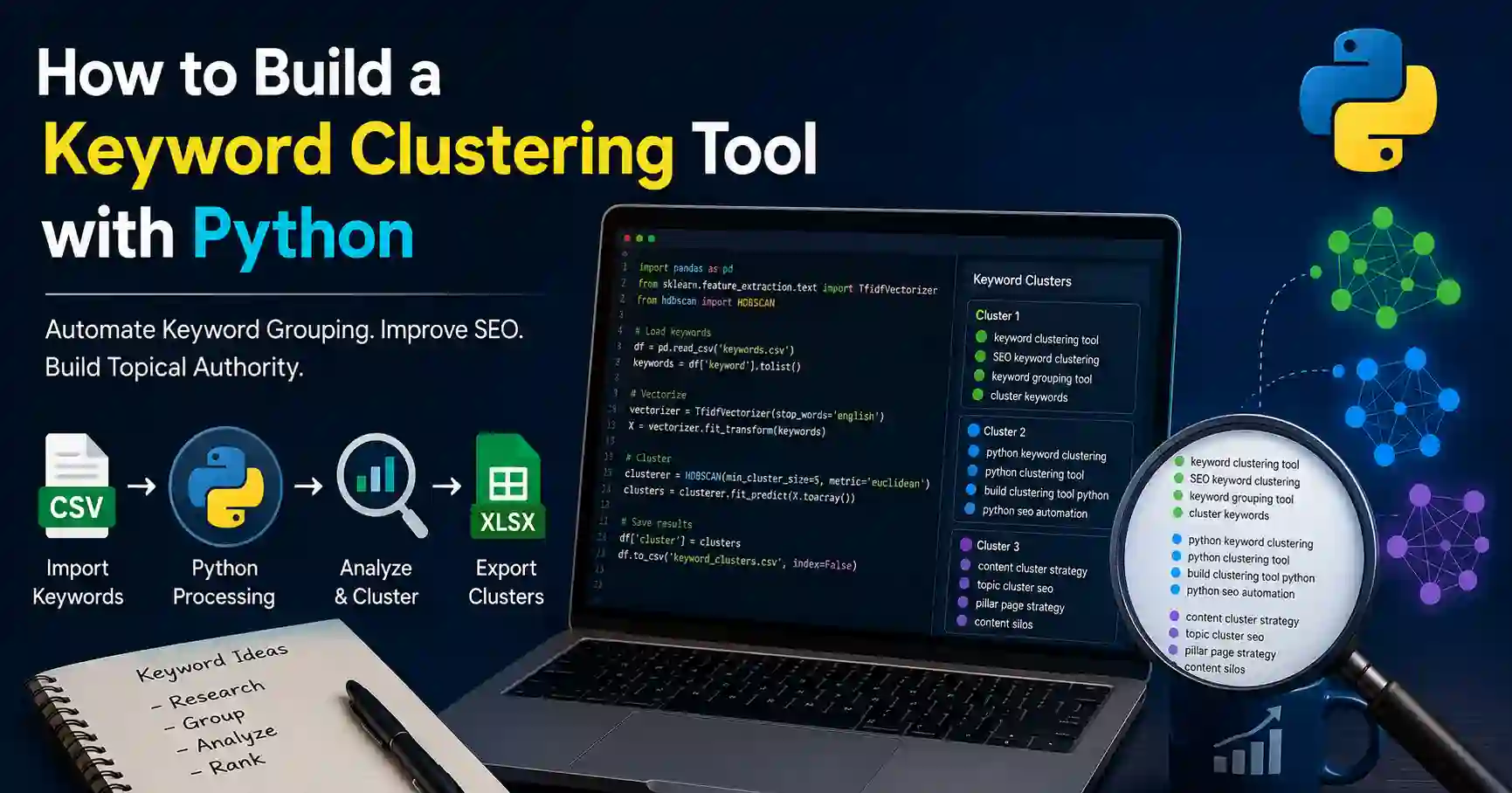
You know that feeling? Drowning in keywords from Search Console or Ahrefs, just staring blankly at a spreadsheet, wondering where the heck to even start. Everyone’s been there. Sorting those keywords by hand? It’s easily one of the worst time-sinks in all of SEO, especially when you’re mapping out content for a growing site.
That’s where a Python-powered keyword clustering tool really shines, you stop sifting. Python automatically groups similar search queries, figuring out their meaning and what users actually want. What do you get from that? Sharper content, much stronger topical authority, and an SEO process that just zips along.
So, this guide, it’s all about building your own keyword clustering tool using Python. We’ll dig into the tech behind it and see why more SEO pros are using Python to make keyword research less of a nightmare and way more manageable.
Why Should You Build a Keyword Clustering Tool with Python?
So, keyword clustering is basically lumping related keywords into bigger topics. Instead of a new page for every little keyword tweak, you just write one big article. It covers the whole topic.
Python, frankly, transforms your workflow, Keywords? Grouping happens automatically, liberating you from those expensive SEO tools. Just imagine the cash back! If you’re also exploring AI-powered keyword research, check out our guide on AI Keyword Research Process for Bloggers.
For example, these keywords belong to the same cluster:
- keyword clustering tool
- Python keyword clustering
- SEO keyword clustering
- keyword grouping tool
- semantic keyword clustering
Why scatter your efforts across five separate articles when a single, in-depth master guide could encompass everything?
Python truly revolutionizes this entire endeavor. You gain the ability to group keywords automatically, obviating the need for costly SEO software. Whether you’re wrangling 500 terms or a staggering hundred thousand, Python code tackles the task with remarkable alacrity.
Curious about streamlining your SEO operations? Our Python for SEO Automation Guide awaits.
“Modern SEO demands complete topic mastery, not merely chasing individual keywords.”
This fundamental change in approach is precisely the reason keyword clustering has become so indispensable for any successful strategy today. It’s that important.
How Does Keyword Clustering Actually Work?
At its core, keyword clustering is about identifying relationships between search queries.
Imagine you have these keywords:
- best running shoes
- running shoes for beginners
- running shoes under $100
- affordable running shoes
Google, bless its algorithms, totally gets related search terms, even with word changes. So why fight yourself, right? With clustering, it’s just one killer article, period.
A typical Python workflow looks like this:
Collect Your Keywords
Start by exporting keywords from tools like:
- Google Search Console
- Ahrefs
- Semrush
- Google Keyword Planner
- CSV files
The larger your dataset, the more useful clustering becomes.
Clean the Dataset
Before analysis, remove:
- duplicate keywords
- punctuation
- extra spaces
- unnecessary symbols
A clean dataset produces much more accurate keyword clusters.
Convert Keywords into Numerical Data
Computers don’t understand text the way humans do.
TF-IDF turns raw text into number vectors. Scikit-learn makes plain language into mathematical points, it’s math that does the work. Now, algorithms can easily spot keyword similarity.
Group Similar Keywords
When keywords turn into numbers, Python runs a clustering algorithm, HDBSCAN is a top pick. Why? It finds keyword groups automatically. No need to guess how many clusters there should be.
The final output usually looks something like this:
| Keyword | Cluster |
| keyword clustering | SEO Research |
| semantic keyword clustering | SEO Research |
| python seo automation | Python SEO |
Within seconds, hundreds or even thousands of keywords become neatly organized.
Which Python Libraries Are Best for SEO Keyword Clustering?
One reason Python dominates SEO automation is its rich ecosystem of libraries.
Some of the most useful include:
Pandas
Perfect for importing CSV files, cleaning datasets, and exporting clustered keywords.
Scikit-learn
Provides TF-IDF vectorization along with multiple clustering algorithms.
spaCy
Excellent for Natural Language Processing (NLP), helping Python understand keyword relationships more accurately.
HDBSCAN
A powerful clustering algorithm that performs exceptionally well for SEO datasets because it automatically identifies keyword groups.
Plotly
Useful for creating interactive visualizations of your keyword clusters.
You can whip up your own keyword clustering tool, Python’s just so darn flexible. It’s a fantastic project.
Semantic Keyword Clustering vs SERP Clustering: Which One Is Better?
Beginners often wonder: semantic keyword clustering, or SERP clustering. Which one wins? It’s a toss-up.
The answer depends on your SEO goals.
Semantic Keyword Clustering
Semantic clustering groups keywords based on their linguistic meaning.
For example:
- best gaming laptop
- gaming notebook
- laptop for gaming
Mere synonym swaps fail completely against modern NLP filters. They spot thematic links instantly, Semantic clustering moves fast, hinging entirely on your precise vocabulary.
SERP Clustering
SERP clustering takes a different approach.
Instead of analyzing the keywords themselves, it compares Google’s search results.
If two keywords return many of the same ranking pages, Google is effectively saying they belong together.
Many SEO professionals combine semantic analysis with SERP clustering because it produces clusters that closely match Google’s understanding of search intent.
Read Google Search Central helpful guide today. It outlines their exact advice for crafting genuinely useful pages.
What Features Should You Include in Your Keyword Clustering Tool?
The basic clustering script works. Squeeze in a couple of sneaky tweaks, though, and it turns into a legit SEO weapon.
Some useful features include:
- CSV upload support
- Automatic keyword cleaning
- Search intent detection
- Semantic keyword clustering
- SERP-based grouping
- Cluster naming
- Search volume integration
- Keyword difficulty analysis
- Excel export
- Interactive dashboards
- Duplicate keyword removal
- Content cluster suggestions
Agencies, freelancers, and marketing teams find this tool indispensable. Why? Because, as expert Aleyda Solis points out, automation devours tedious chores. This single shift frees human minds entirely for brilliant content, letting bold strategy finally take the wheel without distraction.
How Can You Improve the Accuracy of Keyword Clusters?
Even the best algorithms benefit from human review.
Here are a few practical tips:
Separate Search Intent
Don’t mix informational keywords with transactional keywords if users expect different types of content.
Remove Brand-Specific Queries
Unless you’re targeting branded traffic, these keywords often deserve their own clusters.
Review Small Clusters
Tiny groups sometimes belong inside larger topics.
Keep Long-Tail Keywords
Long-tail keywords often reveal valuable user intent and naturally strengthen topical authority.
Update Clusters Regularly
Search trends change over time. Re-running your clustering tool every few months helps keep your content strategy current.
If you’re planning a complete topical SEO strategy, don’t miss our guide on How to Build an Effective Content Cluster Strategy, where we explain how keyword clusters become content hubs that improve internal linking and authority.
Why Is Keyword Clustering Becoming Essential for Modern SEO?
Google no longer ranks pages simply because they repeat an exact keyword. Instead, it prioritizes content that is genuinely helpful and satisfies user intent. Google’s Creating Helpful, Reliable, People-First Content documentation explains the principles behind creating content that performs well in Search. Instead, it evaluates whether your content thoroughly answers a user’s question and covers the broader topic.
That explains why keyword clustering became the gold standard for modern search optimization, Stop churning out endless thin pages for tiny keyword tweaks. Build one heavy resource instead, a definitive hub that covers a whole constellation of related queries.
Python makes scaling this up actually doable. Tiny blog or massive enterprise site with thousands of URLs, automation buys back hours.
Above all, grouped keywords let you build tight silos, clean up internal links, stop cannibalization in its tracks, and finally lock down topical authority.
Once you’ve grouped your keywords, the next step is turning them into pillar pages and supporting articles. Our guide on What Exactly Is an AI Content Cluster Strategy? explains how to build an effective content cluster that improves rankings and strengthens your website’s topical authority.
Conclusion
Building a keyword clustering tool using Python is one of the smartest ways to automate keyword research and improve your SEO strategy. Combine standard data processing libraries with algorithms like TF-IDF and HDBSCAN, and you can transform thousands of messy keywords into clear topic clusters in just minutes.
That speed matters. Still, the real advantage is building content that actually matches what Google searchers want. Search engines care more about topical depth than exact match phrases now, making clustering crucial.
Whether you are an SEO beginner, a content marketer, or just tinkering with Python, building this tool pays off. Automate your workflow. Have you tried this yet, Drop your experience below.
FAQ’s
Is Python suitable for SEO beginners?
Python welcomes beginners. You can automate SEO chores like keyword clustering, data cleaning, and reporting using just a handful of libraries. It’s surprisingly easy.
Which clustering algorithm is best for SEO?
HDBSCAN shines here. It sniffs out keyword clusters entirely on its own, bypassing the tedious guesswork of predetermining exact group counts.
Can keyword clustering improve rankings?
Honestly, clustering alone won’t magically boost rankings. But, gosh, it’s brilliant for spotting truly comprehensive, user-focused content, that’s real SEO gold.
What’s the difference between semantic clustering and SERP clustering?
Alright, semantic clustering: it’s all about keywords and their meaning. SERP clustering? That just lumps them by what Google actually displays.
Can I build a keyword clustering tool without paid SEO software?
Absolutely. Python allows you to build a powerful keyword clustering tool using free libraries and keyword data exported from various sources.

Kumar Swamy is the CEO of Itech Manthra Pvt Ltd and a dedicated Article Writer and SEO Specialist. With a wealth of experience in crafting high-quality content, he focuses on technology, business, and current events, ensuring that readers receive timely and relevant insights.
As a technical SEO expert, Kumar Swamy employs effective strategies to optimize websites for search engines, boosting visibility and performance. Passionate about sharing knowledge, he aims to empower audiences with informative and engaging articles.
Connect with Kumar Swamy to explore the evolving landscape of content creation!