Have you noticed that Google sometimes answers your question before you even get a chance to click a website?
That’s the promise of Google AI Mode. Instead of scanning a traditional search results page, users can ask longer, conversational questions and receive an AI generated response designed to keep the research process inside Google.
Sounds convenient. But there’s a catch for publishers, SEO professionals, and website owners.
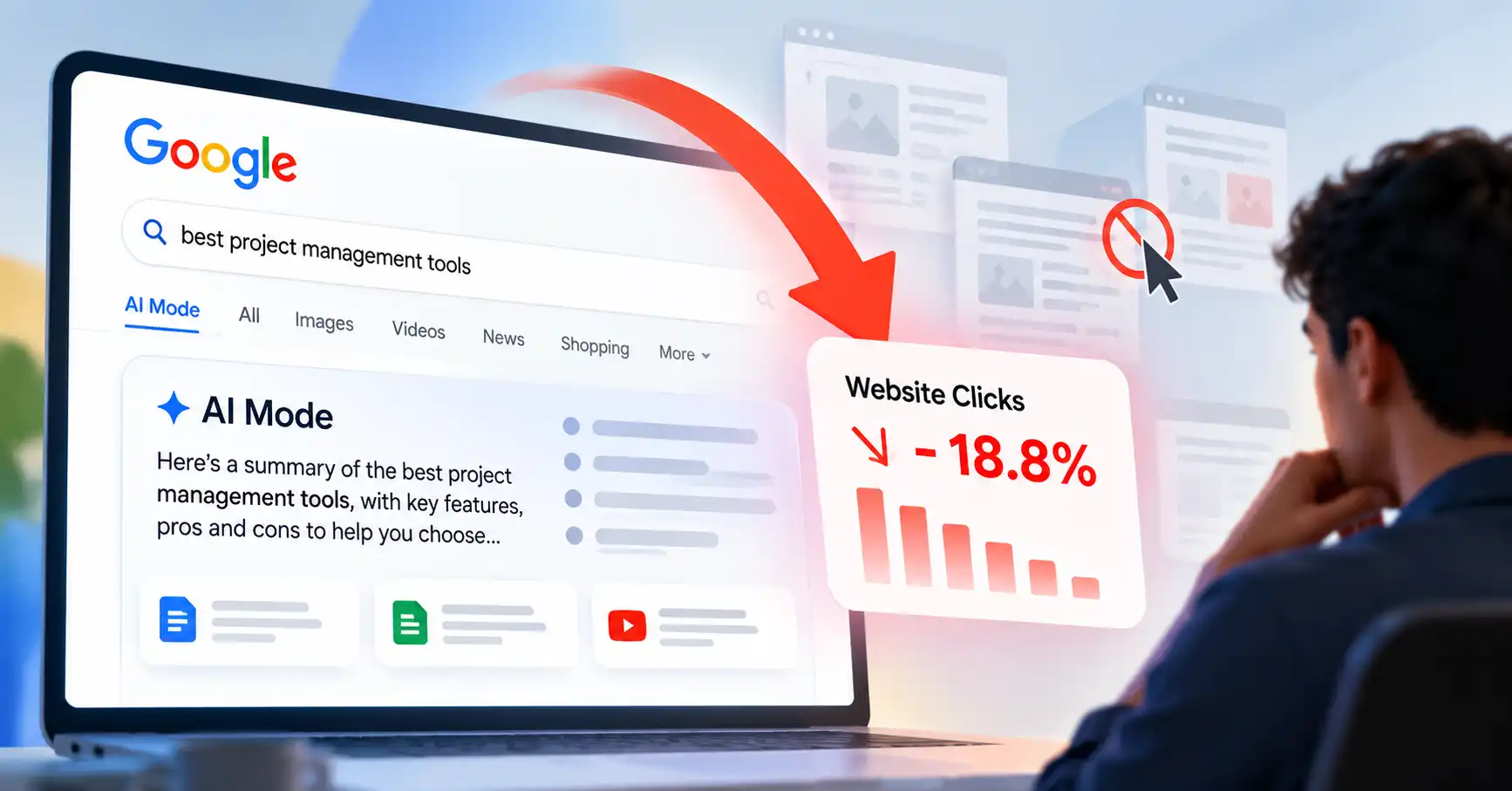
A new randomized field experiment involving 1,100 Google users found that forcing people into Google AI Mode reduced the share of searches that resulted in an external website click by 18.8 percentage points. The same study also found lower satisfaction, usefulness, perceived control, and trust among people assigned to AI Mode.
That makes this more than another debate about whether AI search is the future. It raises a much more practical question: if Google answers the question itself, what happens to the websites that used to receive the click?
What did the Google AI Mode study actually find?
The research was conducted by researchers from the University of Pennsylvania and Northeastern University. Participants were U.S. based Chrome users who normally used Google as their primary search engine.
After a three day baseline period, participants were randomly assigned to different search experiences for seven days. One group continued using Google normally, another had AI features restricted, and a third group was redirected into AI Mode for essentially all of its searches.
The headline finding is hard to miss: AI Mode reduced external click through by 18.8 percentage points compared with normal Google Search.
It wasn’t only general publisher traffic that changed. The researchers reported declines in the share of users clicking news websites, Reddit and Wikipedia. AI Mode also reduced Google search sessions by about 0.92 sessions per day.
There was another interesting result. People assigned to AI Mode were more likely to use competing search engines such as Bing, DuckDuckGo or Yahoo. The share of users doing so increased by 11.2 percentage points.
So the story isn’t simply “people love AI answers and stop clicking.” The experiment suggests something more complicated: AI Mode can keep people inside an AI generated answer experience while also reducing some measures of satisfaction and encouraging a portion of users to search elsewhere.
Why is Google AI Mode changing organic traffic?
Traditional SEO has always depended heavily on a simple journey:
Search → result → click → website → engagement or conversion.
Google AI Mode changes that journey.
A user might search for “best CRM for a small SaaS company,” for example. Instead of immediately opening several comparison pages, AI Mode can summarize different options, explain the differences and provide supporting links.
The user may get enough information without visiting any of those websites.
That’s where zero click searches become increasingly important.
A zero click search isn’t necessarily a failure for the searcher. If someone asks for a simple definition, calculation or quick fact, getting the answer immediately can be useful.
For publishers, though, the economics are different. The website still created the information that helped answer the query, but the user may never arrive.
This is one reason the latest findings matter for organic traffic. A page can remain technically visible in Google’s ecosystem while receiving fewer visitors from the search results.
Google has pushed back against broad claims that AI features are simply destroying web traffic. Its published position is that Search continues to send billions of clicks to websites and that AI features can generate higher quality visits for some queries.
Both things can be true at the same time: Google may continue sending enormous volumes of traffic overall, while particular publishers, query types or industries experience different effects.
What does the study say about user satisfaction?
This is arguably the more surprising part.
You might expect users to become more satisfied if Google gives them a detailed answer without making them open multiple websites.
The experiment didn’t find that.
Participants assigned to AI Mode reported lower perceived usefulness, satisfaction and sense of control. Trust in information on Google also declined. Perceived personalization and relevance declined as well.
The open ended feedback was mixed rather than universally negative. About 34% of AI Mode users gave negative feedback, compared with about 29% who gave positive feedback.
The complaints were revealing. Some users felt they had less control over when AI was used. Others found it harder to navigate directly to a specific website or felt there weren’t enough links and sources to explore. Some also complained that AI responses were too long for simple searches.
On the positive side, users mentioned convenience, time savings and useful summaries.
That distinction matters.
AI Mode can be useful without necessarily being the preferred experience for every search. Someone researching a complicated subject may appreciate an AI conversation. Someone trying to reach a specific website may simply want the link.
Does this mean Google AI Overviews and AI Mode are bad for SEO?
Not necessarily.
This is where SEO discussions often become too binary.
The study found that removing AI Overviews increased external click through by 8.8 percentage points, but the researchers also noted an important limitation: Google’s HTML changes during the experiment made it increasingly difficult for their browser extension to hide AI Overviews consistently. The researchers therefore applied statistical methods to account for imperfect exposure.
The AI Mode result was more directly implemented because 94.7% of searches assigned to that group were successfully routed into AI Mode.
For SEO professionals, the practical takeaway isn’t “stop optimizing for Google.”
It’s almost the opposite.
Your content now needs to work in two environments: traditional search results and AI powered search experiences.
Google itself says the foundational SEO practices remain relevant for AI Overviews and AI Mode. Pages still need to be crawlable, indexable, useful, well structured and genuinely valuable to readers.
For a deeper look at how that technical side works, see Technical SEO for AI Search: 4 Key Fundamentals.
How should businesses adapt their AI search SEO strategy?
The biggest mistake would be chasing AI visibility while ignoring what happens after the impression.
If AI search is increasingly answering informational queries directly, publishers should focus more heavily on content that gives users a reason to continue.
That means moving beyond generic summaries.
Create original research. Add first hand experience. Include examples, comparisons, opinions backed by evidence, proprietary data and practical details that aren’t easily reproduced by another AI system.
Think about the difference between:
“AI search is changing SEO.”
And:
“We analyzed 200 search queries across five industries and found these three patterns in AI generated answers.”
The second gives people something worth visiting.
This is also where your existing SEO strategy becomes more important, not less. Internal linking, technical accessibility, topical authority, strong page experience and clear content structure still matter.
Google’s current guidance specifically says there aren’t special technical requirements or a secret markup system required to appear in AI Overviews or AI Mode. The fundamentals still do the heavy lifting.
If you’re already using AI to support keyword research, content analysis or optimization, this guide may help: 7 Ways to Use AI for SEO That Actually Improve Rankings and Search Visibility.
What should SEOs measure beyond clicks?
Clicks still matter. But they’re no longer enough.
That’s perhaps the biggest lesson from the rise of AI search.
A website could receive fewer clicks but still gain brand exposure through an AI answer. On the other hand, a large number of AI impressions may mean very little if those impressions don’t produce visits, leads, sales or returning users.
Google has also introduced dedicated Google Search Console AI performance reports that provide visibility into how URLs appear in generative AI features. The reports include information such as impressions, pages, countries, devices and dates.
That gives SEO teams a better starting point for measuring AI visibility.
But don’t stop there.
Connect Search Console data with analytics and conversion data. Watch branded searches. Track assisted conversions. Monitor direct traffic. Look at engagement from organic visitors.
In other words, don’t simply ask:
“Did Google show my page?”
Ask:
“Did Google showing my page help my business?”
That’s a much more useful SEO question in an AI first search environment.
What does Google AI Mode mean for the future of search?
The latest research doesn’t prove that AI Mode will permanently reduce Google’s usefulness or that users will abandon traditional search.
It studied a specific group of U.S. users over a relatively short seven day period, and the sample skewed younger and highly educated. AI Mode was also forced on participants rather than chosen voluntarily, which is an important limitation when interpreting the findings.
Still, the study gives publishers something they haven’t had enough of: experimental evidence showing how an AI first search interface can change actual user behavior.
The future of SEO probably won’t be about choosing between traditional rankings and AI visibility.
It’ll be about earning attention in both.
The brands that have the strongest position may not simply be the ones that appear in an AI answer. They’ll be the ones that give users a reason to go beyond that answer.
Google AI Mode may reduce some clicks. The response shouldn’t be to publish more generic content and hope for the best. It should be to create content that’s genuinely worth clicking.
And that’s a lesson SEO has been teaching for years just with a much bigger AI shaped spotlight on it.
FAQ’s
A 2026 randomized field experiment found that assigning users to AI Mode reduced external click through by 18.8 percentage points compared with normal Google Search.
AI Overviews provide AI generated summaries within Google Search results, while AI Mode is a more conversational search experience designed for longer questions, follow ups and deeper exploration.
There is no evidence that traditional SEO is disappearing. Google says its core SEO fundamentals remain relevant for AI search, including crawlability, indexing, useful content and good page experience.
Zero click searches happen when users find the information they need directly on the search results page without visiting an external website.
Focus on original, useful content, strong technical SEO, clear site structure, first hand expertise and information that provides value beyond a basic AI generated summary. Also monitor AI visibility and business outcomes instead of relying only on rankings and clicks.
Conclusion
Google AI Mode is changing the relationship between search visibility and website traffic. The new study suggests that when AI becomes the default interface, fewer users may travel from Google to external websites and that doesn’t automatically translate into higher satisfaction.
For publishers and SEO teams, the answer isn’t to panic. It’s to rethink what makes a search result worth clicking.
Create something useful, original and difficult to replace.
That’s still SEO. It’s just SEO in a search engine that now wants to answer more of the questions itself.

Kumar Swamy is the CEO of Itech Manthra Pvt Ltd and a dedicated Article Writer and SEO Specialist. With a wealth of experience in crafting high-quality content, he focuses on technology, business, and current events, ensuring that readers receive timely and relevant insights.
As a technical SEO expert, Kumar Swamy employs effective strategies to optimize websites for search engines, boosting visibility and performance. Passionate about sharing knowledge, he aims to empower audiences with informative and engaging articles.
Connect with Kumar Swamy to explore the evolving landscape of content creation!