Ever feel like SEO has turned into a never-ending list of spreadsheets, keyword reports, content updates, audits, and ranking checks?
You’re not alone.
AI can make a lot of that work faster, but there’s a catch: using AI simply to pump out more blog posts isn’t really an SEO strategy. In fact, it can leave you with more content and very little extra visibility.
The smarter approach is to use AI for the parts of SEO that require digging, comparing, connecting data, spotting opportunities, and testing what actually works.
That matters even more now that Google Search is changing rapidly, with AI Overviews and AI Mode making search more conversational and less dependent on the traditional “10 blue links” experience. Google also says its generative search experiences still rely heavily on the foundations of traditional SEO. Google Search Central’s AI search guidance
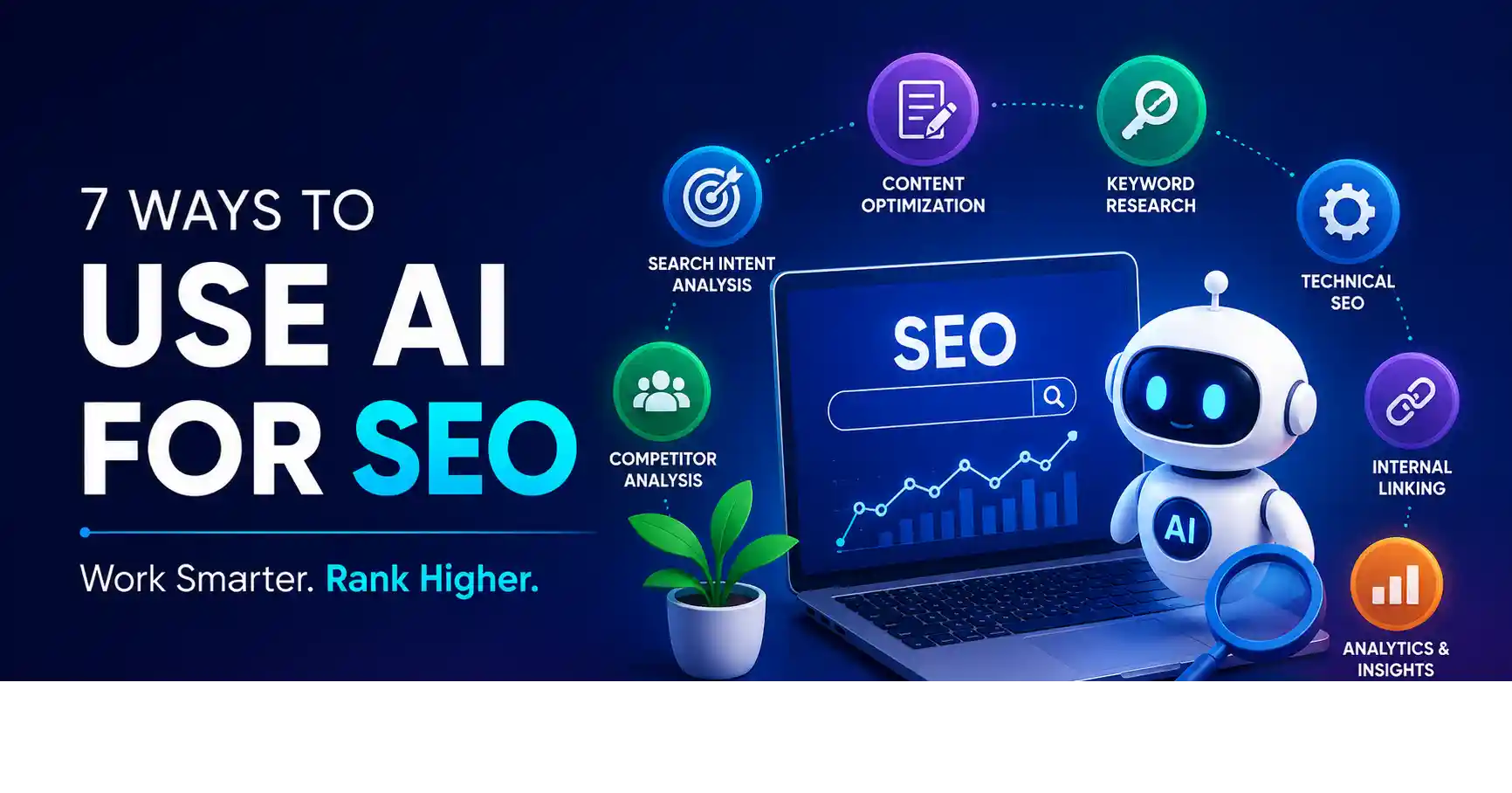
So, where should you actually use AI for SEO? Here are seven practical ways.
1. How can AI improve keyword research and search intent?
Keyword research is one of the most obvious uses for AI, but simply asking an AI tool to generate 100 keywords isn’t particularly useful.
The real value comes from understanding why someone is searching.
For example, someone searching “best AI SEO tools” is probably comparing options. Someone searching “how to use AI for SEO” wants educational content.If a person is looking for an SEO tool, they might be ready to choose already.
AI can sort keywords by what the searcher wants.
It can also pull out follow up questions.
It can find long tail wording that people use.
It can turn a big set of terms into smaller topic groups.
That approach can feel more focused than old keyword lists.
You do not have to write a separate post for each small keyword change.
You can pick the main subject first.
Then you can map the related points and the questions to cover on one page.
The main move is simple.
Let the AI arrange the items.
You still decide which keywords fit your business goals.
2. Can AI make content optimization more effective?
Yes, and this is also when an AI helper can be more handy than asking it to draft a full article.
Instead of starting from scratch, give the tool your current page. Share your target keyword, the kind of search intent you are aiming for, and a few pages that already rank. Then request a gap check. Have it point out parts that feel missing, spots where the explanation is thin, questions the page does not answer, and details that may be out of date. Also ask where your page still falls short for the reader.
With that setup, the AI acts more like an editor for improvements. It is not a machine that just churns out words.
For example, if a page sits near position 8, it may not need an extra 2,000 words. You might only need a clearer start. Maybe your headings are not doing enough. Maybe the examples could be more useful. Perhaps your internal links need to be more direct. Maybe the main answer should come earlier and be more clear.
Google stresses similar ideas. It favors content that helps real people. It is not about writing just to steer rankings.
A good shortcut is this. Do not ask AI, “How do I add more length?”
Ask, “What would make this page better than what is already ranking?”
That question usually leads to more useful work.
3. What can AI find in a technical SEO audit?
Technical SEO can get messy quickly. Crawl errors, indexing problems, redirects, duplicate URLs, missing metadata, broken links, structured data issues… the list goes on.
AI can turn long technical reports into a clear set of next steps.
Send it your crawl stats or an audit write-up.
Ask for a split into three buckets.
1. Issues that may hurt indexing.
2. Issues that may hurt how users feel the site.
3. Suggestions with less urgency.
This is not a cue to follow every item without checking.
AI is good at finding patterns. It’s not automatically good at understanding your website’s business priorities.
For example, fixing a blocked important page is probably more urgent than rewriting hundreds of low-impact image filenames.
Good technical SEO still depends on human judgment. AI simply helps you get through the boring investigation much faster.
If you’re working on AI-focused technical optimization, our guide to technical SEO for AI search is a useful next step.
4. How can AI uncover content gaps your competitors are exploiting?
Here’s one of the most useful applications of AI for SEO.
Instead of asking, “What should I write about?”, ask, “What are my competitors covering that I’m missing?”
Give AI the URLs or content outlines of several competing pages and compare them against your own article.
AI can identify:
- Topics competitors cover that you don’t
- Questions your page doesn’t answer
- Subtopics appearing across multiple ranking pages
- Content that looks outdated
- Opportunities for original examples or data
- Areas where your competitors are surprisingly weak
This is essentially SEO competitor analysis with an AI assistant doing much of the comparison work.
But don’t copy competitors. That’s the easy trap.
If five websites explain the same thing in almost the same way, that’s actually your opportunity to do something different.
Add a real example. Include original data. Show a process. Test a tool. Explain a mistake you’ve seen. Give readers something they can’t get from five other articles.
That’s how AI-assisted research becomes useful instead of producing another copycat page.
5. Can AI help build a stronger internal linking strategy?
Absolutely, and it’s an area that’s still surprisingly underused.
Imagine you have 200 articles on your website. Finding every logical internal linking opportunity manually can take hours.
An AI system can look at what a page is about. It can also check the headings and the main keywords. It may compare how different articles connect. Then it can recommend link spots where it fits naturally..
An article on AI SEO tools can also point readers to other related topics. It might mention AI search optimization. It could cover keyword research as well. It may include some technical SEO tips. It can also discuss content strategy.
The important word is naturally.
Don’t add links just because an AI suggested them. Each link should help the reader continue their journey or help search engines understand how your content fits together.
Good internal linking can also prevent valuable pages from becoming isolated.
Think of your website as a connected map rather than a collection of individual blog posts.
6. How can AI turn SEO data into better decisions?
SEO data is everywhere. Google Search Console, Google Analytics, ranking reports, keyword tools and trend data can all tell you something.
The problem is that the useful insight often sits between the reports.
Fragmented datasets finally converge. Artificial intelligence instantly unearths hidden patterns, effortlessly catching crucial insights you would otherwise miss across siloed platforms.
Traffic is arriving, yet clicks are completely absent. That simply means your search snippet is totally failing. Fix it today.
Another page might have excellent engagement but very little search visibility. That could indicate a keyword targeting or discoverability issue.
A third page could be losing impressions while the topic itself is becoming more popular. That’s a very different problem.
This is where AI SEO becomes less about automation and more about decision-making.
And if you’re already working with Search Console, you can also explore our guide on how to make Google Search Console work harder for your SEO.
7. How should you use AI for search visibility beyond traditional Google rankings?
SEO is not just about the usual rankings anymore.
More people are finding info through AI search tools.
This includes Google’s AI features and chat style search platforms.
Because of that shift, you can think of AI search as part of how you stay visible.
AI also can help you check how your brand or site shows up for different search queries.
Ask questions such as:
“Which brands are most frequently mentioned for this topic?”
“What sources are commonly cited?”
“What information is missing from my website?”
“How is my company described compared with competitors?”
Forget stuffing your pages with cheap hacks meant just for algorithms. You need a site that reads smoothly, carries real weight, and naturally draws links from peers. Clear writing matters, so do comprehensive guides, obscure facts, real bylines, practical examples, and solid tech. Google puts it bluntly. If you want to rank in modern search results, you simply have to build something genuinely useful, relevant, and fully accessible to crawling bots.
What does the best AI SEO workflow look like?
The biggest mistake is using one huge prompt to automate the whole SEO job.
A better way is to move step by step:
Research, then Analyze, then Plan, then Create, then Check, then Improve, then Measure.
AI can support many of those stages. Still, the key calls should stay with people. You do not want the system making the final decisions.
SEO pro and Google Search advocate John Mueller has said more than once to focus on the person using the page, not on tricks. In the AI era this matters even more. If the page does not help someone, then polishing it for AI will not fix the core issue.
This also holds for writing and content.
Let AI do the busy work. Keep the judgment with a human..
FAQ’s
Yes. Using AI by itself is not the issue. What matters is the output. Is it useful? Is it correct? Is it truly original? Also, did someone make it for real readers, or was it pushed out only to game search rankings?
The right tool depends entirely on the task. AI helpers tackle research. Meanwhile, specialized SEO platforms juggle stubborn keywords, heavy technical audits, and performance tracking, Pick carefully.
I do not think so. Yes, AI can handle boring tasks and sift through lots of data fast. But you still need people for the hard parts like planning, coming up with ideas, real research, and checking that the work is actually good.
It can, sure. But AI text doesn’t get some special ranking boost. Google cares about quality, usefulness, and whether the stuff actually helps users.
No. It is starting to feel like one more layer. Technical SEO still matters. Helpful content still matters too. Sites also need to be easy to crawl. Internal links need to be in place. Authority still plays a role as well. Even with AI search, the systems still pull from pages that search engines can find and understand.
Conclusion
The best way to use AI for SEO isn’t pushing out more volume. It’s about thinking smarter.
Use it to sniff out keywords, figure out search intent, fix old pages, spot technical glitches, and find what rivals missed. Strengthen your links, Parse the metrics. Get ready for search driven by AI.
Just don’t hand over the steering wheel completely.
Your experience, original ideas, first-hand knowledge, data, and judgment are still what separate useful SEO from generic SEO.
In other words, let AI do the digging. You decide where to go.

Kumar Swamy is the CEO of Itech Manthra Pvt Ltd and a dedicated Article Writer and SEO Specialist. With a wealth of experience in crafting high-quality content, he focuses on technology, business, and current events, ensuring that readers receive timely and relevant insights.
As a technical SEO expert, Kumar Swamy employs effective strategies to optimize websites for search engines, boosting visibility and performance. Passionate about sharing knowledge, he aims to empower audiences with informative and engaging articles.
Connect with Kumar Swamy to explore the evolving landscape of content creation!