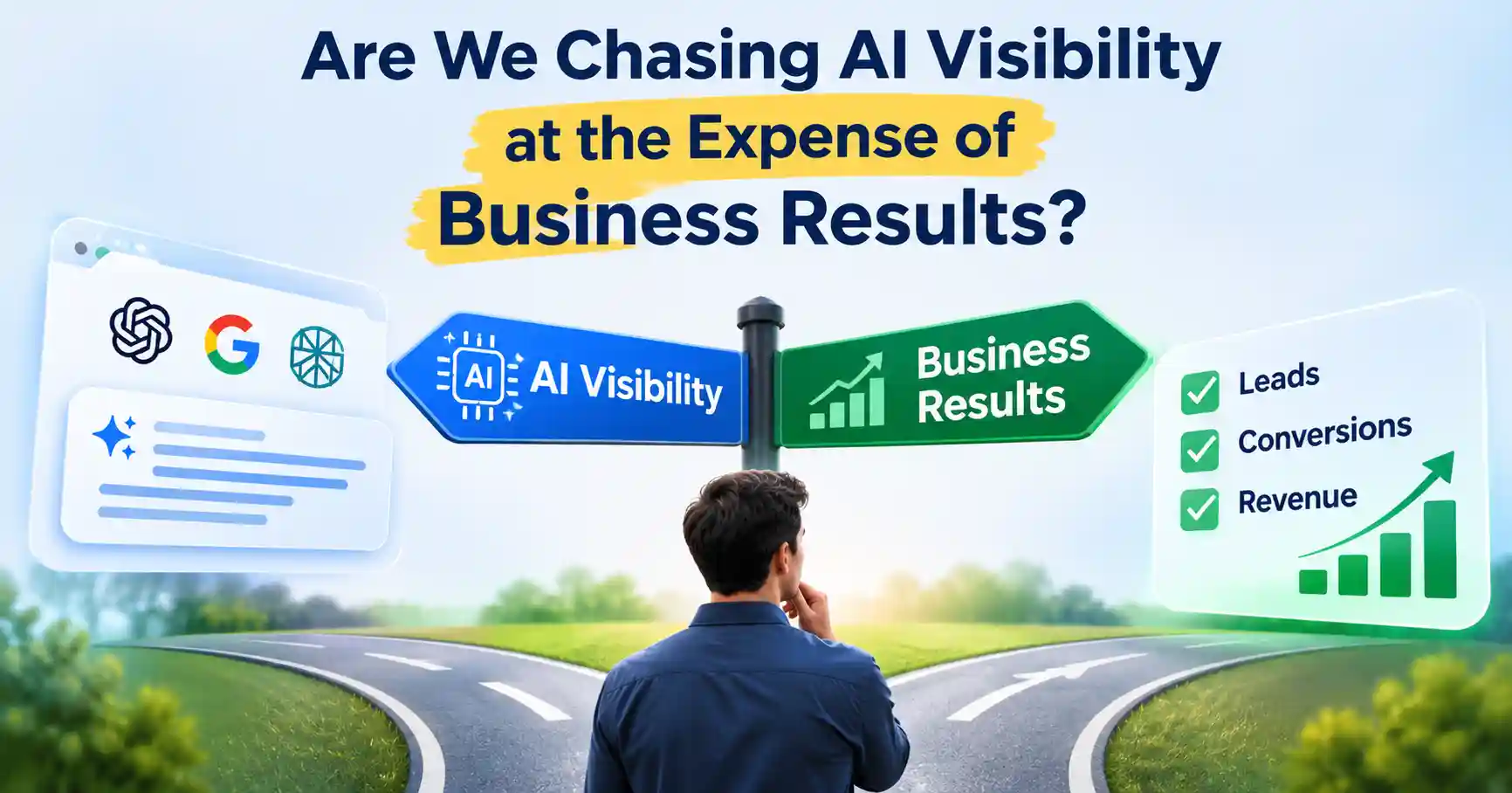
AI visibility has quickly become one of marketing’s biggest talking points. Businesses want their brands mentioned in ChatGPT responses, cited by Perplexity, and recommended in Google’s AI powered search results. Marketing teams are investing in new tools, monitoring AI mentions, and experimenting with Generative Engine Optimization (GEO).
But there’s a question worth asking: Are we becoming so focused on AI visibility that we’re losing sight of the business results that matter?
Being mentioned in an AI generated answer doesn’t automatically bring in customers, qualified leads, or revenue. Visibility creates opportunities for discovery, but it doesn’t guarantee commercial success.
The challenge isn’t deciding between traditional SEO and AI visibility. It’s figuring out where each deserves attention and whether those investments are actually contributing to business growth.
Why AI Visibility Has Become Marketing’s New Obsession
The shift from Google rankings to AI generated answers
Search behavior is changing. Users are increasingly encountering AI generated summaries, conversational answers, and recommendations alongside traditional search results.
Google’s AI Overviews and AI Mode, along with ChatGPT and Perplexity, have introduced new ways for people to discover brands and evaluate products.
For businesses, this opens up an opportunity to become part of the conversation before a potential customer even visits their website.
That also changes what visibility means. Ranking a webpage is no longer the only way to reach an audience. Brands can also gain exposure by being referenced, cited, or recommended in AI generated responses.
Why marketers are tracking AI mentions and citations
AI visibility tools allow businesses to monitor brand mentions, citations, and appearances across selected prompts.
These metrics have their place. They help marketers understand whether their brands are showing up in relevant conversations and how their presence compares with competitors.
The problem starts when tracking these numbers becomes an objective in itself. With new tools and metrics attracting so much attention, it’s easy to mistake visibility for progress.
The Problem With Treating AI Visibility as a Business Result
A brand mention doesn’t automatically bring in a customer
Imagine a SaaS company that frequently appears in AI generated answers about project management software.
Its marketing team notices an increase in brand mentions and celebrates the improvement in AI visibility. But there’s no clear evidence that those mentions are influencing product discovery, driving website visits, or contributing to customer acquisition.
A brand mention is an opportunity for exposure, not a business outcome.
That distinction matters because AI visibility, referral traffic, engagement, and conversions represent different stages of a potential customer journey. Treating them as the same thing can lead to misleading conclusions.
Visibility metrics can create a false sense of marketing progress
Consider two marketing initiatives:
- Campaign A increases AI brand mentions but produces no measurable improvement in qualified leads.
- Campaign B improves a product landing page and generates more demo requests from existing organic traffic.
If the team evaluates performance primarily through AI visibility, Campaign A might look like the bigger success.
Yet Campaign B could deliver considerably more commercial value.
That doesn’t necessarily mean Campaign A failed. AI exposure may contribute to brand awareness or influence future searches. The issue is declaring success without looking at the evidence.
What research actually tells us about AI visibility and conversions
AI referral traffic doesn’t always behave like conventional organic traffic. Some studies report strong engagement or conversion rates from AI referrals, but the findings vary depending on the websites, industries, traffic volumes, and attribution methods involved.
A high conversion rate from a relatively small referral channel doesn’t automatically translate into significant revenue at scale.
Marketers need to look at both conversion efficiency and commercial contribution. Neither metric alone tells the whole story.
Are We Investing Too Much in AI Visibility and Too Little in Growth?
The opportunity cost of chasing AI citations
Every marketing team works with limited resources.
Time spent monitoring hundreds of AI prompts, creating content primarily to earn citations, or purchasing additional visibility tools is time that can’t be spent elsewhere.
Other opportunities might include:
- Fixing technical SEO issues.
- Improving landing page conversion rates.
- Creating product comparison content.
- Researching customer objections.
- Strengthening lead qualification.
- Improving onboarding and retention.
The question isn’t whether AI visibility matters. It’s whether another marketing investment could deliver greater value right now.
When AI visibility investments make business sense
AI visibility is worth pursuing when it supports an actual customer discovery or evaluation process.
For instance, a software company targeting buyers searching for alternatives to an established competitor could benefit from appearing in AI generated comparisons.
Businesses selling complex products may also want their expertise represented when potential customers ask detailed questions before making a purchasing decision.
In both cases, AI visibility serves a broader marketing purpose: helping potential customers discover and evaluate the business.
When marketers should reconsider their priorities
It’s worth reviewing AI visibility investments when:
- Brand mentions increase, but business performance remains unchanged.
- Teams struggle to explain why specific prompts matter commercially.
- Visibility monitoring consumes more resources than the insights justify.
- Conversion problems elsewhere in the funnel remain unresolved.
The answer isn’t necessarily to abandon GEO. Sometimes, reducing unnecessary tracking and redirecting resources toward more valuable activities is the better move.
How to Measure AI Visibility Without Losing Sight of Revenue
A useful AI visibility strategy connects discovery metrics with business performance. That means looking beyond mentions and citations to understand what happens after someone encounters a brand.
Separate visibility metrics from business KPIs
A practical measurement framework should distinguish five levels:
| Measurement layer | What to track |
| Visibility | AI mentions, citations, share of voice |
| Demand | AI referral visits, branded search |
| Engagement | Product exploration, engaged sessions |
| Conversion | Qualified leads, sign ups, purchases |
| Business impact | Pipeline, revenue, gross profit |
These metrics aren’t interchangeable.
Visibility indicates potential exposure. Demand and engagement show whether people take further action. Conversions and revenue offer stronger evidence of commercial contribution.
Connect AI discovery with GA4, Search Console, and CRM
Google Analytics 4 can help identify referral traffic from AI platforms when visits arrive with identifiable referral information.
Search Console helps marketers monitor organic search performance and branded search patterns. However, it can’t directly attribute a conversion to a particular AI generated answer.
CRM data provides another useful perspective. Asking prospects how they discovered a company can uncover AI assisted discovery that analytics tools might miss.
A more complete measurement approach combines:
- AI referral traffic and landing page engagement.
- Branded search trends over time.
- Lead quality and conversion rates.
- Self reported discovery information.
- Pipeline and revenue contribution.
Together, these signals provide a clearer picture without assuming that every AI influenced customer journey can be tracked perfectly.
Build a business first AI visibility dashboard
Instead of reporting AI mentions in isolation, bring visibility metrics together with commercial indicators.
| Metric | Business question |
| AI citations | Are we appearing in relevant answers? |
| Referral sessions | Are people visiting our website? |
| Qualified leads | Are visitors becoming potential customers? |
| Pipeline contribution | Is the channel influencing opportunities? |
| Cost per qualified lead | Is the investment commercially efficient? |
The objective isn’t to prove that every AI mention generated revenue. It’s to understand whether AI visibility is contributing to the wider marketing strategy.
A Practical Framework for Balancing AI Visibility and Business Growth
Step 1: Define the business objective before optimizing AI visibility
Start with a measurable business goal.
That could mean increasing qualified demo requests, improving product discovery, or supporting a particular revenue segment.
Avoid starting with a vague target such as increasing AI mentions. The business objective should guide the visibility strategy, not the other way around.
Step 2: Identify high value buyer questions
Not every AI prompt deserves the same level of attention.
Prioritize questions related to product comparisons, buying decisions, alternatives, pricing, implementation, and customer problems.
These queries are generally more closely connected to commercial intent than broad informational questions.
Step 3: Improve content that helps customers make decisions
Focus on content that answers genuine buyer questions.
Product comparisons, implementation guides, original research, detailed FAQs, and practical use cases can help potential customers evaluate solutions.
This approach also aligns with Google’s guidance to create helpful, reliable, people first content rather than content designed primarily to manipulate search rankings.
Step 4: Test visibility improvements against business signals
Monitor whether targeted content improves AI visibility, referral engagement, branded search, or qualified lead generation.
Be careful about assuming that an increase in citations caused an increase in revenue. Look for consistent patterns and account for other factors that may influence performance.
Step 5: Reallocate investment based on evidence
Imagine a SaaS business investing additional resources in AI prompt monitoring without seeing much commercial progress.
At the same time, its existing organic traffic converts poorly because the demo landing page doesn’t address customer objections.
In that situation, improving the landing page may deliver more value than expanding AI visibility monitoring.
Marketing decisions should reflect evidence, opportunities, and available resources not simply whichever trend is attracting the most attention.
What Should Marketers Prioritize in the AI Search Era?
AI visibility should complement established marketing fundamentals.
Businesses still need technically sound websites, useful content, effective conversion paths, and a clear understanding of customer needs.
AI search visibility can strengthen these efforts, particularly when content answers questions customers genuinely ask.
For a broader perspective, explore the real business opportunity in AI search.
Marketers should also understand how AI search traffic differs from organic traffic. Those differences matter when interpreting referral performance and deciding where to invest.
A sensible strategy brings traditional SEO, conversion optimization, customer research, and selective AI visibility monitoring together.
FAQ’s
Not necessarily. AI visibility creates opportunities for brand exposure and discovery, but revenue depends on factors such as customer intent, product relevance, conversion experience, and sales execution. Businesses should evaluate visibility alongside qualified leads and commercial outcomes.
Neither metric should automatically take priority. AI visibility may influence discovery without generating a direct website visit, while organic traffic can provide measurable engagement and conversions. The right balance depends on customer behavior and business objectives.
Combine AI referral traffic, engagement, qualified leads, pipeline, and revenue with appropriate attribution methods. Include self reported discovery wherever possible. Be transparent about measurement limitations, and avoid attributing revenue to AI visibility without supporting evidence.
GEO tools can help monitor AI mentions, citations, and competitive visibility. Their value depends on whether the insights lead to useful marketing decisions. Start with a clear objective, evaluate the quality of the data, and expand investment only when the benefits justify the cost.
Conclusion
AI visibility is an important development in search marketing. Businesses need to understand where their brands appear in AI generated answers and how customers discover their products.
But visibility shouldn’t become a substitute for marketing performance.
The stronger approach is to treat AI visibility as one part of a broader growth strategy, alongside SEO, conversion optimization, customer research, and revenue measurement.
Track the metrics that inform decisions. Invest in opportunities that matter to customers. And don’t confuse being mentioned with being chosen.
The real question isn’t how often AI mentions your brand. It’s whether your marketing helps the right customers find you, trust you, and ultimately do business with you.

Kumar Swamy is the CEO of Itech Manthra Pvt Ltd and a dedicated Article Writer and SEO Specialist. With a wealth of experience in crafting high-quality content, he focuses on technology, business, and current events, ensuring that readers receive timely and relevant insights.
As a technical SEO expert, Kumar Swamy employs effective strategies to optimize websites for search engines, boosting visibility and performance. Passionate about sharing knowledge, he aims to empower audiences with informative and engaging articles.
Connect with Kumar Swamy to explore the evolving landscape of content creation!