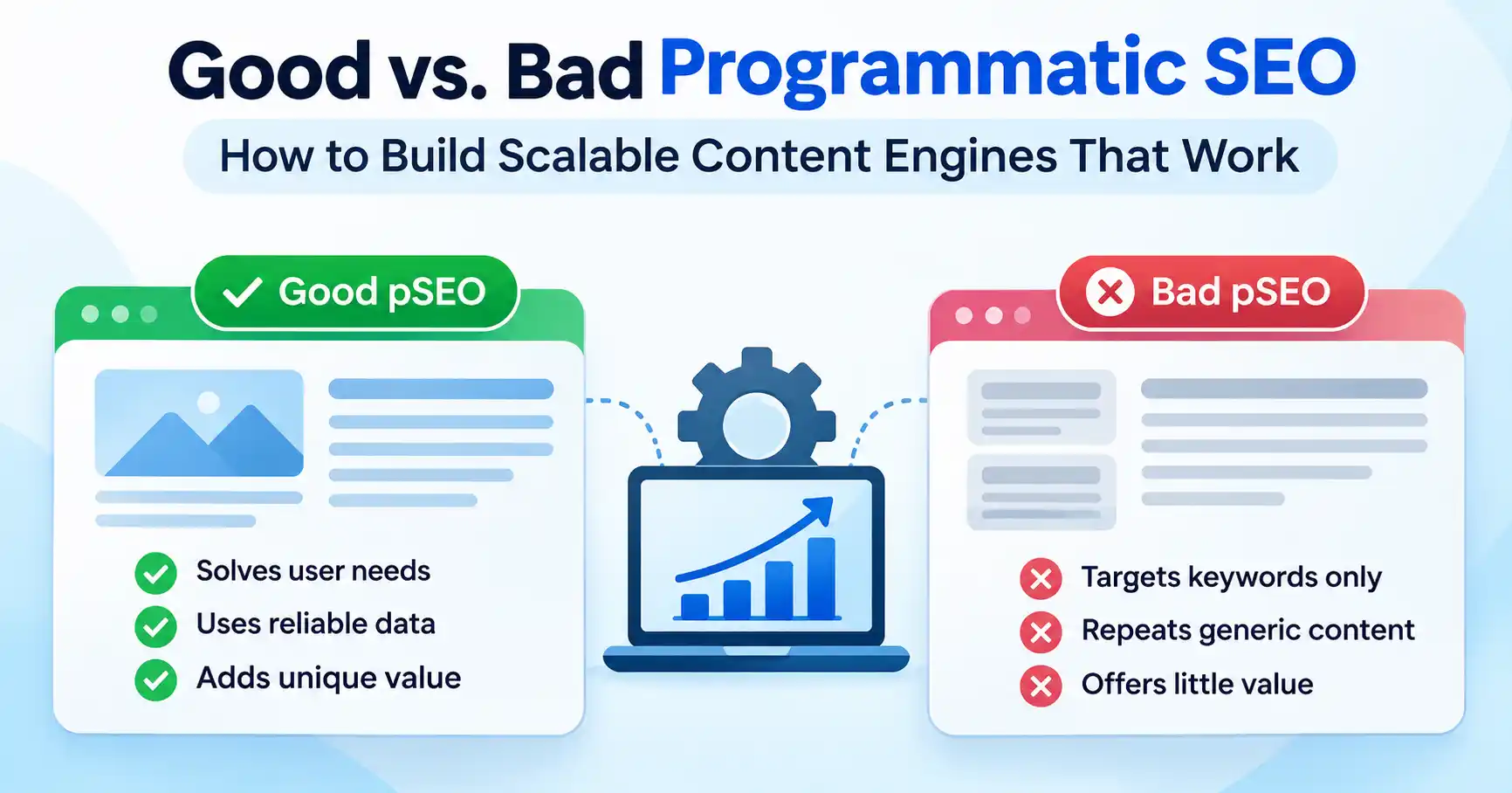
Programmatic SEO (pSEO) gives businesses a way to create hundreds or even thousands of search focused pages without writing each one individually. Done well, it helps websites meet specific user needs at scale. Done poorly, it produces repetitive pages that offer little value.
The real difference isn’t the number of pages you publish or whether you use automation. It’s whether those pages genuinely help people.
For bloggers, marketers, SaaS companies, and business owners, understanding this distinction matters before investing in a scalable content strategy. Here’s how to build a programmatic SEO strategy that focuses on usefulness, quality, and sustainable organic growth.
What Is Programmatic SEO?
Programmatic SEO is a method of creating web pages at scale using structured data, reusable templates, and automation. Rather than writing every page manually, teams build systems that generate content around recurring search patterns.
For example, a currency conversion website can use exchange rate data and a template to create pages for different currency pairs. Similarly, a software integration platform can generate pages explaining how different applications connect.
How Programmatic SEO Works
Most pSEO systems rely on three core components:
- Keyword patterns: Search queries with repeatable structures, such as “X vs. Y” or “best tool for industry.”
- Structured datasets: Reliable information that supports the content of each generated page.
- Reusable templates: Page layouts that organize information consistently while adapting to different topics.
These components work together to generate pages. However, the quality of the results depends on the data, the template, and how well the content matches search intent.
Programmatic SEO vs. AI Generated Content
Programmatic SEO and AI generated content aren’t interchangeable terms.
Programmatic SEO describes how content is published at scale. AI generated content describes how that content is produced. A website can use AI as part of a pSEO workflow, but it can also generate pages through databases, application logic, and editorial templates without using AI.
Neither approach guarantees useful content. What matters is whether the finished page gives readers something valuable.
Good vs. Bad Programmatic SEO: What’s the Difference?
The difference becomes easier to understand when you compare how each approach handles content creation.
| Good pSEO | Bad pSEO |
| Solves a specific user problem | Targets keywords without understanding intent |
| Uses accurate, useful data | Repeats generic or unreliable information |
| Adds meaningful information to each page | Changes names while keeping identical content |
| Uses templates to improve consistency | Uses templates to produce filler |
| Tests pages before scaling | Publishes thousands of URLs immediately |
| Maintains and updates content | Leaves outdated pages untouched |
Good pSEO creates useful experiences at scale. Bad pSEO assumes that every keyword deserves its own page.
Consider a SaaS integration website.
A useful page explaining how Slack connects with a project management application might include supported triggers, available actions, setup requirements, and practical workflow examples.
A poor version could simply repeat the names of two applications across hundreds of pages while displaying the same generic paragraph. The URLs might look different, but the information barely changes.
The real question is whether each page has a meaningful reason to exist.
What Makes a Successful pSEO Strategy?
Start With a Real User Problem
Don’t begin by asking how many pages your website can generate. Start with what people actually need.
A travel website might discover that users want destination information, transportation options, and accommodation categories. A SaaS platform might identify recurring questions about integrations, pricing, or software alternatives.
These needs can support scalable content because they follow recognizable patterns while still requiring specific information.
Identify Repeatable Search Patterns
Look for queries that share a structure but represent genuinely useful opportunities.
Examples include:
- Currency conversion between different currencies
- Software integrations between applications
- Product comparisons with distinct features
- Local services with meaningful location specific information
Not every keyword variation needs a separate URL. If multiple searches express essentially the same intent, one comprehensive page may serve users better.
Build a Reliable Dataset
The dataset plays a major role in the quality of generated pages.
Before publishing, check whether your information is accurate, complete enough, and relevant to the page’s purpose. Establish rules for missing values, outdated records, duplicate entries, and conflicting information.
A template can’t compensate for unreliable data. Worse, automation can spread the same data errors across hundreds of pages in a short time.
Create Templates Around Search Intent
Templates should make information easier to understand, not simply provide a place to insert keywords.
A software integration page, for instance, could include:
- Supported applications and integration requirements
- Available triggers and actions
- Setup instructions
- Example workflows
- Limitations or compatibility details
This structure gives readers practical information while allowing individual pages to reflect their specific subject.
Add Information Competitors Cannot Easily Replicate
Some of the strongest pSEO opportunities come from information or functionality that isn’t readily available elsewhere.
Original datasets, interactive tools, practical workflows, and product specific insights can help pages stand out from generic search content.
This is where businesses can build a lasting content advantage. Their pages become useful because of the information or experience they provide, not simply because they exist.
Real World Programmatic SEO Examples
Wise: Currency Conversion Pages
Wise provides a currency converter that allows users to calculate conversions between currencies using exchange rate information.
The value isn’t just having a page for every currency combination. Users can perform a conversion, access relevant exchange rate information, and understand the result.
Lesson: When a page includes functionality that directly solves a problem, automation can help scale that experience.
Zapier: Software Integration Pages
Zapier maintains a large integrations directory connecting applications and automation workflows. Its integration ecosystem helps users explore connections between software tools.
For example, someone looking to connect Slack with another application can explore relevant integration options instead of starting with a generic automation explanation.
Lesson: Integration pages work best when they explain what users can actually do, rather than simply listing connected applications.
Tripadvisor: Location and Category Pages
Tripadvisor provides destination and travel listings that help people explore accommodation, attractions, and travel options.
Location based pages can be useful because travelers need information specific to their destination. However, a page becomes less valuable when it lacks meaningful local information or simply duplicates content from nearby locations.
Lesson: Location based pSEO requires genuine local relevance, not just a location name inserted into a template.
Why Bad pSEO Strategies Fail
Several mistakes can undermine scalable content projects:
- Publishing without unique information: Pages contain little beyond generic descriptions and keywords.
- Scaling before validation: Teams generate thousands of URLs before confirming that users need them.
- Ignoring search intent: Different keyword variations produce pages that answer the same question.
- Neglecting technical SEO: Pages become difficult to crawl, discover, or navigate.
- Leaving outdated content live: Data changes, but generated pages don’t reflect those updates.
One easily overlooked problem is that a page can be technically unique yet practically useless. Different product names, cities, or categories don’t automatically create distinct value.
How to Build a Scalable pSEO Content Engine
A reliable programmatic SEO strategy should grow through testing, not uncontrolled publishing.
Step 1: Validate Search Demand and Intent
Research keyword patterns and examine search results. Determine whether the queries represent a genuine need and whether separate pages would serve different purposes.
Step 2: Define the Dataset
Identify the fields needed to answer user questions. Document data sources, update frequency, missing information, and validation rules.
Step 3: Build Templates and Quality Rules
Create a reusable structure that adapts to each page’s information. Establish minimum requirements for completeness, accuracy, and usefulness.
Step 4: Launch a Small Test Batch
Publish a limited set of pages covering representative examples. Review them manually before expanding the system.
Step 5: Monitor Indexing and Performance
Use Google Search Console to assess indexing, impressions, clicks, and search queries. Investigate technical issues and patterns in underperforming pages.
Step 6: Improve, Consolidate, or Remove Weak Pages
Review pages that no longer serve their purpose. Update useful pages, consolidate overlapping content where appropriate, and remove or exclude pages that offer no meaningful value.
For a structured approach to deciding which pages deserve attention, explore iTechManthra’s guide to prioritizing SEO content updates and new opportunities.
Programmatic SEO and Google’s Scaled Content Abuse Policy
Google’s scaled content abuse policy addresses websites that generate large amounts of content primarily to manipulate search rankings rather than help users.
The policy applies regardless of whether pages are created using AI, automation, or manual processes. Google identifies mass produced, unoriginal pages with little user value as a form of scaled content abuse.
This doesn’t mean programmatic SEO is prohibited.
Websites can generate many pages responsibly when those pages serve real users and provide meaningful value. The distinction is between scaling useful content and scaling content primarily to manipulate search rankings.
Google’s people first content guidance offers a useful framework for evaluating whether pages provide original information, reliable explanations, and a satisfying experience.
How to Measure Programmatic SEO Performance
Page count alone won’t tell you whether your pSEO strategy is working.
Track performance at both the individual URL and template level.
| Metric | What it tells you |
| Indexed pages | Whether Google has included eligible pages in its index |
| Search impressions | Whether pages appear for relevant queries |
| Organic clicks | Whether search visibility generates visits |
| CTR | How frequently impressions result in clicks |
| Conversions | Whether organic visitors take meaningful actions |
| Template performance | Which page structures perform better |
| Content freshness | Whether information remains accurate |
Google Search Console helps monitor search performance and indexing. Its Page indexing report identifies indexed and non indexed URLs, including legitimate reasons some pages aren’t indexed.
One practical approach is to compare groups of pages generated from the same template. If an entire category performs poorly, investigate the dataset, search intent, and template before making changes to individual URLs.
Programmatic SEO in the AI Search Era
AI search makes the distinction between useful pages and generic content even more important.
When search experiences summarize information directly, pages that simply repeat common explanations have less to distinguish them. Original data, interactive functionality, clear evidence, and practical insights give users stronger reasons to visit the underlying website.
For example, an integration page with tested setup instructions and supported workflow details offers considerably more than a generic description of two applications.
iTechManthra’s guide to helpful content workflows for AI search explores ways to strengthen research, originality, and content quality.
There isn’t a guaranteed formula for earning AI citations or search rankings. Focus on building resources that are genuinely useful, accessible, and reliable.
Programmatic SEO Quality Checklist
Before publishing a generated page, ask:
- Does it solve a real user problem?
- Is the underlying data accurate and current?
- Does it provide meaningful information beyond other pages?
- Does it satisfy a distinct search intent?
- Is the template useful and easy to understand?
- Is the page worth including in search results?
- Can the information be maintained?
- Is there a process for reviewing weak pages?
If several answers are no, reconsider whether the page should be published or indexed.
FAQ’s
Good pSEO uses automation to create useful pages supported by reliable data and meaningful information. Bad pSEO produces repetitive, low value pages primarily to capture search traffic without adequately serving users.
It can be effective when pages solve real problems and provide useful information. Results depend on search demand, competition, implementation, content quality, and the value of the pages not simply the number generated.
Programmatic SEO itself isn’t prohibited. However, generating large amounts of unoriginal content primarily to manipulate search rankings can violate Google’s scaled content abuse policy and lead to ranking or indexing consequences.
Yes. AI can support research, content generation, formatting, and quality checks. The important requirement is that the resulting pages provide genuine value and aren’t mass produced primarily to manipulate search rankings.
Conclusion
Programmatic SEO can help businesses build scalable content engines, but successful scaling starts with usefulness rather than volume.
Identify genuine audience needs, build reliable datasets, create meaningful templates, and test pages before expanding. Monitor performance regularly and improve or remove pages that no longer serve their purpose.
The strongest pSEO strategy isn’t the one that generates the most URLs. It’s the one that consistently produces pages people actually need.

Kumar Swamy is the CEO of Itech Manthra Pvt Ltd and a dedicated Article Writer and SEO Specialist. With a wealth of experience in crafting high-quality content, he focuses on technology, business, and current events, ensuring that readers receive timely and relevant insights.
As a technical SEO expert, Kumar Swamy employs effective strategies to optimize websites for search engines, boosting visibility and performance. Passionate about sharing knowledge, he aims to empower audiences with informative and engaging articles.
Connect with Kumar Swamy to explore the evolving landscape of content creation!