Publishing blog posts can help grow organic traffic, but traffic alone doesn’t guarantee leads or sales. If readers land on your informational articles and leave without discovering your products or services, there’s a disconnect between your content and your business goals.
That’s where content clusters built around bottom of funnel (BOFU) pages come in.
Rather than choosing blog topics in isolation, start with the pages that matter most to your business. Build supporting content around them that answers customer questions, addresses buying concerns, and gives readers a natural path toward exploring your offerings.
This approach brings your SEO content strategy closer to your business objectives. Here’s how to build content clusters that support both search visibility and conversions.
What Is a Bottom of Funnel Content Cluster?
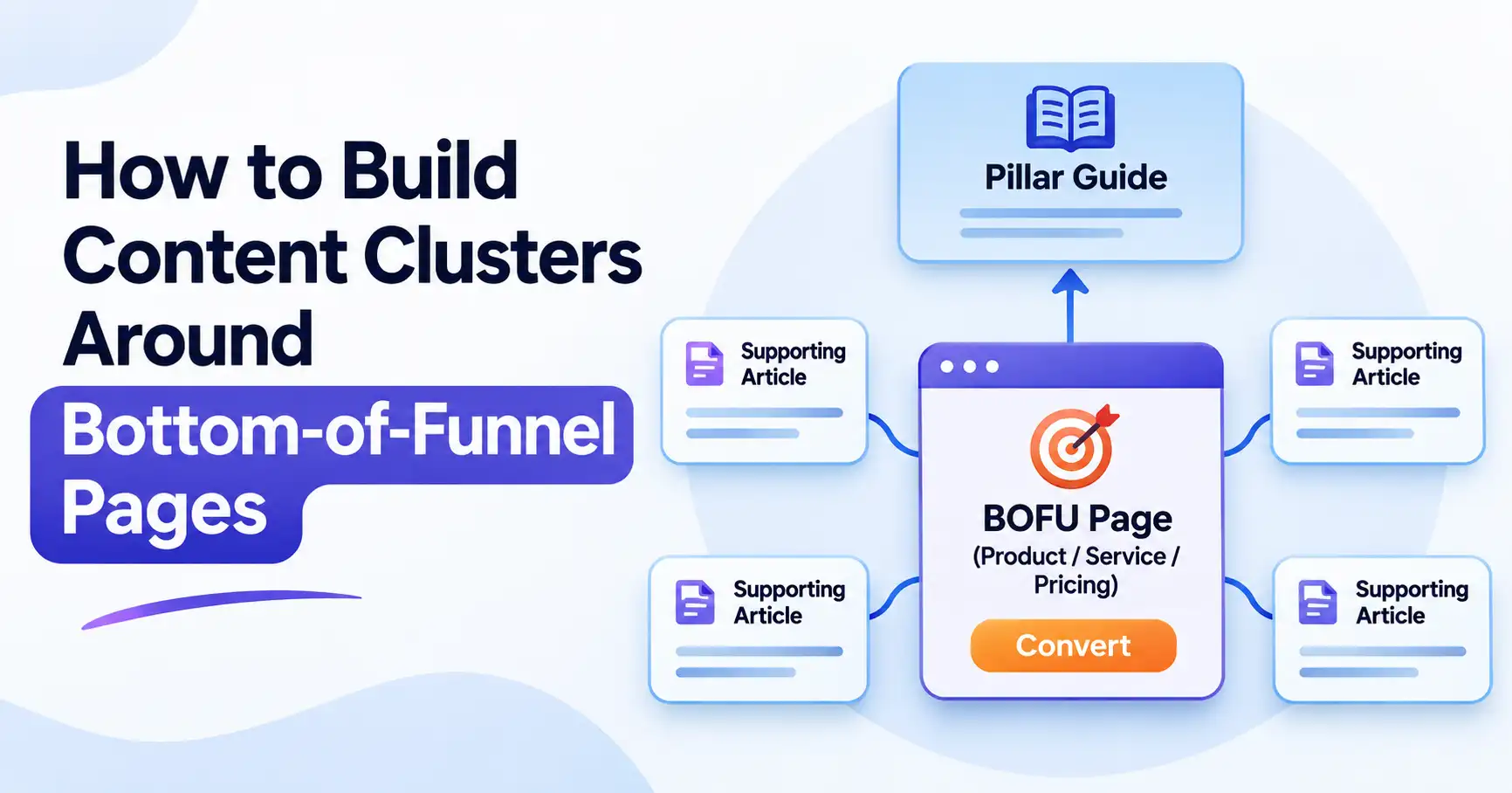
A bottom of funnel content cluster is a collection of related pages built around a commercial or conversion focused page.
Most clusters follow a three layer structure:
- BOFU page: A product page, service landing page, pricing page, or demo page designed to encourage a conversion.
- Pillar guide: A comprehensive resource covering the broader topic associated with the offering.
- Supporting articles: Focused blog posts that answer specific questions, explain use cases, and address customer concerns.
For example, an email marketing software company might build a content cluster around its email marketing platform page.
The pillar guide could cover email marketing fundamentals, while supporting articles explore segmentation, automation workflows, deliverability, and campaign optimization.
Each page targets a different search intent, but together they reinforce the same offering.
Why Build Content Clusters Around BOFU Pages?
Traditional content planning often begins with keywords that have attractive search demand. The problem is that high volume keywords don’t always attract people interested in your products or services.
A BOFU first approach changes how you plan content. Instead of starting with traffic opportunities, you begin with business priorities and work backward.
Connect informational content with commercial intent
Readers searching for educational content aren’t necessarily ready to buy. They may be trying to understand a problem, compare solutions, or figure out what to do next.
A helpful article can support that research process. When it links naturally to a relevant product or service page, readers have a clear next step if they’re ready to explore a solution.
Improve internal linking and content discovery
Internal links connect related resources and help search engines discover pages across your website.
Google also explains that descriptive internal links provide context about linked pages and help search engines understand site structure.
Keep content planning commercially relevant
Every supporting article should serve a purpose. It could answer a customer question, explain a use case, address an objection, or introduce a relevant solution.
This gives your content team a stronger basis for prioritization than publishing more articles simply to increase volume.
How to Build Content Clusters Around Bottom of Funnel Pages
Step 1: Identify your important conversion pages
Start by identifying the pages associated with your core offerings.
These may include:
- Product or software landing pages
- Service pages
- Pricing pages
- Demo or consultation pages
- Product comparison pages
Choose one page that represents an important business opportunity.
For example, a digital marketing agency might prioritize its SEO services landing page because it directly supports lead generation.
Before creating supporting content, check that the page clearly explains the service, addresses customer concerns, and includes an appropriate conversion action.
Step 2: Map the page to customer problems and use cases
Once you’ve selected a BOFU page, think about the problems customers are trying to solve before considering your offering.
For an SEO agency, those problems might include declining organic traffic, poor keyword rankings, technical SEO issues, or limited lead generation.
Each problem can point to a potential supporting article.
The important distinction is between questions that genuinely relate to your offering and topics that only have a loose connection to it.
Step 3: Research supporting keywords and search intent
Use keyword research tools, Google Search Console, competitor content, and customer conversations to uncover relevant searches.
Group keywords based on the questions and search intents behind them.
For example:
| Search intent | Supporting topic |
| Understand a problem | Why is organic traffic declining? |
| Learn a solution | How to improve website SEO |
| Evaluate approaches | Technical SEO vs. on page SEO |
| Prepare for a purchase | How to choose an SEO agency |
Don’t create separate articles for every keyword variation. When several searches reflect the same intent, a single comprehensive article may be a better fit.
Step 4: Create a pillar guide connected to the BOFU page
Your pillar guide should explain the broader topic that ties the supporting articles together.
For an SEO services page, a suitable pillar guide might be The Complete Guide to SEO.
It could introduce keyword research, technical optimization, content strategy, and link building, then link to more detailed articles covering each area.
The guide should also connect readers to the relevant SEO services page when they need professional support. That link should fit naturally into the discussion, rather than interrupting it with an unrelated sales pitch.
Step 5: Publish supporting articles that answer specific questions
Supporting articles add the depth that a pillar guide can’t provide on its own.
For an SEO services cluster, potential topics include:
- How to Conduct a Technical SEO Audit
- How to Find Keyword Opportunities
- How to Optimize Existing Blog Content
- How to Improve Internal Linking
- How to Measure Organic Search Performance
Each article should focus on one clear topic and address the search intent behind it.
Five closely related articles can be a useful starting point. Expand the cluster only when additional topics offer genuine value to your audience and business.
Step 6: Connect the cluster with strategic internal links
Internal links turn individual articles into a connected content cluster.
A straightforward linking framework can help:
- Supporting articles link to the pillar guide.
- Supporting articles link to the BOFU page where relevant.
- The pillar guide links to important supporting articles.
- Related articles link to one another when the connection benefits readers.
- The BOFU page links to helpful resources when they support buying decisions.
Use descriptive anchor text that makes the destination clear.
For instance, an article about technical SEO audits could link to an SEO services page using the anchor text “professional SEO services.”
Google’s link best practices recommend relevant, descriptive anchor text instead of generic phrases or unnecessarily long keyword heavy links.
Step 7: Audit existing content before publishing more
You may already have articles that fit the cluster. Reviewing them before creating new content can reveal opportunities to strengthen what you’ve published.
Look for:
- Articles that directly support the BOFU page
- Articles that need stronger internal links
- Topics that overlap with existing posts
- Outdated information that needs refreshing
- Customer questions that remain unanswered
Before publishing a new article, consider whether an existing page could be improved to satisfy the search intent more effectively.
For more guidance, read how to prioritize SEO content.
Example: An SEO Services Content Cluster
Imagine an agency targeting businesses that need SEO support.
Its content cluster might include:
BOFU page: SEO Services
Pillar guide: The Complete Guide to SEO
Supporting articles:
- How to Conduct a Technical SEO Audit
- How to Improve Existing Blog Content
- Keyword Research for Business Websites
- How to Build an Internal Linking Strategy
- SEO vs. GEO: Understanding the Differences
The technical SEO audit article could link to the pillar guide and, where appropriate, the SEO services page. The pillar guide would connect readers to the supporting articles while introducing the agency’s services.
This gives readers a relevant route from learning about SEO to exploring professional assistance.
The same structure can be applied to SaaS products, ecommerce categories, consulting services, and other conversion focused offerings.
How to Prioritize Content Within a Cluster
Not every supporting topic needs to be published immediately.
Evaluate potential articles using four factors:
| Factor | What to evaluate |
| Business relevance | Does the topic connect directly to an offering? |
| Search intent | Does it answer a genuine customer question? |
| Content opportunity | Can your website provide a useful, differentiated answer? |
| Conversion relevance | Is there a natural next step toward the BOFU page? |
Start with topics that closely connect to your offering and your customers’ buying decisions.
Broader informational topics can follow when they add meaningful depth to the cluster.
If you’re reviewing existing pages before publishing, make every page count before creating more content.
How to Measure BOFU Content Cluster Performance
Evaluate the cluster as a whole instead of judging every article solely by its traffic.
Several metrics can help you understand how it’s performing:
- Organic clicks and impressions: Are relevant pages appearing in search results?
- BOFU page visibility: Is the conversion page gaining organic exposure?
- Organic conversions: Are visitors submitting forms, requesting demos, or contacting the business?
- Assisted conversions: Does supporting content appear in users’ conversion journeys?
- Content engagement: Are readers exploring related pages?
Google Search Console can help track organic clicks, impressions, and queries for individual URLs.
Analytics tools can provide additional insight into conversion events and user journeys. However, attribution needs careful interpretation. A blog visit before a conversion doesn’t automatically mean that article caused the conversion.
Review performance regularly and use what you learn about search behavior and content engagement to refine the cluster.
Common Mistakes to Avoid
Building a content cluster isn’t about publishing as many articles as possible.
Avoid these common mistakes:
- Publishing supporting articles without a clear connection to the offering.
- Creating multiple pages targeting essentially the same search intent.
- Adding internal links that don’t help readers.
- Promoting products too aggressively within informational content.
- Measuring success only through total blog traffic.
- Overlooking existing articles that could be improved.
The objective is to create a coherent collection of useful pages, not an artificially large content network.
FAQ’s
A BOFU content cluster is a group of related informational and commercial pages organized around a conversion focused page, such as a product, service, or pricing page.
There’s no fixed number. Start with a pillar guide and a few closely related supporting articles. Add more content only when new topics offer meaningful value to readers and your business.
Yes, when the BOFU page represents an important offering. Creating or optimizing it first gives supporting content a clear destination and helps you identify relevant topics.
Content clusters can support better content organization, internal linking, and discoverability. They don’t guarantee rankings, though. Search performance also depends on relevance, content quality, competition, technical accessibility, and other factors.
Conclusion
Building content clusters around bottom of funnel pages requires a shift in how you approach content planning. Instead of publishing articles independently, organize them around the offerings your business needs to support.
Start with a conversion page, understand the questions customers ask, create a useful pillar guide, and develop supporting articles that address relevant search intent. Connect those pages through natural internal links, then measure their combined contribution to organic visibility and conversions.
Begin with one important offering. Audit the content you already have, identify the gaps, and build a cluster that helps readers move from understanding a problem to finding a solution.

Kumar Swamy is the CEO of Itech Manthra Pvt Ltd and a dedicated Article Writer and SEO Specialist. With a wealth of experience in crafting high-quality content, he focuses on technology, business, and current events, ensuring that readers receive timely and relevant insights.
As a technical SEO expert, Kumar Swamy employs effective strategies to optimize websites for search engines, boosting visibility and performance. Passionate about sharing knowledge, he aims to empower audiences with informative and engaging articles.
Connect with Kumar Swamy to explore the evolving landscape of content creation!