Have you noticed how Google Search is starting to feel less like a list of links and more like a conversation? That shift just got another push.
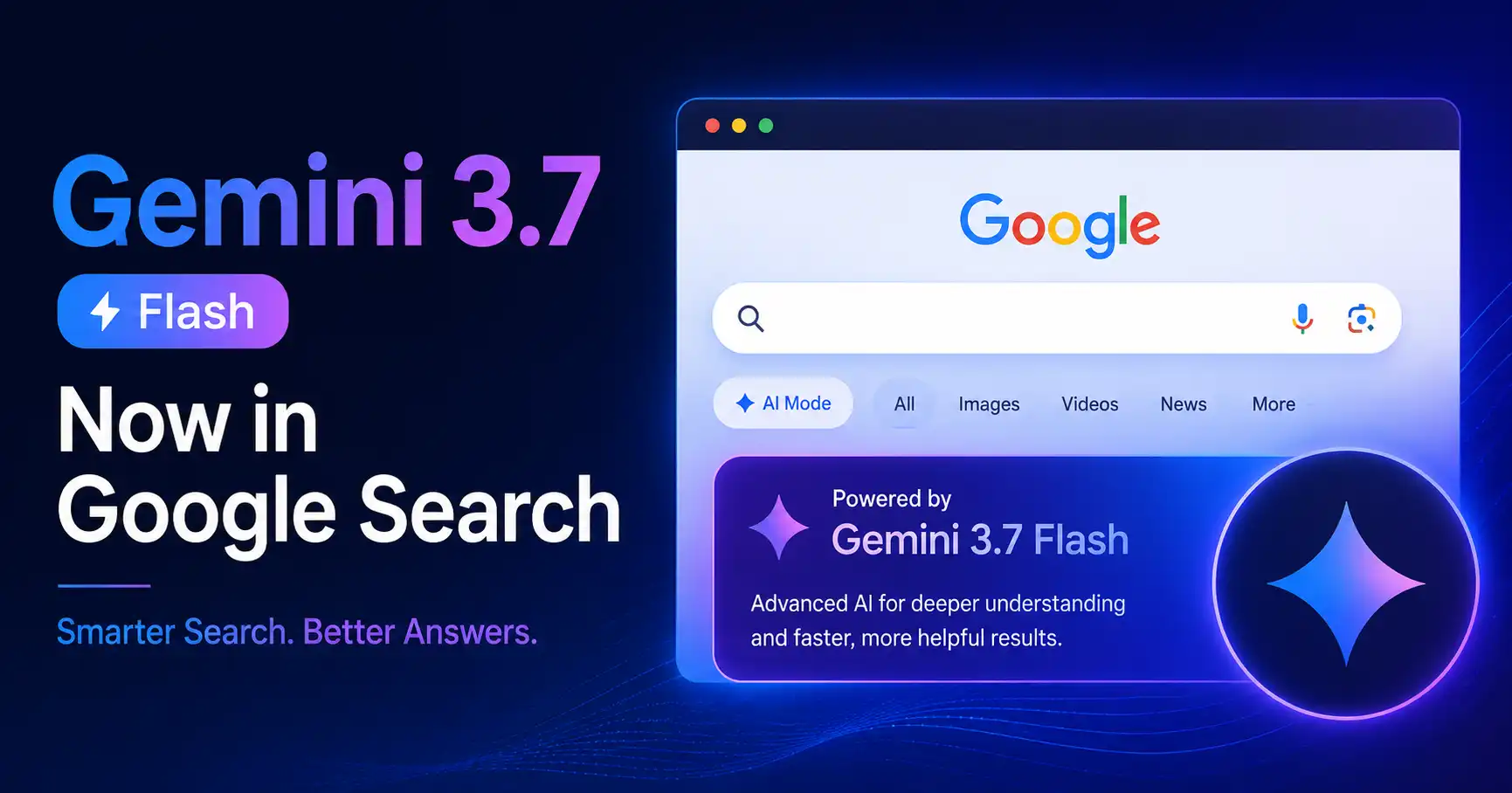
Google is rolling out Gemini 3.7 Flash in Google Search, bringing its newer workhorse AI model into AI Mode. The initial rollout is global for Google AI Pro and Ultra subscribers using English, giving users access to a model designed to better understand instructions, follow context, and handle more complex requests.
For everyday searchers, that could mean more useful answers with fewer follow up prompts. For marketers and website owners, though, there’s a bigger question: what does this mean for visibility in Google Search?
What is Gemini 3.7 Flash, and why is Google putting it in Search?
Gemini 3.7 Flash is Google’s latest Flash model, positioned as a fast, capable model for coding, agents, complex tasks, and knowledge work.
Google announced the model as its “most intelligent workhorse model yet,” with improvements aimed at first pass accuracy, instruction following, tool use, planning, and web development.
Now Google is bringing those capabilities into Search.
The important part isn’t simply that Google has a newer Gemini model. It’s where the model is being used. Search is one of Google’s biggest products, so even a relatively small improvement in AI reasoning or instruction following can change how people interact with search results.
Search Engine Land reported that Google confirmed Gemini 3.7 Flash is rolling out globally in AI Mode for Google AI Pro and Ultra subscribers in English.
That makes this more than another Gemini model release. It’s another step toward Google Search becoming an AI first discovery experience.
How does Gemini 3.7 Flash improve Google AI Mode?
The biggest improvement users are likely to notice is not necessarily a flashy new feature. It’s better understanding.
Google’s Robby Stein said the model improves AI Mode’s ability to follow instructions and understand user intent, which should lead to more helpful responses.
Think about a search such as:
“I’m planning a three day trip. Compare these destinations based on weather, cost, things to do, and travel time, then recommend one for a family.”
A traditional search engine would generally return pages for each part of the question. An AI powered search experience can attempt to understand the complete request and organize the information into one response.
That’s where Gemini 3.7 Flash becomes interesting.
Instead of treating every sentence as a separate keyword query, the model can better understand the relationship between the instructions.
For users, that can make Google AI Mode feel more natural. You don’t necessarily have to keep rephrasing your question just to get the search engine to understand what you meant.
Is Gemini 3.7 Flash available to everyone in Google Search?
Not yet.
The current rollout is aimed at Google AI Pro and Ultra subscribers, with English language AI Mode access. Google is rolling the model out globally to those eligible users rather than immediately putting it in front of every Google Search user.
To access Gemini 3.7 Flash, eligible users can enter AI Mode and use the model selector through the “+” option.
This phased approach is worth watching.
Google has a history of gradually expanding AI powered Search features after testing them with selected users. As Gemini models become more efficient, newer versions can potentially reach a much wider audience.
So, if you don’t see Gemini 3.7 Flash in your Google Search experience yet, that doesn’t necessarily mean something is wrong with your account.
The rollout itself is part of the story.
What does Gemini 3.7 Flash mean for SEO and AI search optimization?
This is probably the question website owners should care about most.
A better AI search model means Google can potentially understand complicated queries more effectively. That puts even more emphasis on content that clearly answers real user questions.
This doesn’t mean traditional SEO suddenly disappears.
Instead, AI search optimization becomes another layer of search visibility.
Content should be:
- Easy for users to understand
- Directly relevant to search intent
- Well organized with descriptive headings
- Supported by useful examples and evidence
- Written around real questions rather than keyword repetition
- Specific enough to provide genuine value
This also connects with the broader move from traditional keyword research toward conversational queries and Generative Engine Optimization. Clear, structured answers can make content easier for AI systems to understand and potentially reference.
As Google Search becomes better at understanding intent, stuffing the same keyword into every paragraph becomes even less useful.
The better approach is to explain the topic properly.
In other words, write for the person asking the question first, then make the content easy for search systems to interpret.
Will Gemini 3.7 Flash change AI Overviews and organic traffic?
Could be, yeah, but let’s not get ahead of ourselves. Gemini 3. 7 Flash, the buzz is, is hitting AI Mode only. So if you own a site, don’t just assume every AI Overview suddenly runs on that specific model. That’s a key detail. Google Search has a bunch of AI stuff going on. And the models behind it can shift depending on what you’re asking and what feature is in play. The big takeaway? Google’s still pouring money into AI for search. For publishers, it’s all about getting seen.
A user might discover a website through a traditional blue link, an AI generated response, a cited source, or a follow up inside AI Mode. That makes search visibility broader than simply asking, “What position does my page rank at?”
This is where Google Search AI changes the SEO conversation.
A page can be technically optimized and still miss opportunities if its content doesn’t provide the kind of clear, useful information AI powered search experiences need.
As one practical rule, don’t write an article simply because a keyword has search volume. Write it because you can give the searcher a better answer than the alternatives.
What should website owners do before Gemini 3.7 Flash expands?
Don’t panic and don’t rebuild your entire SEO strategy overnight.
Instead, start with the basics.
Review your important pages and ask:
Does this page answer the main question quickly?
Does it cover related questions naturally?
Are the facts clear and easy to verify?
Does the content demonstrate real expertise?
Could an AI system understand the main answer without digging through five paragraphs of filler?
This is also a good time to strengthen your AI search optimization strategy.
Use question based headings where they genuinely help. Add original examples, useful comparisons, first hand insights, and concise explanations. Build topical authority instead of publishing dozens of shallow pages.
As Google’s AI capabilities improve, content quality and clarity become increasingly important.
And there’s a useful lesson here: SEO isn’t being replaced by AI search. It’s becoming more multidimensional.
What does Gemini 3.7 Flash mean for the future of Google Search?
Gemini 3.7 Flash is another signal that Google wants Search to understand what people mean, not just what they type.
That’s a subtle difference, but it’s a big one.
Search users increasingly ask longer, more complicated questions. They expect comparisons, recommendations, summaries, explanations, and follow up conversations rather than ten blue links and a “good luck.”
Gemini 3.7 Flash is designed to make that interaction better by improving instruction following and intent understanding.
For users, that could make AI Mode more useful.
For publishers, it means the definition of search visibility is changing.
The websites that stand out won’t necessarily be the ones that use the most keywords. They’ll be the ones that provide information worth finding, understanding, trusting, and referencing.
FAQ’s
Gemini 3.7 Flash is Google’s newer workhorse AI model designed for fast, capable performance across tasks such as coding, agents, knowledge work, and complex instructions.
Yes. Google has started rolling it out in AI Mode for Google AI Pro and Ultra subscribers in English.
Eligible users can open AI Mode and use the “+” model selector to choose Gemini 3.7 Flash.
No. It’s part of Google’s expanding AI powered Search experience. Traditional search results and AI powered experiences can continue to coexist.
Rather than optimizing for one specific model, focus on clear, useful, authoritative content that satisfies search intent and is easy for both people and AI systems to understand.
Conclusion
Sure, Gemini 3. 7 Flash heading to Google Search looks like just another model upgrade. But the real story? Search is getting conversational, driven by what you actually mean.
Users should expect sharper AI Mode replies. For anyone running a website, it’s a fresh nudge: SEO isn’t just about rankings anymore; it’s about being seen everywhere AI search happens.
Don’t just chase every new model. Instead, craft content that’s genuinely helpful. Answer questions with crystal clarity. Make your expertise easy to grasp.

Kumar Swamy is the CEO of Itech Manthra Pvt Ltd and a dedicated Article Writer and SEO Specialist. With a wealth of experience in crafting high-quality content, he focuses on technology, business, and current events, ensuring that readers receive timely and relevant insights.
As a technical SEO expert, Kumar Swamy employs effective strategies to optimize websites for search engines, boosting visibility and performance. Passionate about sharing knowledge, he aims to empower audiences with informative and engaging articles.
Connect with Kumar Swamy to explore the evolving landscape of content creation!