Have you ever found a product you liked, then spent another 30 minutes checking reviews comparing prices watching videos, and searching a few more questions before finally buying it.
That little hesitation says a lot about how people search today.
Customers rarely move from one Google result straight to a purchase. They bounce around between Google, AI tools, YouTube, reviews, social media, communities and brand websites. Each step tries to answer one simple question, “Can I trust this choice?”
That’s why understanding how customers build confidence across the search journey is getting increasingly important for marketers. Search isn’t only about being visible anymore. It’s also about being useful at every moment, during the whole decision pathway, you know.
Google research found that consumers sometimes feel overwhelmed by choices, and information even when the right details can boost confidence while purchasing. So you end up with a search journey where trust, usefulness and fitting context can weigh as much as the rankings themselves.
For brands, the message is pretty plain: visibility grabs attention, but confidence moves action.
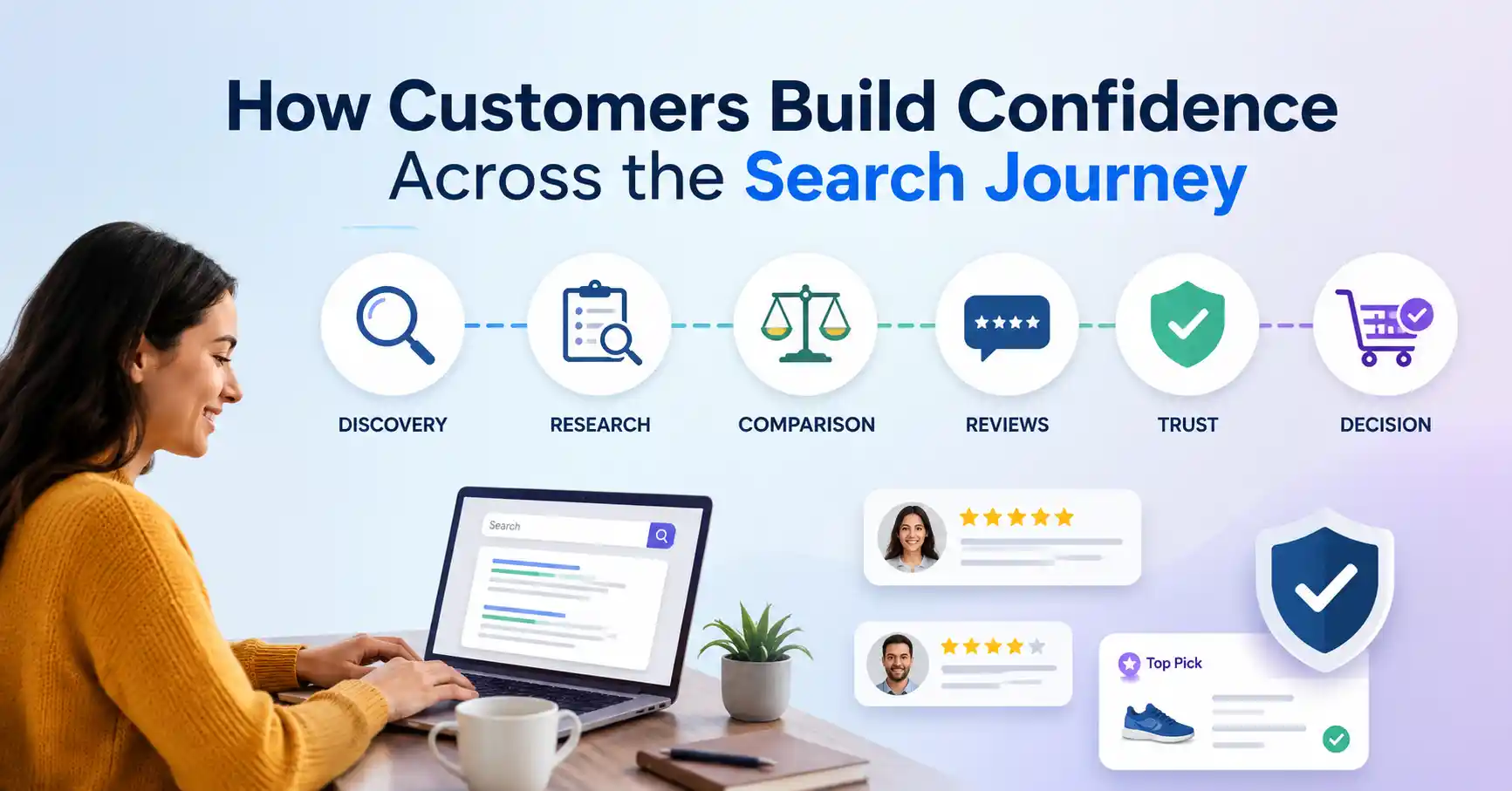
How do customers build confidence across the search journey?
- Discovery: Customers begin by searching for answers, products, services, or a practical solution around a problem.
- Exploration: They dig into different options, and they try to judge which features, advantages, or remedies are really available.
- Research: Customers usually want detailed information to see if a certain choice really matches what they actually need, not just what it claims.
- Comparison: They weigh brands, price tags, features, specifications, reviews, and related alternatives before settling on something.
- Validation: Customers frequently look for reviews, testimonials, expert perspectives, live demos, and real experiences that feel believable in everyday use.
- Trust building: Keeping the same message across Google, websites, social platforms, marketplaces and other spots reduces hesitation fast.
- Decision: Once enough questions get answered, people often feel steadier when picking a product, a service, or a brand.
- Post purchase confidence: If things work out after purchase, confidence increases. Customers are more likely to return, recommend the company, or search it again using their usual habits.
The key part here is that this journey is not perfectly linear. It never holds to one straight line either.
A customer might find your business today, compare you with three competitors tomorrow, read reviews next week, then later come back through a branded search before purchasing.
So, businesses shouldn’t create only buyer ready material, like it is meant for closing alone.
Content really needs to back up the whole customer journey from beginning to end.
Why does search intent matter when building customer confidence?
Search intent is the reason someone does a search in the first place.
When someone types “what is CRM software?” they are usually looking for learning. Then “best CRM for small business” points to someone thinking through options, comparing capabilities, maybe checking multiple vendors.
A query like “CRM software pricing” often means the person is nearer to a decision already. They may not be only browsing around.
When brands understand those differences, they can produce content that matches what people actually need at that exact moment.
Rather than shoving out endless generic posts, businesses can craft content that follows the customer route in a more natural way. It should not just repeat the same headline everywhere.
You know, like it matches the journey in small steps:
- Educational guides for when people are just starting to research
- Comparison pages for folks weighing options and tradeoffs
- Pricing pages for searches that are clearly close to choosing
- Case studies for extra credibility, trust, and proof in context
- Reviews and testimonials for reassurance, especially when doubt shows up
- Product demonstrations when customers want to see it working, not just read about it
- FAQs to remove those last doubts before purchase
This is where SEO becomes more useful than endlessly chasing keywords. You don’t want to keep hoping the rankings will magically behave.
The main point isn’t to answer the exact same question again and again. It is more about anticipating, you could say, the next question the customer will ask.
Why are reviews, comparisons and real experiences so important?
- Reviews add social proof: Lots of customers lean on other buyer experiences because they are not getting the message directly from the brand itself.
- Comparisons reduce uncertainty: When you see things side by side, it gets easier to notice the actual difference between competing products or services.
- Real experiences give it weight: Customer stories show how something behaves in daily use away from the polished marketing world.
- Independent opinions build trust: People often leave a company website and go to YouTube, Reddit, marketplaces, discussion boards, and review focused websites.
- Even negative feedback helps: A brand that answers criticism plainly can look more dependable than a brand that pretends everything is flawless.
- Thorough product details support the claim: Specs, pricing, service terms, warranties, and small live demonstrations let customers verify what they heard somewhere else.
- Trust signals mix together, not by themselves: One review alone rarely flips the decision, but steady matching details across a few places makes the choice feel more secure overall.
- Real authenticity actually matters: Most people can tell the difference between true lived experience and made up, overly polished marketing claims.
Why does social proof matter during the search journey?
This gets even more important because the current search journey is sort of fractured. It is spread across several lanes.
Someone might land on a product through Google. Then they may watch a YouTube assessment, ask an AI assistant for alternatives, and open Reddit to find out what real users are saying.
A brand cannot really control every one of those conversations. It can make sure the information customers run into is correct, useful and coherent.
As Google’s people first guidance emphasizes, the material should be mostly for helping users, not just there to bend search rankings.
That sensible principle still applies outside SEO too: help people choose better, and then discoverability becomes way more meaningful.
How does AI nudge consumer behavior during search?
- AI is going faster on research: People can ask AI tools to give a brief summary of a tough topic, instead of wrestling with a stack of pages.
- AI can make short lists: Shoppers can ask for recommendations using features, price brackets, real world use cases, or personal preferences.
- Customers can compare more quickly: AI helps highlight differences between products, services, and competing options.
- Search feels more conversational: Users can ask whole questions instead of depending on a couple keyword phrases.
- AI still does not remove validation: Customers might still check reviews, company websites, videos, and other evidence before they make a serious purchase.
- Brand details have to remain consistent: Mismatched information across sites and platforms can wear down confidence when AI and search systems summarize a brand.
- Useful content has more chances to get seen: Clear breakdowns, original analysis, side by side comparisons, and specific answers can make it easier for people to understand what a brand actually stands for.
- Trust is still crucial: A fast AI recommendation is not automatically sufficient, especially for an expensive or higher risk purchase.
- The customer journey is getting more scattered: Search, AI, social media, video, and community spaces can all blend into one long decision cycle.
- Marketers need to look past the usual rank list: It is becoming just as important to be shown in the right way across the wider search ecosystem.
Why does AI still need trustworthy brand information?
Google’s research also showed more regular use of AI powered search experiences for shopping and deciding.
This does not mean traditional search disappears. Instead, customers now get an extra route to check, measure, and evaluate options.
So that creates a pretty good opening for brands.
Instead of only asking, “How do we rank number one?”, marketers should also wonder, “If an AI assistant summarizes our company, will it have enough practical details to describe us correctly?”
What can brands do to improve the customer experience?
A better search journey does not have to depend on complex technology. It can start smaller.
First, figure out what customers need to know before they feel ready to purchase.
Then, pay attention to what your sales team keeps hearing. Review customer support conversations, and watch what people ask when they search.
Check competitor comparison pages too. Stay aware of reviews, forums, and community discussions.
After that, convert those questions into helpful content that actually answers them.
For example, if customers keep asking whether your product is suitable for beginners, don’t bury the response inside a long product page. Put a straightforward explanation where it can be found easily.
If people keep comparing your product to a competitor, make a helpful comparison page.
When customers pause because they do not really get how pricing works, explain the entire pricing model clearly, not in a blurry way.
For those who need evidence, give real proof like real examples, actual screenshots, real numbers, or specific results.
This approach helps both SEO and the customer experience. You are dealing with actual frictions instead of publishing content only because a keyword tool nudged it, you know.
Does more visibility always turn into trust automatically?
No.
A company might show up first, yet still lose the buyer.
Why does that happen?
Because visibility answers “Can I find you?”
Trust answers “Should I choose you?”
Imagine you are browsing for a laptop and you see two brands on the screen.
One has a polished website with tons of sweeping claims about being “industry leading”. The other one includes granular specs, customer reviews, comparison notes, warranty terms, and direct answers to the usual questions.
Which one feels safer for the buyer?
Most people choose the second option.
That is why SEO, content marketing, and brand trust need to sit in the same lane together. They should not each do their own thing.
Search visibility can pull in the right people. Helpful information gives them a reason to keep moving and make progress.
Google’s people first content guidance also makes it clear that original, truly useful information has real weight. It should be made for people, not just built mainly to chase rankings or tug at algorithms.
In practice, don’t only publish content that earns a click.
Publish content that makes the next choice easier, more straightforward to evaluate, and less annoying.
What does the future of the search journey look like?
- Search will get more conversational: People will ask longer, more natural questions instead of only firing off short keyword phrases.
- AI will act like another research layer: Customers will use AI alongside classic search, social, video, and review sites. Some steps that used to live in separate tabs may get stitched together in the flow.
- Customers will want faster answers: Those long research loops might feel more compressed because AI can summarize and compare information.
- Trust will remain the deciding factor: Faster answers do not automatically make customers trust what they see, even when the response sounds polished.
- Cross platform validation will keep mattering: Especially for big purchases. People will continue checking reviews, communities, videos, websites, and other sources.
- Brand consistency will also get more important: Both customers and AI systems need to locate reliable information wherever they look.
- Original know how will matter more: Brands with real experience, research, data, and useful perspectives can rise above generic content that feels interchangeable.
- Discoverability is going to get wider: Appearing only in classic search results may not be the main win anymore.
- Customer experience will shape future searching: If the buying journey runs smoothly, repeat searches, referrals, and steadier loyalty become more likely.
- The brands that win will shrink uncertainty: Firms that make research easier and decisions clearer will have a better shot at converting people.
The future probably isnt just “Google versus AI.” People make it sound cleaner than it is.
It’s more tangled than that, in real life.
Customers will grab whatever tool helps them answer the very next question. They might start with an AI assistant, then jump to Google for checking.
Next, they could watch a video to see the product in motion. After that, they may read reviews for calm confidence and finally land on the company website.
Tools will evolve, sure.
But the need for confidence, that won’t.
How can businesses prepare for a shifting search journey?
The most practical way is to map your content to the questions customers ask in each phase.
Start with discovery questions. Then move into research, comparison, validation, and purchase questions.
Make key details easy to spot. Keep facts aligned and use authentic customer experiences.
Refresh anything outdated. Do not conceal meaningful limits or terms.
Above all else, write for someone who is really trying to decide.
As Google researchers have stressed again and again, relevance is what counts. People want details that fit their particular situation, not just content that includes the right keywords.
This idea becomes even more crucial once AI changes the way information gets found and then summarized.
So for companies, it means the future of SEO is not only about publishing more pieces.
It’s about delivering better answers, not only louder pages.
FAQ’s
The customer search journey is the chain of searches, comparisons, reviews, and small interactions a person moves through before deciding whether to buy from a brand.
Strong visibility can bring people in, but confidence helps them follow through. Helpful information, customer reviews, demonstrated expertise, and steady brand cues can reduce doubt.
AI can reduce the time spent researching by summarizing details, weighing alternatives, and crafting recommendations. People may still check bigger choices via search, reviews, videos and sources they already trust.
Trust tends to build when the details feel clean and specific, when feedback is genuine and not a little suspicious, when costs are displayed in a straight forward way, and when side by side comparisons actually do something useful.
Expert writing, true lived experiences, and even consistent communication across channels can also matter more than people think.
Yes. Businesses should keep strong SEO fundamentals in place while also putting out material that is clear, authoritative, and genuinely helpful, so it can be understood and surfaced through AI driven search experiences.
Conclusion: Confidence is the real destination
Customers do not gain confidence from just one single search result.
They grow it slowly by stacking tiny assurances, like a useful response, a trustworthy review, a direct comparison, a handy video, steady facts, and then a purchase experience that lines up with what they were promised.
So today’s SEO should not fixate only on stealing the first click.
Instead, it should try to remain valuable across the whole journey, every step.
When brands understand search intent, respond to shifting consumer behavior, strengthen brand trust, and improve the overall customer experience, they usually end up with a better chance to turn visibility into action.
And as search becomes more conversational and increasingly AI assisted, customer confidence might become one of the most meaningful advantages a brand can build.

Kumar Swamy is the CEO of Itech Manthra Pvt Ltd and a dedicated Article Writer and SEO Specialist. With a wealth of experience in crafting high-quality content, he focuses on technology, business, and current events, ensuring that readers receive timely and relevant insights.
As a technical SEO expert, Kumar Swamy employs effective strategies to optimize websites for search engines, boosting visibility and performance. Passionate about sharing knowledge, he aims to empower audiences with informative and engaging articles.
Connect with Kumar Swamy to explore the evolving landscape of content creation!