Managing Google Merchant Center accounts for a handful of clients is one thing. Managing dozens — or hundreds — is a completely different headache. If you’re an agency handling Google Shopping, product feeds, and ecommerce advertising, you’ve probably wondered how far Google’s new agency setup can actually scale.
Now we have a clearer answer.
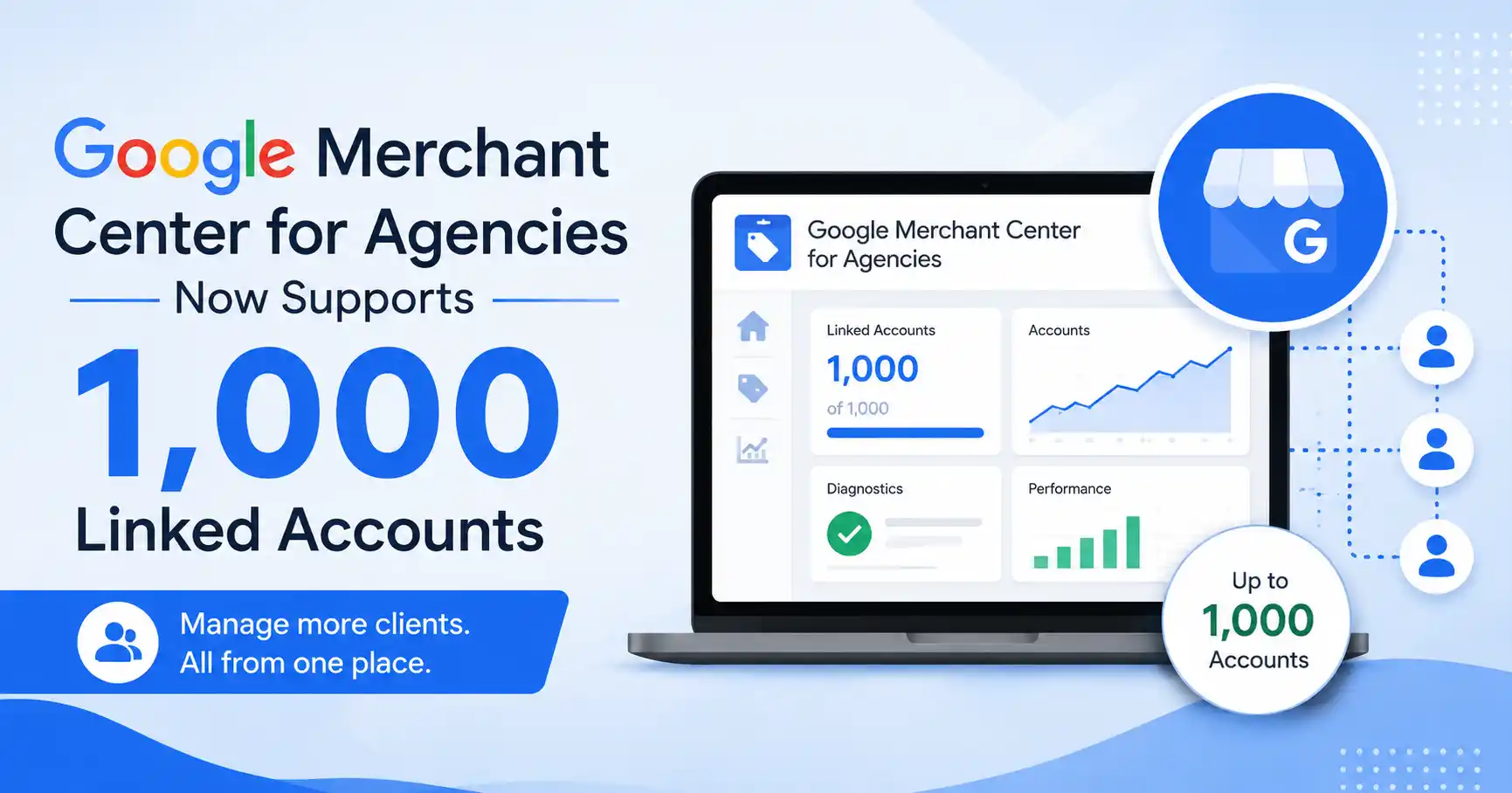
Google has clarified that Google Merchant Center for Agencies can link up to 1,000 client Merchant Center accounts under one agency account. The change doesn’t add a flashy new button or campaign type. Instead, it removes a big question mark for agencies planning their account structure and growth.
And honestly, that number matters more than it might sound.
What exactly changed in Google Merchant Center for Agencies?
The main change is simple: Google has now documented a maximum of 1,000 linked client accounts for a Merchant Center for Agencies account.
Previously, agencies knew the platform was designed for managing multiple clients, but the upper limit wasn’t clearly documented. Google’s updated guidance now gives agencies a concrete ceiling to plan around.
That’s particularly useful for large digital marketing agencies, ecommerce agencies, PPC teams, and businesses managing a growing portfolio of retailers.
It’s also important to understand what this update doesn’t mean. Google hasn’t announced that an individual Merchant Center account can suddenly contain 1,000 sub accounts. This is about the number of client Merchant Center accounts that can be linked to an agency account.
That distinction is easy to miss.
For agencies, though, the practical benefit is obvious: more clients can be brought into one centralized management environment.
Why does the 1,000 account limit matter for agencies?
The biggest benefit is scalability.
Imagine an agency managing 150 ecommerce clients. Previously, the team had to think carefully about account access, client permissions, diagnostics, product issues, and switching between accounts. As the client list grows, simple account management can become surprisingly messy.
Merchant Center for Agencies is designed to put that work into one central hub. Google describes the platform as a way for agencies to manage multiple client accounts and user permissions from one place.
That can make Merchant Center account management much easier.
Instead of treating every client as an isolated workspace, agencies can build a more organized portfolio.
The agency overview can also surface account statuses, issues, diagnostics, and changes in important metrics. Google says its diagnostics tools can help agencies filter issues by client, country, or marketing method and prioritize problems based on potential click impact.
As Google’s own guidance effectively emphasizes, the goal is centralized management rather than forcing agencies to juggle access account by account.
For a small agency, that’s convenient.
For a large agency, it can become operationally important.
How does Google Merchant Center for Agencies handle client access?
This is where the update gets more interesting.
The platform isn’t simply a giant list of client accounts. Google has introduced a role based access model that separates agency level permissions from client level permissions.
There are two primary agency roles: Admin and Standard.
Agency Admins can link and unlink client accounts, manage agency users, and control access. Standard users have more limited access and can be assigned specific client accounts through labels or direct permissions.
This matters when an agency has different teams working on different clients.
For example, an agency could have:
- One team managing fashion ecommerce clients
- Another handling electronics brands
- A PPC team monitoring Google Shopping campaigns
- Senior managers overseeing the entire portfolio
Instead of giving everybody access to everything, agencies can use labels to organize access to specific groups of clients. Google says labels can be assigned to client accounts and then used to grant Standard users access to selected groups.
That’s a much cleaner approach than sharing access manually every time someone joins a project.
What does this mean for Google Shopping management?
For agencies running Shopping campaigns, the bigger opportunity is operational rather than purely technical.
A larger linked account capacity means an agency can keep more clients inside one agency structure while monitoring product related problems across its portfolio.
This becomes especially useful when product feed optimization is part of the agency’s regular workflow.
A product feed problem might look small from the outside — missing attributes, disapproved products, incorrect pricing, availability problems — but those issues can directly affect product visibility and advertising performance.
Google’s agency dashboard is built around identifying these problems across client accounts rather than making teams discover them one account at a time.
For agencies managing hundreds of stores, that portfolio level view could save a considerable amount of repetitive checking.
And when product issues affect Google Shopping visibility, faster detection can mean faster fixes.
Does the update replace multi client accounts?
Not exactly.
This is an important point that can easily get lost in the headline.
Multi client accounts (MCAs) and Merchant Center for Agencies serve related but different purposes.
Google’s current documentation says an agency can link a client’s MCA in the same way it links a single Merchant Center account. Sub accounts inside that MCA can also inherit labels from the parent level, while additional labels can be applied directly to individual sub accounts.
So agencies don’t necessarily need to abandon their existing account structures.
Instead, Merchant Center for Agencies can act as a broader management layer for client relationships and access.
Think of it this way: an MCA can help organize a merchant’s account structure, while the agency environment helps the agency manage its overall client portfolio.
That distinction becomes increasingly useful as an agency grows.
What should agencies do with the new 1,000 account capacity?
Don’t rush to link every account just because Google gives you room to do so.
The smarter approach is to create a clean operating structure first.
Start by grouping clients based on business type, region, team ownership, or service level. Then use labels to control which employees can access which accounts.
It’s also worth reviewing who actually needs Admin access. Google notes that an Agency Admin automatically gets access to linked accounts, while Standard users can receive more focused access.
For agencies, this can improve both security and day to day efficiency.
A practical structure could look like this:
- Agency Admins: leadership and senior account managers
- Standard users: specialists handling assigned clients
- Labels: teams, regions, industries, or priority groups
- Client access: Admin or Standard + performance and insights
- Diagnostics: regular portfolio wide checks
- Product feeds: ongoing monitoring and optimization
The 1,000 account limit gives agencies plenty of room to grow, but organization is what will determine whether that scale actually feels manageable.
FAQ’s
A Merchant Center for Agencies account can link up to 1,000 client Merchant Center accounts, according to Google’s updated documentation.
No. The 1,000 figure refers to client Merchant Center accounts linked to the agency account. MCA sub account limits are governed separately.
Yes. Agency Admins can use labels and role based permissions to give Standard users access to selected client accounts.
Google announced general worldwide availability in May 2026.
It gives agencies a clearly documented capacity for scaling client account management while providing centralized visibility, permissions, diagnostics, and portfolio management.
Conclusion : What is the bigger takeaway for agencies?
The interesting part of this announcement isn’t really the number 1,000.
It’s what the number tells us about Google’s direction.
Merchant Center for Agencies is becoming a serious management layer for agencies rather than just another way to access individual merchant accounts. Google made the platform generally available worldwide in May 2026, highlighting centralized management, portfolio oversight, proactive issue resolution, and client performance improvements.
Now there’s a clearly documented capacity of up to 1,000 linked client accounts.
That gives larger agencies something they didn’t have before: a clearer picture of how far they can scale their Google Merchant Center operations inside Google’s own ecosystem.
As agencies handle more ecommerce brands, Google Shopping management, product feeds, diagnostics, and account permissions will only become more complex.
The agencies that build a sensible structure now will be in a much better position to scale without turning Merchant Center into a never ending spreadsheet of passwords, permissions, and client tabs.

Kumar Swamy is the CEO of Itech Manthra Pvt Ltd and a dedicated Article Writer and SEO Specialist. With a wealth of experience in crafting high-quality content, he focuses on technology, business, and current events, ensuring that readers receive timely and relevant insights.
As a technical SEO expert, Kumar Swamy employs effective strategies to optimize websites for search engines, boosting visibility and performance. Passionate about sharing knowledge, he aims to empower audiences with informative and engaging articles.
Connect with Kumar Swamy to explore the evolving landscape of content creation!