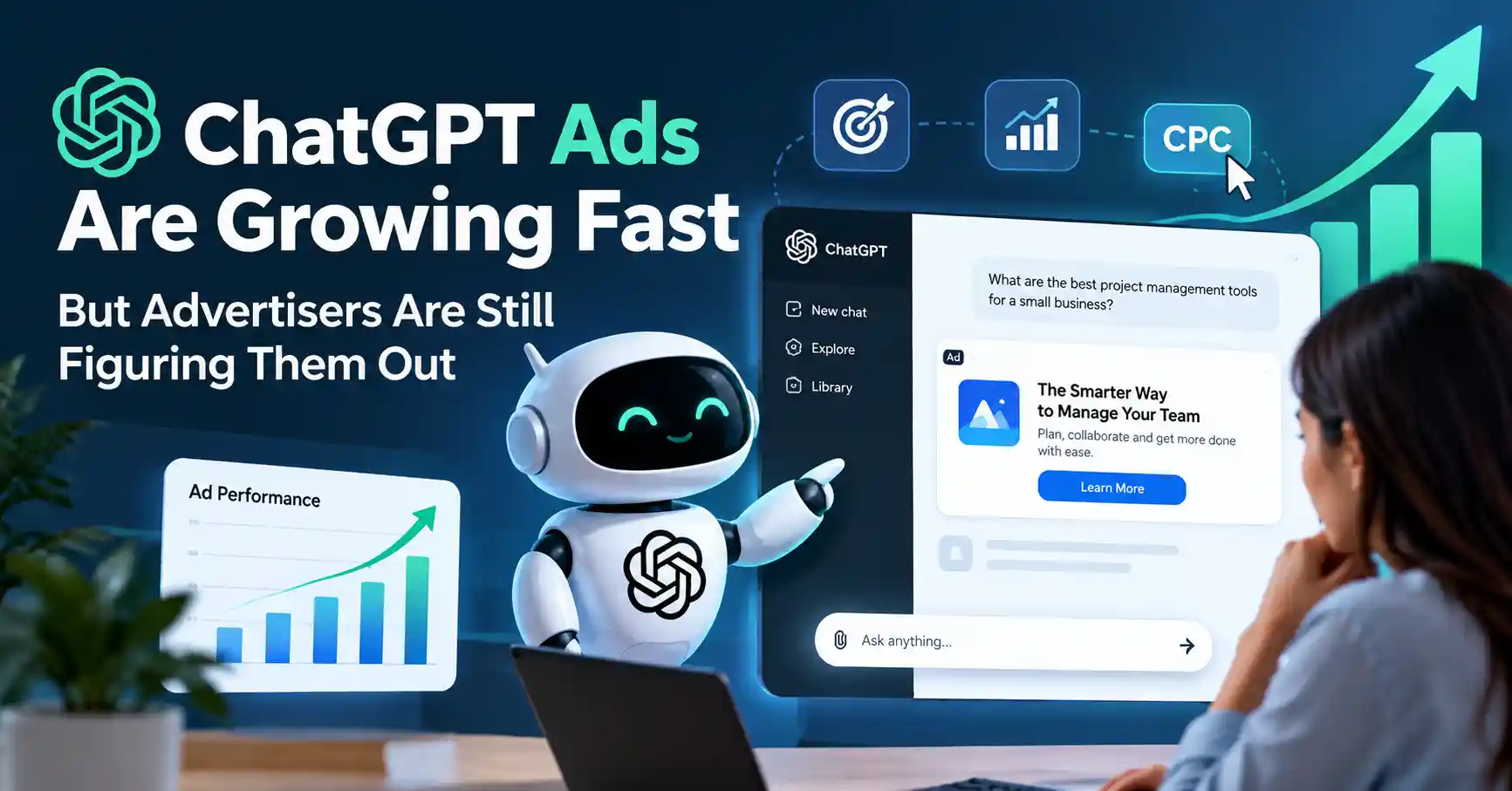
What happens when advertising moves from a search box into an actual conversation?
That’s the question marketers are starting to answer as ChatGPT Ads move beyond the experimental stage. What began as a relatively small advertising test has quickly turned into a serious new channel, with more advertisers, new buying options and a growing number of brands trying to understand what actually works.
A recent report from Search Engine Land, based on research from Graphite and Similarweb, shows just how quickly the market is developing. Six months after launch, 43% of ad eligible ChatGPT users in the U.S. had reportedly seen an ad, while the platform had reached a $1 billion annualized revenue run rate and attracted tens of thousands of advertisers.
But there’s an interesting catch: advertisers are spending money before the playbook is fully written.
That makes ChatGPT advertising one of the more interesting areas to watch in digital marketing right now.
Why are ChatGPT Ads growing so quickly?
The biggest difference between ChatGPT Ads and traditional search advertising is the environment in which the ad appears.
On Google, someone typically types a keyword and receives a page of results. On ChatGPT, the person can explain the problem in detail, compare alternatives, mention a budget and ask follow up questions. That gives the advertising system considerably more conversational context.
OpenAI says its ads system considers the context of the current conversation and, depending on location and user settings, certain signals from a user’s broader ChatGPT experience. Ads are also designed to remain separate from ChatGPT’s answers.
That distinction is important.
A person asking, “What CRM should a 20 person sales team use?” isn’t simply revealing a keyword. They’re revealing a business size, use case and buying situation.
That creates a different kind of advertising opportunity.
OpenAI has also expanded the platform quickly. Ads Manager introduced self serve campaign management, while CPC bidding and additional conversion measurement tools made ChatGPT Ads more familiar to performance marketers.
What are advertisers still trying to figure out?
This is where the current ChatGPT Ads story gets interesting.
According to the Search Engine Land report, Graphite and Similarweb analyzed more than 98,000 ads and 8,000 landing pages to understand how early advertisers are approaching the channel. The findings suggest that many businesses are still experimenting with creative, landing pages and campaign strategy rather than following an established formula.
In other words, advertisers know people are there. They know the intent can be valuable. But they’re still learning what makes someone click.
That isn’t unusual for a young advertising platform.
Google Ads has had decades to develop its targeting, bidding, creative and attribution systems. Meta has built an enormous ecosystem around audience signals and optimization.
ChatGPT Ads are still being shaped.
For marketers, that means copying an existing Google Ads campaign and putting it into ChatGPT Ads may not be enough.
The better question is: what does advertising look like when the customer is already having a conversation?
How is ChatGPT ad targeting different from traditional advertising?
Traditional paid search is heavily connected to keywords.
Conversational advertising is more dependent on context and intent.
Imagine two people searching for “project management software.”
One may simply be researching the category. Another may be comparing tools for a 50 person company and looking for integrations with Slack and Microsoft Teams.
The words may overlap, but the intent is different.
That’s why ChatGPT ad targeting is becoming an important concept for marketers. OpenAI describes its system as using conversational context to identify when an advertisement may be relevant to what someone is exploring.
OpenAI’s advertising guidance also recommends clear, specific and benefit focused messaging rather than generic copy. It encourages advertisers to create multiple distinct variations so the system has more opportunities to find relevant situations for an ad.
This changes the creative mindset.
Instead of writing one broad advertisement for everyone, brands may need several messages that answer different customer needs.
For example:
- A price conscious customer may care about affordability.
- A business buyer may care about integrations.
- A beginner may care about simplicity.
- An experienced user may care about advanced features.
The ad needs to make sense in the conversation, not simply win a keyword auction.
What does ChatGPT Ads Manager tell us about the future?
The evolution of ChatGPT Ads Manager is perhaps one of the clearest signals that OpenAI isn’t treating advertising as a short term experiment.
OpenAI introduced self serve Ads Manager in beta, allowing advertisers to register, add payment details, set budgets and bids, upload advertisements, launch campaigns and review performance. CPC bidding was added alongside existing CPM buying, while pixel based measurement and Conversions API expanded the ability to measure actions after an ad interaction.
That makes the platform look increasingly familiar to digital marketers.
But the underlying environment is different.
OpenAI’s own advertising platform now emphasizes reaching people while they’re exploring options, comparing alternatives and making decisions.
That’s a meaningful shift from simply placing an advertisement beside a search result.
For marketers who want to experiment, the official ChatGPT Ads platform provides access to the current advertising setup.
If you’re completely new to the channel, you can also see our practical guide on how to run ChatGPT Ads in 2026 before planning a campaign.
What should brands change in their ChatGPT advertising strategy?
The early evidence suggests that advertisers shouldn’t treat ChatGPT advertising as just another copy of Google Ads.
Start with the customer question.
What does someone ask ChatGPT immediately before they might need your product?
That question can be more useful than simply asking which keyword has the highest search volume.
Then build different creative angles around those situations. OpenAI itself recommends using a broader set of distinct ad variations rather than repeatedly saying the same thing.
Landing pages matter too.
If an ad promises a specific benefit but sends the user to a generic homepage, the experience becomes disconnected. A focused landing page should continue the same conversation the advertisement started.
Measurement is equally important.
Clicks alone won’t tell the whole story. Advertisers should watch conversions, qualified leads, purchases and other meaningful actions where tracking is available.
As OpenAI puts it, stronger measurement signals can help advertisers optimize toward real outcomes rather than impressions alone.
And there’s another development worth watching: OpenAI is testing Sponsored Agents, where clicking an advertisement can begin a conversation with a business sponsored AI agent. That moves advertising another step away from the traditional “click ad → visit landing page” model.
We’ve covered what that could mean for marketers in our analysis of OpenAI ChatGPT Ads and Sponsored Agents.
Is AI advertising becoming a new performance channel?
The numbers suggest that advertisers are taking the channel seriously, but the market is still young.
OpenAI reported in August that ChatGPT Ads had reached a $1 billion annualized revenue run rate in less than 200 days and were being used by tens of thousands of advertisers. It also said the platform had expanded to more than 40 countries, with self service access expanding across regions including India.
Those numbers show scale. They don’t, by themselves, prove that ChatGPT Ads will outperform established advertising platforms.
That’s an important distinction.
The more interesting development is the advertising model itself.
AI advertising can place a brand in the middle of a decision making conversation. Instead of interrupting someone while they browse, the advertisement can appear when the person is already exploring a problem, comparing options or deciding what to do next.
That’s a fundamentally different context.
And advertisers are still learning how to use it.
For now, the smartest approach is experimentation: test different messages, understand conversational intent, build focused landing pages and measure actual business outcomes rather than getting distracted by early vanity metrics.
FAQ’s
ChatGPT Ads are sponsored advertisements that appear within the ChatGPT experience. OpenAI says they are clearly labeled and kept separate from ChatGPT’s answers.
ChatGPT ad targeting uses contextual signals from conversations to identify advertisements that may be relevant to what a user is exploring. Depending on the market and settings, additional signals may also be used.
ChatGPT Ads Manager is OpenAI’s self serve advertising platform. Advertisers can create campaigns, manage budgets and bids, upload creative and review campaign performance.
No. Both are paid advertising channels, but ChatGPT Ads operate inside a conversational AI environment. The emphasis is more closely tied to conversational context and decision making rather than traditional keyword based search alone.
The platform is relatively new, so marketers are still testing creative formats, targeting approaches, landing pages, bidding strategies and measurement methods. The current research indicates that there isn’t yet a mature, universal playbook.
Conclusion
ChatGPT Ads have moved remarkably quickly from a new experiment to a growing advertising ecosystem. The platform now has self serve buying, CPC bidding, conversion measurement and a rapidly expanding advertiser base.
Yet the most important lesson from the latest research may be that nobody has completely figured out the formula yet.
That creates both uncertainty and opportunity.
For marketers, the next stage of ChatGPT advertising won’t simply be about buying more impressions. It’ll be about understanding how people ask questions, how they make decisions and how a brand can become relevant without disrupting that experience.
The companies learning those patterns now may have a very different advertising playbook by the time AI native advertising becomes mainstream.

Kumar Swamy is the CEO of Itech Manthra Pvt Ltd and a dedicated Article Writer and SEO Specialist. With a wealth of experience in crafting high-quality content, he focuses on technology, business, and current events, ensuring that readers receive timely and relevant insights.
As a technical SEO expert, Kumar Swamy employs effective strategies to optimize websites for search engines, boosting visibility and performance. Passionate about sharing knowledge, he aims to empower audiences with informative and engaging articles.
Connect with Kumar Swamy to explore the evolving landscape of content creation!