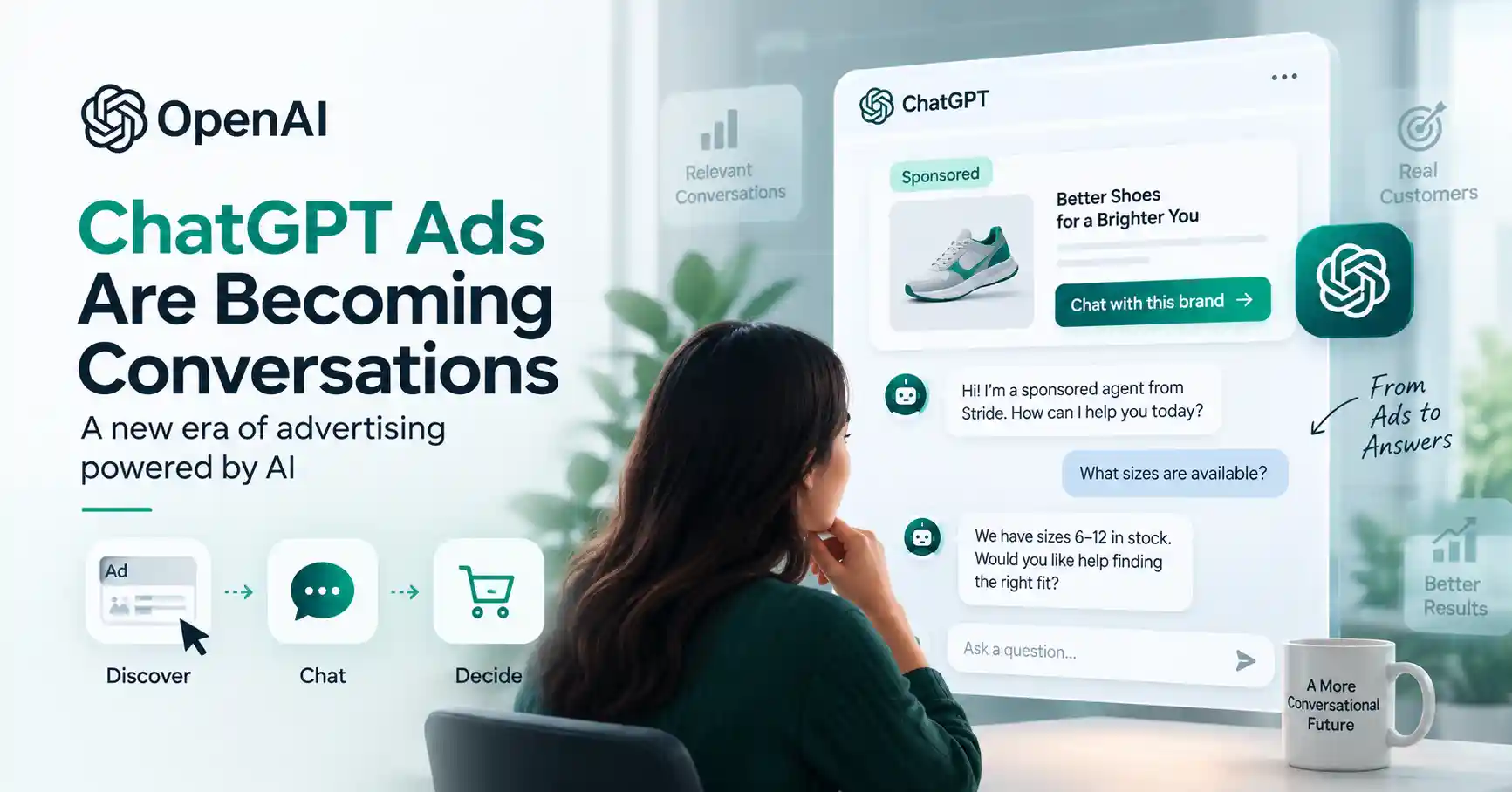
What if clicking an ad didn’t take you to a landing page?
What if it opened a conversation instead?
That’s the direction OpenAI is now taking with ChatGPT advertising. The company is testing Sponsored Agents, a new format that lets people move from an ad into a separate conversation with a business sponsored AI agent.
It’s a small change on the surface, but it could reshape how advertising works inside AI platforms. Instead of the familiar “see ad → click → visit website” journey, ChatGPT can potentially turn the middle of that journey into an actual conversation.
For marketers, that’s worth paying attention to.
What is changing with OpenAI ChatGPT Ads?
Until now, ChatGPT Ads have largely followed a familiar advertising model. A sponsored ad appears below a ChatGPT response, with the advertiser, headline, description and destination clearly identified.
OpenAI is now experimenting with something more native to the AI environment: Sponsored Agents.
If a user sees an ad that fits, they can begin a new chat with the company behind it. They may want to learn more first, like what the product can do, how much it costs, whether it works with their device, what size to pick, or if it is in stock. After that, they can decide what to do next.
That distinction matters.
The user isn’t simply being pushed from ChatGPT to a website. The ad becomes an entry point into a conversation.
OpenAI says the Sponsored Agent conversation remains separate from ChatGPT’s independent answers and from the user’s original conversation.
That separation is particularly important because advertising inside an AI assistant raises an obvious question: does the ad influence what the AI says?
OpenAI’s stated approach is that ads remain separate from ChatGPT’s answers.
Why is conversational advertising different from a normal ad click?
Think about how people actually buy something online.
A search ad might get someone to a product page. But the person may still have five questions before they’re ready to buy.
“Will this work with my setup?”
“Is this suitable for beginners?”
“What size should I choose?”
“What’s the difference between this and the cheaper version?”
Normally, those questions require another search, another website visit or a conversation with a salesperson.
Conversational advertising potentially puts that layer directly after the ad.
This is where the idea gets interesting. The ad isn’t necessarily the final message. It can become the beginning of the consideration process.
Digiday described the new format as essentially a move from clicking to a website toward clicking to chat. That’s a significant difference from conventional digital advertising, where the landing page has traditionally carried most of the responsibility after the click.
For brands, it could mean fewer disconnected steps between discovery and consideration.
How do Sponsored Agents work inside ChatGPT?
The basic flow is fairly straightforward.
A person is using ChatGPT and encounters a relevant sponsored ad. Instead of only clicking through to an advertiser’s website, the user can choose to interact with a Sponsored Agent.
The conversation is clearly identified as being sponsored by the business.
From there, the user can ask questions and explore the offering. If they’re ready to continue, the experience can send them to the advertiser’s website.
That creates an interesting hybrid between advertising, customer support and product discovery.
Imagine someone asking ChatGPT for ideas for a dining table.
They see an advertisement from a furniture company. Rather than immediately opening a product page, they can ask the sponsored agent whether the table would fit a particular room, how many people it seats or what kind of maintenance it requires.
The important part is that the interaction happens in the format people already understand: conversation.
That’s what makes Sponsored Agents different from simply putting a bigger image or another call to action button underneath a ChatGPT response.
What does this mean for AI advertising and marketers?
For advertisers, the bigger change isn’t just another ad format. It’s the possibility that the advertising experience itself becomes interactive.
Traditional advertising generally tries to answer one question:
“Can we get this person to click?”
AI advertising can potentially ask a more useful question:
“Can we help this person decide?”
That’s a different objective.
It also changes what advertisers need to prepare.
A good Sponsored Agent won’t simply repeat marketing slogans. It needs useful product information, clear answers and enough context to handle the questions customers naturally ask.
This makes product data, FAQs, comparison information, reviews, pricing details and landing page quality increasingly important.
It also explains why OpenAI is expanding the advertiser tooling around ChatGPT Ads at the same time.
The company is adding AI assistance for campaign creation, ad copy and imagery, while allowing advertisers to use natural language prompts to create, update and analyze campaigns.
In other words, OpenAI isn’t only changing the ad. It’s changing how marketers can build the ad campaign too.
Is OpenAI building an AI native advertising platform?
That appears to be the broader direction.
OpenAI has been steadily adding pieces that look familiar to performance marketers: Ads Manager, CPC buying, conversion measurement, campaign optimization and integrations with existing business tools.
Now it is adding an advertising format that is much more specific to conversational AI.
This is where the phrase AI native advertising fits.
An AI native ad is not just a normal display, search, or social ad that gets dropped into an AI assistant.It uses the capabilities of the AI environment itself.
The conversation becomes part of the experience.
OpenAI is also integrating ChatGPT Ads with platforms including HubSpot and Shopify. For marketers, that could eventually connect advertising, customer information, ecommerce data and conversational interactions more closely than traditional ad platforms typically do.
There’s still a lot to prove, of course. Sponsored Agents are being tested with selected advertisers, so the final experience could evolve considerably.
What should businesses do differently now?
Don’t rush to paste Google Ads campaigns into ChatGPT and call that an AI strategy. The smart move starts elsewhere. Figure out what your buyers ask before they hand over cash.
Dig through sales calls, support tickets, product reviews, comparison pages, and search queries, that data tells the real story.
What are customers unsure about?
What objections repeatedly appear?
Which product features need explanation?
Those questions can become valuable inputs for conversational advertising.
Your website also matters. If your product pages contain vague claims, missing specifications or outdated information, an AI powered advertising experience has less useful material to work with.
This is closely connected to the broader shift toward AI visibility. Your brand increasingly needs to be understandable not only to search engines, but also to AI systems interpreting products, categories and customer intent.
For marketers already tracking AI visibility and PPC performance, this creates another layer to watch. The relationship between paid advertising, AI discovery and eventual conversion is becoming harder to separate into neat boxes.
Could ChatGPT Ads change the customer journey?
Possibly, and that’s probably the most important thing to watch.
The traditional journey often looks something like this:
Search → Ad → Website → Research → Comparison → Purchase
A conversational experience could compress part of that process:
Question → Ad → Conversation → Decision
That doesn’t mean every purchase will happen this way. People will still visit websites, compare prices, read reviews and talk to humans.
But for high intent purchases where customers have lots of questions, conversational advertising could remove some friction.
It also puts more pressure on brands to be genuinely useful.
A clever headline might win a click. It won’t necessarily survive a five minute conversation.
If a customer asks difficult questions and the brand’s sponsored agent can’t answer them clearly, the novelty of conversational advertising won’t matter much.
The brands that benefit most may be the ones with strong product information, clear positioning and a good understanding of customer questions.
What should marketers watch next?
The early Sponsored Agent tests are only the beginning.
Marketers should watch how OpenAI measures these interactions, whether advertisers can connect conversations to conversions, how much control brands have over the agent experience and whether users actually find sponsored conversations useful.
Cost will matter too.
ChatGPT Ads feel different from regular keyword search. In keyword search, the system mainly looks at what someone types. With ChatGPT Ads, the platform can also use the back and forth of a conversation to gauge what the user is trying to do.
As OpenAI grows its ad tools, advertisers will have to watch more than just basic metrics. Impressions and clicks will matter, but they will also need to pay attention to what comes after someone sees the ad and the interaction starts.
That’s the real test.
A conversational ad that produces a lot of chats but very little qualified business isn’t necessarily successful. Likewise, a campaign with fewer clicks could be valuable if those interactions produce highly qualified customers.
The measurement model will need to catch up with the experience.
FAQ’s
ponsored ads from OpenAI ChatGPT show up inside the ChatGPT app. These placements are paid by businesses. They appear while people look at products, services, or make choices.
Sponsored Agents are business sponsored AI agents that users can interact with after engaging with certain ChatGPT ads. They allow users to ask questions and explore an advertiser’s offering through conversation.
A traditional ad usually sends someone to a website after a click. A Sponsored Agent can start a separate conversation with the business inside ChatGPT before the user decides whether to visit the advertiser’s website.
Not necessarily. They represent a new advertising format designed specifically for conversational AI. Traditional search, social and display advertising will continue to serve different purposes
It can bring advertising closer to the consideration stage of the buying journey. Instead of simply trying to generate a click, brands can potentially answer questions and help customers evaluate an offering before they take the next step.
Conclusion
OpenAI ChatGPT Ads are moving beyond the simple idea of showing a sponsored message next to an AI response.
OpenAI is trying something new with Sponsored Agents inside ChatGPT, they are turning a standard ad into a prompt that starts an actual conversation.
For brands, this means the old lines separating pure advertising, product discovery, and customer support are going to blur fast.
Will every single ad go conversational? No.The real question is simpler. Will users lean toward ads that help them sort through choices instead of just yelling at them to click? That is the exact experiment running right now. Marketers had better pay attention.

Kumar Swamy is the CEO of Itech Manthra Pvt Ltd and a dedicated Article Writer and SEO Specialist. With a wealth of experience in crafting high-quality content, he focuses on technology, business, and current events, ensuring that readers receive timely and relevant insights.
As a technical SEO expert, Kumar Swamy employs effective strategies to optimize websites for search engines, boosting visibility and performance. Passionate about sharing knowledge, he aims to empower audiences with informative and engaging articles.
Connect with Kumar Swamy to explore the evolving landscape of content creation!