Introduction
What if your page ranks #1 on Google, gets plenty of organic traffic, and still doesn’t generate the results you actually want?
That’s the awkward SEO problem many businesses eventually run into. The rankings look good. Search Console looks healthy. Traffic is moving in the right direction. But leads, sign ups, purchases or demo requests? Not so much.
The problem may not be your ranking.
It may be what happens after the click.
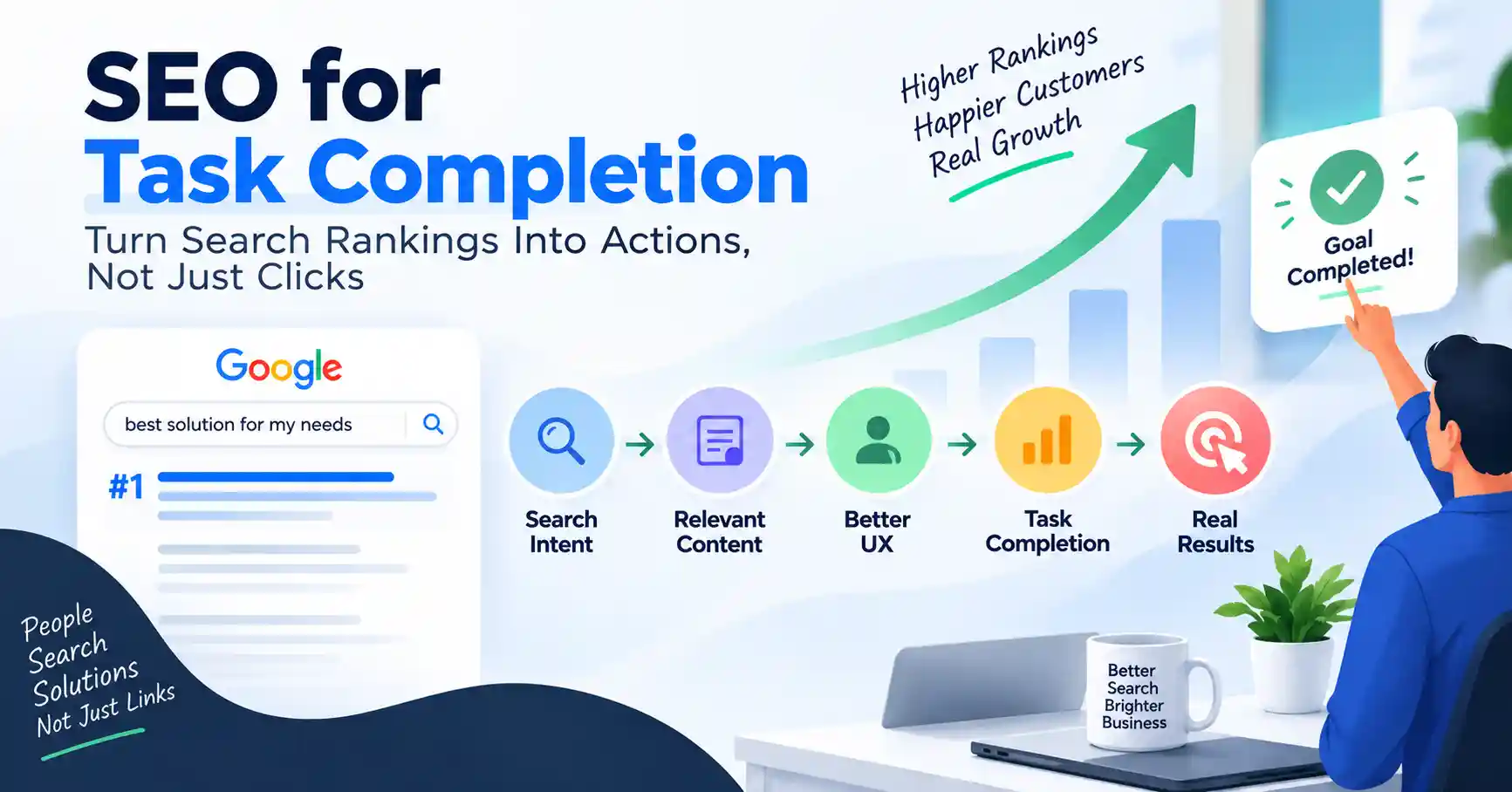
Modern SEO is moving beyond the simple goal of getting a page into Google’s search results. The bigger question is whether the visitor can actually accomplish what they came to your website to do.
That’s the idea behind SEO for task completion.
Search Engine Land recently highlighted this shift, arguing that ranking is only part of the job. The page should also let the person finish what they came for.
In most cases, that is the whole point. People usually search to get an answer, not to stare at where you rank. They search because they want an answer, comparison, product, solution, calculation, quote or next step.
What does SEO for task completion actually mean?
Traditional SEO often starts with a keyword.
Task completion SEO starts with a different question:
“What is this person trying to get done?”
Consider a search such as “best CRM for a 50 person sales team.”
The obvious SEO approach might be to create an article targeting that keyword and explain several CRM platforms.
The person doing the search likely has more work ahead. They might need to look at several choices, figure out the costs, confirm what fits with their current tools, pick two or three options, then share a final suggestion with their boss.
So the page should be made differently.
Instead of simply matching the keyword, you create a page that helps the person move through the decision.
This is where search intent SEO becomes much more useful than keyword placement alone.
A useful task statement could be:
“Help me find a CRM that fits my team’s size, budget and workflow, and give me enough evidence to make a decision.”
Suddenly, the content brief becomes clearer.
You know what information belongs on the page, what questions need answering and what the visitor should be able to do next.
Why is search intent no longer enough on its own?
Search intent has always mattered in SEO. But there’s an important difference between understanding intent and actually completing the user’s job.
Someone searching “SaaS pricing strategy” may want information. Someone searching “SaaS pricing calculator” wants to do something.
Those two visitors shouldn’t receive the same experience.
A purely informational article may satisfy the first person. The second visitor may need a calculator, template, example or downloadable resource.
This is why modern search behavior increasingly looks like a sequence of tasks rather than isolated keywords with AI driven personalized search .
Recent research into web search also points toward a more user centered view of search, where people may seek knowledge, guidance or a concrete output rather than simply a webpage.
For SEO professionals, that means keyword research should be followed by a task analysis.
Ask:
- What does the searcher already know?
- What information are they missing?
- What decision are they trying to make?
- What could stop them from finishing?
- What should they do after reading the page?
Those questions can reveal opportunities that keyword volume alone won’t show.
How can you design a page around task completion?
Once you’ve identified the task, build the page around the shortest useful path to completing it.
Start with the answer.
If someone searches for pricing, don’t make them scroll through 1,500 words of brand storytelling before revealing the price. If they want to know whether your software integrates with Shopify, say so early.
Then remove unnecessary friction.
User experience ties directly into your SEO game plan. A good page loads quick, lets you scan it easily, works on phones, and makes sense. Don’t bury key info behind wonky menus or giant forms. Google itself pushes you toward what they call Core Web Vitals, plus mobile friendliness, security, and whether visitors can actually find the main stuff without a struggle. Then you take it from there.
Don’t make visitors guess what to do after finding their answer.
A pricing page might lead naturally to a free trial. A comparison page might lead to a product demo. A calculator might lead to a relevant guide.
The CTA should make sense because it follows the task.
Can UX and CRO improve SEO performance?
This is where SEO starts overlapping with conversion rate optimization (CRO).
Imagine two pages ranking for the same commercial keyword.
Page A has a strong introduction, attractive graphics and several calls to action, but the actual product information is buried.
Page B answers the main question immediately, explains the differences clearly, provides evidence and makes the next step obvious.
The second page is simply easier to use.
That’s important because a high ranking doesn’t automatically mean a successful page. Google itself says search success shouldn’t be reduced to one page experience metric or a perfect technical score. The broader goal is providing a satisfying experience alongside useful, relevant content.
This also means SEO teams shouldn’t work in isolation.
Content teams understand the questions. SEO teams understand search demand. UX teams understand friction. CRO teams understand conversion behavior.
Put those pieces together and you get a much more complete search strategy.
As Adam Heitzman explains in the Search Engine Land article that inspired this discussion, the real goal is not simply getting someone through the door it’s helping them finish what they came to do.
What should you measure beyond rankings?
Rankings are useful. They’re just not the whole scoreboard.
Start measuring what happens after the visitor arrives.
Depending on the page, useful metrics might include:
- Organic conversion rate
- Form completion rate
- Trial or demo starts
- Product purchases
- Calculator completions
- Downloads
- Scroll depth
- Internal link clicks
- Engagement with important page elements
- Exit points
The key is to match the metric with the page’s actual job.
A blog post doesn’t necessarily need to generate a purchase immediately. Its task could be answering a question and moving the reader toward another useful resource.
A product page has a different job.
A calculator has a different job again.
Core Web Vitals are worth your time too. Google says to target an LCP at 2.5 seconds or less. For INP, try to stay under 200 ms. Keep CLS below 0.1 if you want a smoother experience.
Still, do not get stuck on the targets just because they look neat on paper. If a page loads fast but fails to answer what the visitor came for, it will feel bad anyway.
How does AI search change task completion?
AI search makes this idea even more important.
Google AI Overviews, AI Mode and other generative search experiences can increasingly answer informational questions before someone visits a website. Google says its generative AI experiences continue to rely on core Search fundamentals, while encouraging unique, valuable, people first content.
That creates an interesting SEO problem.
If an AI system can summarize your basic answer, why should someone click through?
The answer is increasingly actionable value.
People still go online to compare items, figure out prices, and book services. They also ask for quotes, use a tool, grab a file, or finish a purchase.
So, AI search optimization should not be treated like it lives on its own. It should connect back to the work you already do for SEO.
Your site still needs to be easy to crawl. It should be clear to read.Technical SEO for AI search can help make sure search engines and AI systems can access and understand your content. And it has to help visitors in a real way.But the pages that provide something beyond a generic summary can have a clearer reason for users to continue from search into the website.
For more context on how search visibility is changing, see our guide to Google Search Console AI Performance Reports.
How can you build a task completion SEO workflow?
A simple workflow can make this practical.
First, identify your most important pages.
Then compare their organic visibility with what happens after the click.
A page ranking well but converting poorly is worth investigating. Look for missing information, unclear CTAs, slow loading elements, unnecessary form fields, confusing navigation or mismatched search intent.
Next, group the problems into three buckets:
Content: Does the page actually answer the searcher’s question?
Experience: Is it easy and fast to use?
Action: Is the next step obvious?
Fix the biggest problem first.
You can also use your Search Console query data to identify different tasks arriving on the same URLIf a single page is showing up for different kinds of searches that do not really match, you might split it into parts. Or you could make different pages for each intent. That way people land on what they actually need.
Google has said something along these lines as well.It points to Google’s guidance on helpful, people first content, which emphasizes creating content that helps visitors achieve their goal. The aim should be usefulness, not just pulling in search traffic.
That’s essentially the heart of task completion SEO.
FAQ’s
Finishing a task is about assisting the person with what they came for. It can mean getting the exact info they need, checking options side by side, working out a number, creating an account, or going through with a buy.
Task completion itself isn’t presented by Google as a standalone ranking factor. However, Google emphasizes helpful content and good page experiences, both of which are closely connected to whether visitors can successfully accomplish their goals.
Search intent explains what a person is trying to accomplish with a query. Task completion goes one step further by asking whether your website actually helps that person finish the job.
It depends on the page. Useful metrics can include conversions, form completions, purchases, trial starts, downloads, calculator completions, internal clicks and meaningful engagement.
Sure. If AI search starts answering more “how do I” questions right away, sites have to give people a reason to stay. That can mean offering tools, doing side by side comparisons, handling sign ups or purchases, sharing solid proof and sources, or providing other steps a visitor can actually take.
Conclusion
SEO used to feel like a straight race to the top of Google. Today, though, a different question matters far more. What happens once you actually arrive?
Sure, grabbing that number one spot drags someone onto your site. But it won’t magically build trust in your product, decode a tricky answer, fill out a form, or seal a sale. That heavy lifting falls squarely on the page itself.
Task completion SEO ties search intent, solid content, UX, CRO, tech speed, and clear next steps into one single flow.
So next time you look over your SEO report, skip the traffic counts. Ask something real.
“Did the person who clicked actually get what they came here to do?”

Kumar Swamy is the CEO of Itech Manthra Pvt Ltd and a dedicated Article Writer and SEO Specialist. With a wealth of experience in crafting high-quality content, he focuses on technology, business, and current events, ensuring that readers receive timely and relevant insights.
As a technical SEO expert, Kumar Swamy employs effective strategies to optimize websites for search engines, boosting visibility and performance. Passionate about sharing knowledge, he aims to empower audiences with informative and engaging articles.
Connect with Kumar Swamy to explore the evolving landscape of content creation!