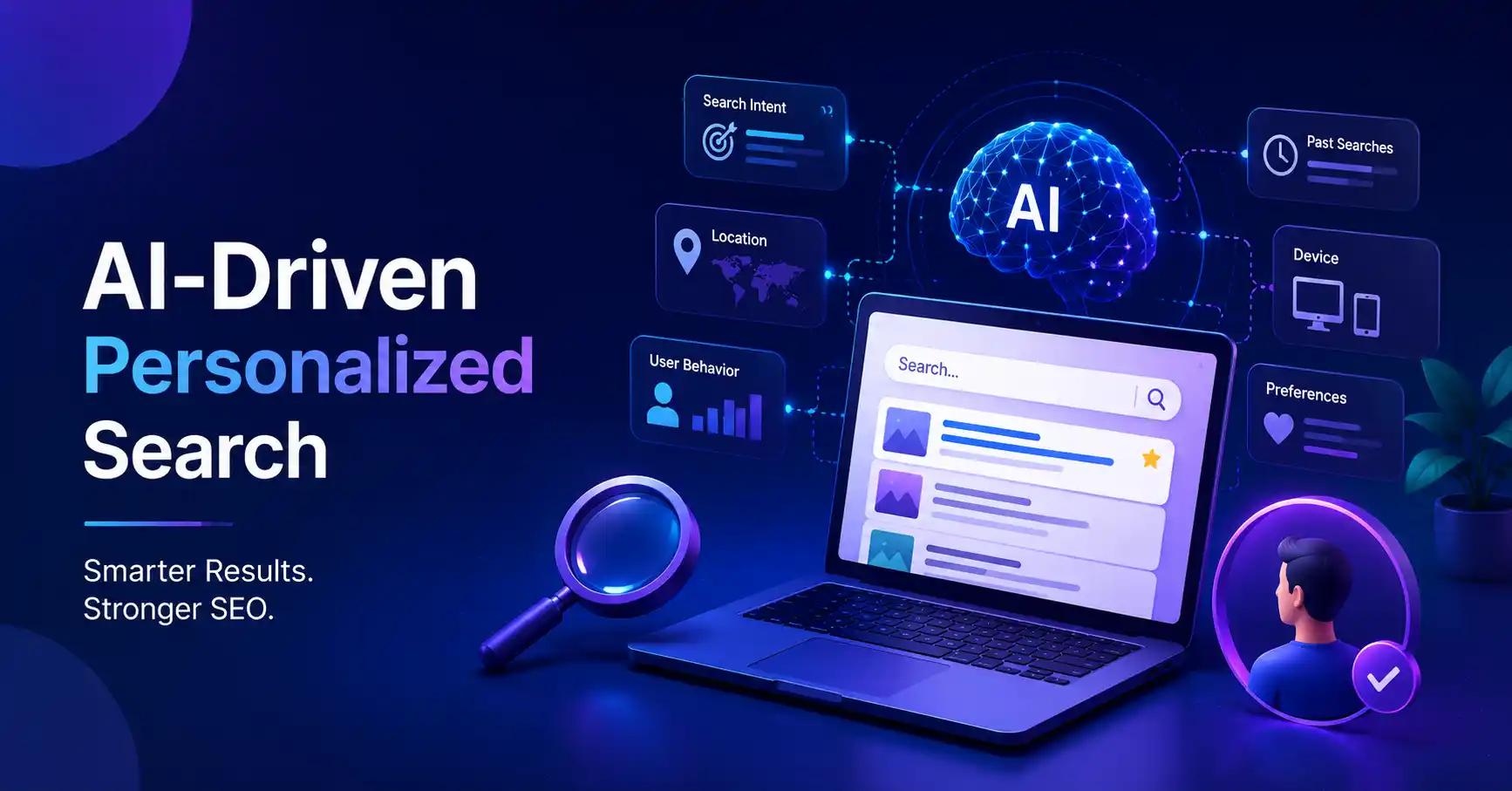
Have you ever asked yourself why two people, typing the same phrase into Google, end up seeing different results? It’s not a bug, it’s AI-driven personalized search running behind the scenes in a way most people never notice.
Search engines used to behave like plain keyword matchers, but now they try to grasp the human intent behind the question. Artificial intelligence looks at context, what the person really means, where they are, what they have done before, what device they are using, plus dozens of other signals , to bring back more relevant pages. So for businesses this means old-school SEO by itself is no longer enough.
In this practical guide , you will learn how AI-driven personalized search runs, why it matters, and what brands should adjust so they stay easy to find.
What is AI-driven personalized search?
AI driven, personalized search uses machine learning along with natural language processing to match the results to each person, rather than pushing the exact same pages at everyone. Newer engines pay attention to user intent, prior searches, how you scroll, where you are, your language setup, and even content quality before deciding which listing gets the spotlight.
Instead of asking “Which page has this keyword?” AI is leaning more toward asking, “Which page will best satisfy this persons need?”
As digital strategist Emma Brooks puts it,
“The future of SEO belongs to businesses that optimize for people first and algorithms second.”
Why is personalized search changing SEO?
People expect answers right away, that feel relevant. AI systems learn from billions of interactions , then try to figure out what users are most likely to click on and trust.
Because of this, search intent , topical authority , the way the user experience feels, and helpful content have become even more important than repeating keywords.
Companies that keep putting out generic posts usually hit a wall. AI tends to favor pages that show real expertise , offer something original, and stay closely aligned with what the user actually wants.
How can businesses optimize for AI-driven personalized search?
First, i t hink you should get clear on what the user is actually trying to solve, not just chase a few keywords, like that. Look at the real concerns, the actual questions your audience keeps repeating, and then shape your content around that. After, you can connect everything in a way that feels natural, with flow, not like you forced it in.
Put together topic clusters where each related article feeds into the next with internal links. A solid internal linking approach lets search engines better grasp how your site is organized, while also steering readers toward useful resources. If you want to strengthen your technical groundwork, check out our guide on Technical SEO ROI it’s a great first step.
Work on the page experience by focusing on quick loading, mobile friendliness, and navigation that users can access easily. Strong Core Web Vitals matter for satisfaction, even when you are not chasing perfect scores.
Keep headings structured, paragraphs tight and clear, use original examples, and write in conversational phrasing. Those tweaks help both humans and AI systems interpret what you’re publishing more accurately.
Should keyword research still matter?
Absolutely , but honestly the approach has changed.
Instead of grinding the exact same keyword again and again, try leaning into covering adjacent topics in a more organic, way. Useful backup ideas are AI search optimization, semantic SEO, search intent optimization, conversational search, plus entity based SEO.
When those concepts show up in a grounded, comprehensive draft without being forced, search engines get a stronger grasp of what you really know, and how you operate.
Also , keep revisiting what you already published. Doing routine updates through a clear SEO maintenance workflow helps your pages remain current, technically stable, and still competitive as time moves forward.
How does AI evaluate content quality?
AI goes way beyond plain keywords. it doesn’t just scan for terms, it tries to get what’s actually being delivered, like originality, real competence, how engaging it is, how fresh it feels, internal linking, credibility, and whether readers can reach answers quickly.
Basically, publishing insights that help, real cases you can relate to, and actionable suggestions tends to beat churning out dozens of shallow posts that add little value.
If you want to understand how Google evaluates content and what it treats as truly helpful, check the official Google Search Central documentation.
What mistakes should you avoid?
Avoid things like keyword piling, churning out posts that feel mass produced, and repeating what competitors already have. Also, don’t ignore what the reader actually wants, and please don’t publish details that are already outdated. When those habits happen, trust takes a hit, and the long term visibility tends to drop too.
Instead, go back to what you already have and update it on a steady rhythm, build stronger internal link paths, and genuinely respond to the questions customers keep asking.
Marketing consultant David Reynolds puts it well:
“AI rewards the brands that keep solving the problems, not the ones that just pump out more pages.”
Conclusion
AI driven personalized search is changing how people find information, but the whole point still stays the same, deliver the most helpful answer, even when the methods shift.
Companies that pay attention to search intent, build topical authority, improve user experience, and keep trustworthy content in place will likely keep earning visibility as search changes over time.
Instead of only tuning for algorithms, tune for the actual humans using them. That approach feels the most likely to work today, and also in the future.
If you already started optimizing for AI driven search, share what you noticed or the questions you have in the comments. We would love to hear your perspective.
FAQs
1. What is AI-driven personalized search?
It uses artificial intelligence to tailor search results , based on what the user means, how they behave, what they prefer , and what’s going on around them.
2. Does personalized search replace SEO?
No. It changes how SEO works by placing greater emphasis on relevance, expertise, and user intent.
3. Is keyword research still important?
Yes. However, semantic SEO and search intent are now just as important as exact-match keywords.
4. How can small businesses benefit from AI-driven search?
By creating high-quality, helpful content that answers customer questions and demonstrates real expertise.
5. What are the best secondary keywords for this topic?
AI search optimization, semantic SEO, search intent optimization , conversational search , and entity-based SEO are some of the most valuable supporting keywords that people actually track..

Kumar Swamy is the CEO of Itech Manthra Pvt Ltd and a dedicated Article Writer and SEO Specialist. With a wealth of experience in crafting high-quality content, he focuses on technology, business, and current events, ensuring that readers receive timely and relevant insights.
As a technical SEO expert, Kumar Swamy employs effective strategies to optimize websites for search engines, boosting visibility and performance. Passionate about sharing knowledge, he aims to empower audiences with informative and engaging articles.
Connect with Kumar Swamy to explore the evolving landscape of content creation!