Have you ever wondered why one website keeps appearing in Google’s AI answers while another, with seemingly great content, barely gets noticed?
It’s easy to blame keywords, backlinks, or even the quality of the writing. But there’s another piece of the puzzle that’s becoming harder to ignore: technical SEO for AI search.
AI powered search experiences such as Google AI Overviews and AI Mode still need to discover, access, understand, and interpret web content. If your site makes that job unnecessarily difficult, brilliant content can end up sitting on the sidelines.
The good news? You don’t need to rebuild your entire website for AI. The fundamentals are surprisingly familiar. The difference is that technical SEO now has another job: making your content easier for both traditional search engines and AI systems to access and understand.
What is technical SEO for AI search, and why does it matter?
Technical SEO for AI search? It’s all about making your website easy for both search engines and those new AI systems to find, get, and use.
Imagine your site’s a library, the books? That’s your content, plain and simple. But the shelving, the catalog, the signs, even the lighting and open doors, that’s technical SEO.
If nobody can find the book or figure out what it contains, having a great book doesn’t help much.
That’s why AI search optimization starts with the basics.
Google’s current guidance makes this point pretty clearly: websites need to be accessible to Googlebot, return successful HTTP responses, contain indexable content, and meet normal technical requirements to be considered in Search and AI experiences.
And there’s an important reality here: AI search isn’t a completely separate SEO universe. Much of what helps you perform in traditional Google Search also creates the foundation for visibility in AI generated results.
If you want a broader look at how SEO is changing, our guide to AI search and SEO fundamentals is a useful next read.
Can AI search find and index your website properly?
This is the first thing to check, because an AI system can’t use content it can’t access.
Crawlability and indexing may sound like old school SEO topics, but they’re still absolutely central to AI search.
Start with the basics:
- Make sure important pages aren’t accidentally blocked by robots.txt.
- Check that valuable URLs can be crawled.
- Make sure pages return an HTTP 200 status when appropriate.
- Review your noindex directives.
- Keep XML sitemaps accurate and up to date.
- Fix broken internal links.
- Avoid creating thousands of unnecessary URLs.
- Make important content available in the rendered page rather than hiding everything behind complicated scripts.
Google specifically says site owners should make sure Googlebot isn’t blocked and that pages contain indexable content.
Internal linking matters here, too. Search engines need crawlable links to map your site. A solid internal network spreads context everywhere. Honestly, never leave your best articles stranded out there alone.
For AI search, that context can be particularly valuable. A page about technical SEO shouldn’t exist as an isolated island. Connect it to related content about AI SEO, content optimization, search intent, and AI visibility.
In other words, don’t just ask, “Can Google crawl this page?”
Ask, “Can a machine quickly discover what this page is about and how it connects to the rest of my site?”
That’s a much better question.
Does structured data help AI understand your content?
Here’s where things get interesting.
Structured data, it’s just extra, machine friendly info, really, that helps search engines grasp what’s actually on a page. It clues systems into articles, products, companies, writers, events, and other content bits.
But here’s the rub: plenty of folks misinterpret it. Just slapping on Schema markup won’t instantly launch your page to the top of AI search rankings. Nope.
Think of it more like a translator. It clarifies things.
If what’s visible on your page contradicts your structured data, well, you’re just making a muddle. Google itself suggests keeping your structured data aligned with what users actually see, so, you know, validate that markup.
For publishers, useful implementations can include relevant Article, Organization, Breadcrumb, Product, or other supported schema types where appropriate.
There’s another simple win here: use clear HTML structure and descriptive headings.
An AI system trying to understand a page shouldn’t have to play detective.
A heading such as “What is technical SEO for AI search?” followed immediately by a concise answer is easier to interpret than a page filled with vague headings, enormous paragraphs, and decorative copy that takes 500 words to get to the point.
That brings us to the next fundamental.
Is your website easy for AI systems to understand?
Being crawlable is only half the job.
A crawler may successfully access your page and still have trouble understanding its most important information.
This is where semantic structure becomes incredibly useful for LLM visibility.
Use:
- Clear H1, H2, and H3 headings
- Short, descriptive paragraphs
- Logical content hierarchy
- Lists where they genuinely help
- Tables for genuine comparisons
- Descriptive image alt text
- Meaningful anchor text
- Clear definitions of important terms
- Direct answers to specific questions
This isn’t about writing for robots instead of people. Actually, it usually makes the page better for humans too.
Google’s AI search, or so they claim, excels with more complex, drawn out queries and even subsequent questions. Their core advice? Keep churning out content that’s genuinely helpful, authentic, and crafted for humans, not simply to outsmart some algorithm.
John Mueller from Google has practically hammered it home: prioritize people, not chasing every fleeting ranking trick. That’s precisely the mindset for AI search, isn’t it?
Make every crucial section easy to quote, grasp, and check. That is the whole game. If an AI pulls a pristine answer instantly instead of wading through a messy paragraph, you nailed it.
How important are speed, mobile UX, and page experience for AI search?
Technical SEO isn’t only about bots.
People still have to use your website after an AI result sends them there. A slow, cluttered, difficult page wrecks all the effort you poured into visibility, Google pushes hard on page experience for AI searches anyway. Load times matter. Device compatibility matters, Can users actually find the core info without digging?
So keep an eye on:
- Core Web Vitals
- Mobile usability
- Server response time
- Large images
- Unnecessary JavaScript
- Layout shifts
- Intrusive pop ups
- Poor navigation
- Difficult to read content
Why make visitors wait? Nobody wants to sit around for eight seconds just to read a quick 200 word answer.
Truth is, a page that loads fast and looks clean helps everyone. Folks landing via AI Overviews or other AI searches can quickly check your info and then poke around your site.
That really does matter, by the way. Google says people coming from AI Overviews can be super engaged. So, forget just tracking clicks. Now, you should be counting conversions, sign ups, and sales, those real actions are what count.
What should you check first in a technical SEO audit for AI search?
You don’t need a 70 point checklist to get started.
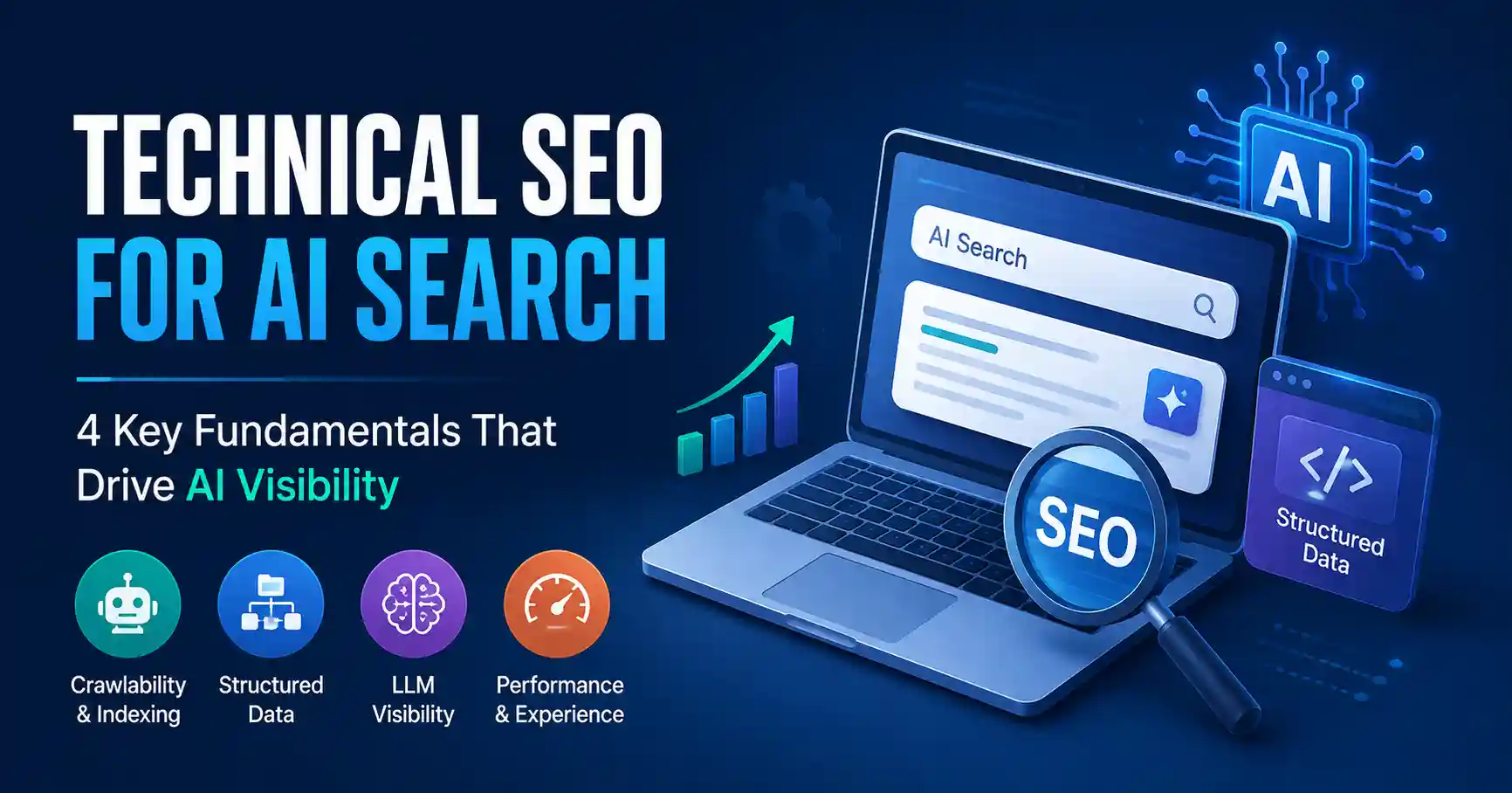
Run a simple technical SEO audit and work through these four fundamentals:
1. Crawlability and indexing: Search engines: do they find your vital pages? Or are they lost?
2. Content structure: Computers, humans, both snatch page info. Swiftly, it’s a snap.
3. Structured data: My markup shows your thoughts.
4. Performance and experience: Quick loading. Truly mobile friendly, deeply accessible, and effortlessly navigable.
Then look at internal linking.
Your main pages should guide people to other useful places. Just make sure the words you use for those links actually tell people what they’ll find. Ditch boring stuff like “find out more.” Google itself admits links help it discover new pages and understand what matters. Good anchor text gives readers a preview.
Here’s the real kicker, though: is your content actually helpful, it might sound more like marketing than technical SEO, but it’s vital. Google hammers this point home constantly. Its AI still follows the same basic rules. It favors content that’s useful, original, and created for people.
The technical layer gets your content through the door.
Quality gives AI systems a reason to use it.
Is technical SEO for AI search really different from traditional SEO?
Not as much as some headlines make it sound.
There are new considerations around AI crawlers, generative search experiences, citations, and LLM visibility. But the foundation hasn’t suddenly disappeared.
Google still needs to discover pages.
It still needs to crawl them.
It still needs to understand them.
It still needs signals that help determine relevance and quality.
The big change is what happens after that. Instead of simply deciding which blue link appears highest, AI powered search can synthesize information from several sources and present an answer directly to the user.
That means your goal shouldn’t simply be “rank number one.”
A better goal is to become a clear, trustworthy, technically accessible source worth including in the answer.
And that’s why technical SEO for AI search matters.
FAQ’s
Technical SEO clears the path for search engines to index your pages, Ignore these basic rules at your peril. You will regret it.
Not a completely separate SEO strategy. Google says its existing Search fundamentals continue to apply to AI experiences. Focus on accessible pages, useful content, good page experience, and accurate structured data.
No. Structured data can help search systems understand content, but it isn’t a guarantee of rankings or AI citations. Your markup should accurately represent visible page content.
Start with crawlability, indexation, clean structure, internal links, original info, and strong technical performance. Skip keyword stuffing or AI filler completely. That is key.
Google doesn’t punish content just for being machine made. They care about value, originality, and actual relevance. Quality wins, period. But if you spin up massive batches of junk purely to game the rankings, that crosses the line into spam territory.
Conclusion
Forget the magic tricks. AI search optimization will not instantly charm ChatGPT or Google AI Mode into loving your site. The reality is far more grounded, messy, and practical than that.
Make your site crawlable. Keep important content indexable. Build a logical internal link structure. Use structured data accurately. Write clearly. Make your pages fast, usable, and clean. Above all, put out material that actually solves a real problem for someone. Those basics still apply whether a user lands on your site via standard Google, an AI Overview, or a chat answer.
Search is changing quickly, but good websites still have one thing in common: they’re easy to find, easy to understand, and worth trusting.
If you’re working on your site’s AI visibility, what technical SEO issue are you struggling with right now? Share it in the comments we’d love to hear what you’re seeing.

Kumar Swamy is the CEO of Itech Manthra Pvt Ltd and a dedicated Article Writer and SEO Specialist. With a wealth of experience in crafting high-quality content, he focuses on technology, business, and current events, ensuring that readers receive timely and relevant insights.
As a technical SEO expert, Kumar Swamy employs effective strategies to optimize websites for search engines, boosting visibility and performance. Passionate about sharing knowledge, he aims to empower audiences with informative and engaging articles.
Connect with Kumar Swamy to explore the evolving landscape of content creation!