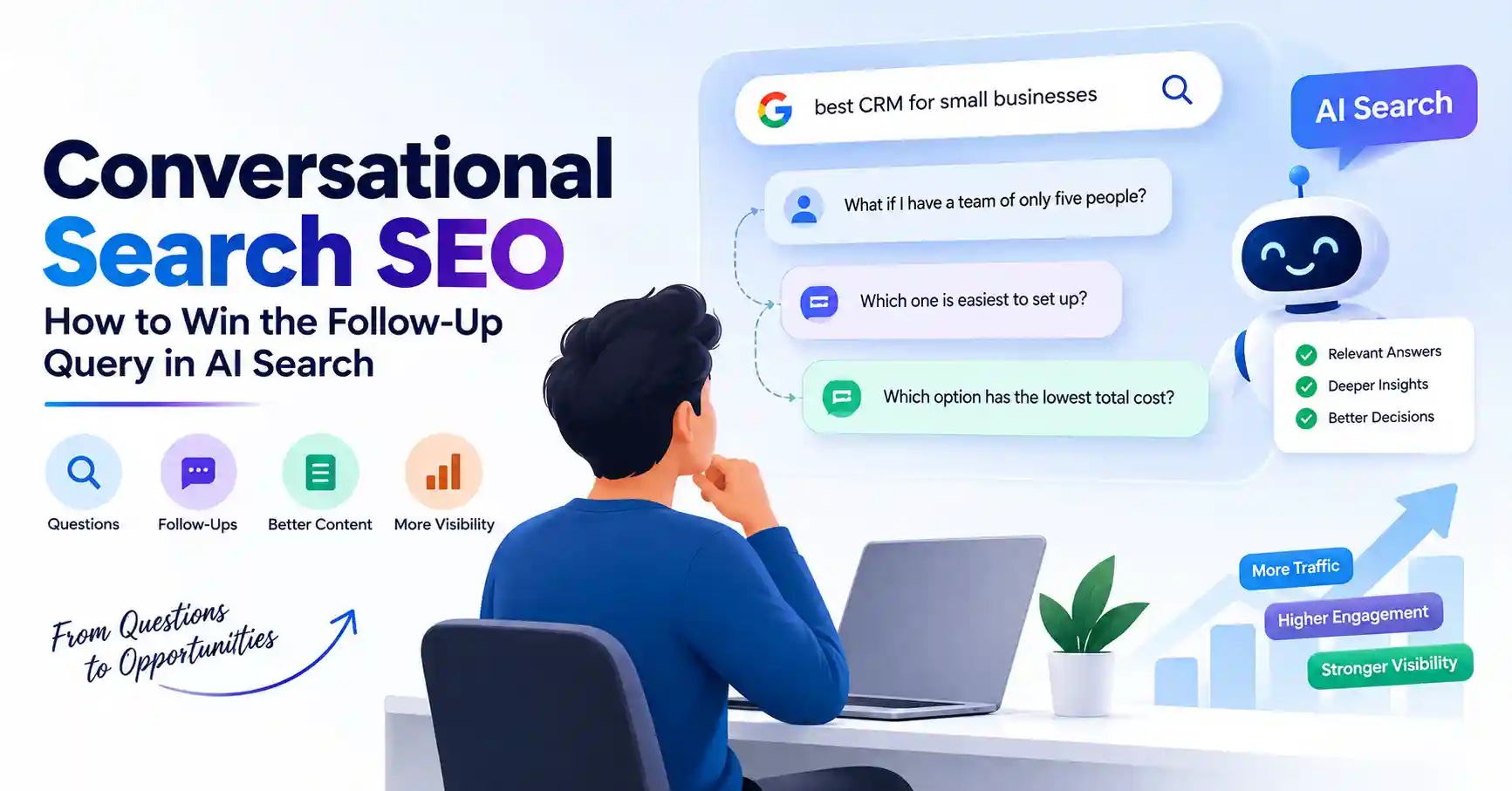
Have you noticed how search is starting to feel less like typing keywords into Google and more like having a conversation?
You might search for “best CRM for small businesses,” get an answer, and then immediately ask, “What if I have a team of only five people?” Then comes another question: “Which one is easiest to set up?” And finally, “Which option has the lowest total cost?”
That small shift changes the SEO game.The first query is no longer the entire search journey.Asking follow up questions can show what someone truly wants.
That is a big reason conversational search is useful. Tools like Google AI Overviews, AI Mode, and ChatGPT can keep the thread going. They can read plain language and help people go from learning to comparing to taking a next step.
So for SEO work, focusing on only one keyword is no longer the whole job.Your content needs to answer the question people ask now and make the next question easier to answer.
What is conversational search, and why is it changing SEO?
Conversational search lets people type questions the way they talk. They can ask one thing, then ask more without starting over. Each new question helps narrow what they mean. It also lets them fix or refine their intent as they go.
Traditional SEO often looked something like this:
Keyword → Search → Result → Click
Conversational search looks more like:
Question → Answer → Follow up → Comparison → Validation → Action
That difference is important.
A person searching “email marketing software” has broad intent. Their next question might be “Which one is best for SaaS?” followed by “Does it integrate with HubSpot?” and then “What does it cost for 10,000 contacts?”
Those aren’t random questions. They’re stages of the same decision.
This is where search intent becomes more useful than simply counting keywords. The initial query tells you the topic. Follow up queries reveal the concerns, constraints and buying triggers behind that topic.
In other words, don’t just ask, “What keyword should this page rank for?”
Ask, “What will the reader probably ask five minutes after reading this page?”
That’s the more interesting SEO question.
How does query fan out change the way we think about SEO?
One of the biggest developments behind AI search is query fan out.
Put simply, an AI powered search system can take one complicated question and break it into several related searches to gather enough information to construct an answer.
Imagine someone asks:
“What’s the best project management software for a remote SaaS team with 20 employees?”
To give a useful answer, the system might first need details like the cost, how remote teamwork works, which tools can connect, the included features, any limits, and what other products are available.
That means the original prompt is only part of the retrieval process.
This gives SEOs a real opening. There is no need to spin up a new page for each possible chat style question. What you can do instead is make one solid resource that covers the key subtopics users are really asking about.
Long tail queries still help in AI search, too. A prompt can be long and chatty, but the search intent underneath often splits into well known SEO angles. People still look for comparisons, clear definitions, costs and pricing, product or service alternatives, common use cases, and questions tied to a specific problem.
So one well built page can win traffic for a bunch of related needs. It can do that without sounding like it was made to list keywords in a neat table.
What should content cover when users keep asking follow up questions?
Here’s a simple way to approach it.
Start with the main question. Then map the questions that naturally follow.
For most topics, five categories are particularly useful:
Clarification: “What does this actually mean?”
Constraints: “Does this work if my budget is limited?”
Comparison: “How is this different from the alternative?”
Proof: “How do I know this actually works?”
Action: “What should I do next?”
These questions can turn a basic article into a much stronger resource.
For example, an article targeting “AI search optimization” shouldn’t stop at defining AI SEO. It could explain how AI search retrieves information, how content structure affects visibility, how citations work, what technical SEO fundamentals still matter and how marketers can measure visibility.
The goal isn’t to make every article enormous.
It’s to make each article useful enough to survive the next question.
As SEO consultant Gianluca Fiorelli has argued in Ahrefs’ research on query fan out, SEOs don’t necessarily need to guess every conversational prompt understanding the smaller related queries AI systems may generate is a more practical approach.
How should you optimize content for AI Overviews and conversational search?
The good news is that you don’t need to throw away traditional SEO.
Google’s current guidance makes this point clearly: optimizing for generative AI search still means applying strong SEO fundamentals. Google also says AI Overviews and AI Mode may use query fan out to generate related searches and retrieve supporting information.
So start with the basics.
Use descriptive titles and headings. Answer important questions directly. Keep essential information in crawlable text. Link related pages logically. Make important facts easy to find. Keep product, service and business information accurate.
Then add depth.
Instead of writing:
“What is conversational search?”
follow it with:
“How does conversational search affect SEO?”
Then:
“What happens to search intent?”
And:
“How should content teams respond?”
That structure makes the page easier for people to scan and gives search systems clearer pieces of information to understand.
Please remember one thing: do not write just for machines.
If a paragraph feels off to a real reader, the way you format it will not fix it.
Does conversational search mean keywords no longer matter?
No. That’s one of the easiest myths to fall for.
Keywords still provide useful information about demand, language and search behavior. What’s changing is the role they play.
Instead of treating a keyword as the entire content strategy, treat it as an entry point into a topic.
For example, “technical SEO for AI search” may be the primary target. But users could also care about crawlability, structured data, AI citations, content accessibility, AI Overviews and Google AI Mode.
These supporting concepts create a stronger topical relationship.
This is also where internal linking becomes valuable.
People chasing conversational search often care about broader optimization strategies and how technical SEO shapes visibility. Related resources build a clean path instead of cramming every single question into one massive article. That rule holds across any content cluster, One solid overview. A few tight supporting pages, sharp comparisons, fresh research, and real tools. You are constructing an actual knowledge system here, not just stacking up a random pile of blog posts.
How can you build a conversational SEO strategy that actually works?
You don’t need to rebuild your entire website overnight.
Start with five important topics that already generate organic traffic or business value.
For each topic, write down:
- The primary question.
- Five likely follow up questions.
- The biggest objection.
- The most important comparison.
- The evidence a skeptical reader would want.
- The action the reader should take next.
Then check whether your existing content answers those questions.
You’ll probably discover gaps.
Maybe your article explains what a product does but doesn’t compare alternatives. Maybe you have a pricing page but no explanation of total cost. Or perhaps you have excellent written content but no original examples, demonstrations or first hand evidence.
Those gaps are opportunities.
This approach also works nicely with AI search optimization because AI systems need useful, accessible information to construct answers. Ahrefs’ research similarly emphasizes that AI search often breaks conversational prompts into smaller retrieval queries, making comprehensive topic coverage important.
And don’t forget measurement.
Rankings and regular search traffic still matter, but they do not tell the full story. Look at AI visibility too. Check citations. Watch branded searches. Measure assisted conversions. Also track how people interact with deeper pages when you can see the data.
Google’s newer AI search reporting also reflects this broader measurement challenge.
What does the future of conversational search mean for SEO professionals?
The biggest change isn’t that people suddenly stopped using keywords.
It’s that search is becoming more like a decision making conversation.
People ask something. They learn. They question the answer. They add constraints. They compare alternatives. Then they decide.
So the best SEO page is not always the one that repeats the target keyword again and again.
It is the page that really gets the issue and keeps being useful even when the wording of the question shifts.
Write like you are starting a conversation, not like you are finishing a task after one search. Reply to the first question in a clear way.
Anticipate the second.
Support the third with evidence.
When the reader feels ready, you should make the next action clear.
This is a steadier way to handle conversational search SEO than trying to follow every new AI update that shows up in the SERPs.
FAQ’s
Conversational search lets people ask questions in a normal way. They can also ask another question right after that. The system keeps the earlier details in mind.
Search basics still count. That includes pages that bots can reach, content that actually helps, links between related pages, and site setup that works for users and tools. Also, make sure the content matches what people are trying to find.
Voice and chat style searches add another layer. They do not wipe out the old work. They just ask you to adjust the plan a bit.
When an AI search tool shatters your single question into various smaller sub queries to harvest facts prior to crafting its ultimate response, that is fan out.
Ditch the filler. Build genuinely helpful pages that unpack key subtopics with real world expertise, strict precision, and the tidy technical SEO that actually works.
SEO used to obsess over grabbing that initial search query, Conversational search flips the script entirely. What happens next? That is the real question now. If your page answers the first question, tackles the natural follow up, drops solid evidence, and nudges the reader toward a concrete next step, you made something way better than a single keyword trap. You built actual conversational content, Modern SEO is moving right there, and honestly, it is about time.
Conclusion: Make the next question count
SEO used to obsess over grabbing that initial search query, Conversational search flips the script entirely. What happens next? That is the real question now. If your page answers the first question, tackles the natural follow up, drops solid evidence, and nudges the reader toward a concrete next step, you made something way better than a single keyword trap. You built actual conversational content, Modern SEO is moving right there, and honestly, it is about time.

Kumar Swamy is the CEO of Itech Manthra Pvt Ltd and a dedicated Article Writer and SEO Specialist. With a wealth of experience in crafting high-quality content, he focuses on technology, business, and current events, ensuring that readers receive timely and relevant insights.
As a technical SEO expert, Kumar Swamy employs effective strategies to optimize websites for search engines, boosting visibility and performance. Passionate about sharing knowledge, he aims to empower audiences with informative and engaging articles.
Connect with Kumar Swamy to explore the evolving landscape of content creation!