Introduction
Ever think what would happen if your ads showed up, right when someone asks an AI about which product, service or solution they should pick?
That’s basically the moment in question behind ChatGPT advertising.
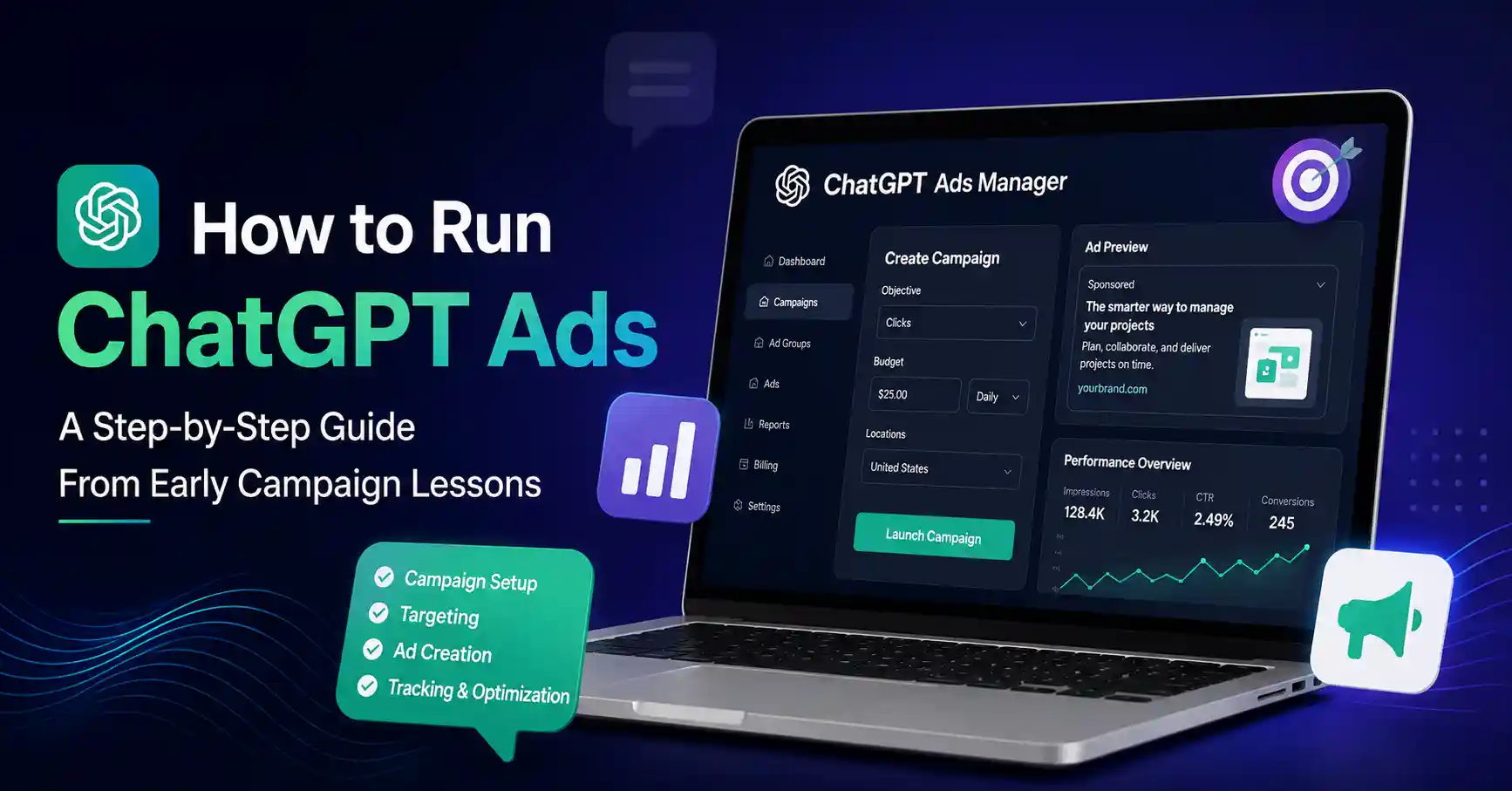
ChatGPT Ads have moved from an early, fairly closed experiment into something more structured. OpenAI now offers a beta Ads Manager where eligible advertisers can build campaigns, set budgets, select objectives, upload creative, run ads, and review performance. CPC plus conversion-focused settings have also made the platform way more appealing for performance marketers.
But there’s a catch. Running ads on ChatGPT isn’t just a matter of copying your Google Ads campaign and hitting “launch”. This space is conversational, so relevance, and also the wider context matter a lot more, than many teams expect.
If you are thinking about testing it, here’s a practical way to go about it, not too complicated, but still workable.
What Makes ChatGPT Advertising Different From Google Ads?
- ChatGPT advertising is conversation-driven: People often spell out what they need in full sentences, instead of typing short keyword phrases.
- User intent can be way more detailed: Someone might ask for “the best CRM for a small SaaS business”, then add their budget, their team size, which integrations they already use, plus what they are aiming for, all within one prompt.
- Context matters: ChatGPT Ads can use what’s being said right around the user message, and also the conversational direction, to figure out which advertising opportunities feel relevant.
- Context hints replace traditional keyword thinking: Instead of guessing based on keywords alone, advertisers can add context hints that describe the situations where a product or service actually fits.
- The customer may be earlier in the decision process: A user could still be browsing ideas, weighing alternatives, seeking a recommendation, or trying to untangle a particular problem before they even compare vendors.
- The ad needs to fit the conversation: A generic headline that works for search ads can feel weirdly off in a chat-style setting.
- Landing page relevance becomes even more important: The promise you make in the ad should line up in a natural way with what people see after they click through.
- ChatGPT Ads are separate from ChatGPT’s answers: The ads show up on their own, and they’re labeled as advertising rather than being mixed in with the AI-generated response.
- The practical takeaway: Don’t just paste your Google Ads keyword group ideas. Build campaigns around customer friction, concrete use cases, and buying readiness.
How Do You Get Started With ChatGPT Ads Manager?
Your first, practical move is to get access to ChatGPT Ads Manager.
Right now OpenAI uses an Ads Manager Beta setup for building and running campaigns. Once you sign up, you can set up your business information, add a logo, configure billing details, choose a payment method, and complete account verification.
Once your account is ready, the basic workflow looks like this, maybe a bit like a checklist:
- Create a campaign.
- Choose your advertising objective.
- Set your budget and dates.
- Select your target locations.
- Create ad groups around related intents.
- Add context hints.
- Create multiple ads and creative variations.
- Add your landing page.
- Launch and monitor performance.
Also, OpenAI supports bulk campaign creation through CSV uploads, which gets really handy if you’re managing several products, regions, or just a pile of campaigns at once.
For a first test though, I’d keep things pretty straightforward. One clear business goal tends to be easier to follow than five campaigns trying to grab attention at the same time.
How Should You Build a ChatGPT Ad Campaign?
This is where those early campaign lessons start paying back in a practical way, even if you already feel ready.
A campaign should have one clear goal, but in reality people often mush it all together. OpenAI currently supports objectives like CPM-based Reach, CPC-based Clicks, and conversion-focused oCPC campaigns. The right call depends on whether you want to grow awareness, pull in visitors, or push a measurable next step down the funnel.
For example:
- Brand awareness: Use Reach.
- Website traffic: Use Clicks.
- Leads or purchases: Consider conversion-focused campaigns when you have enough tracking available.
After that, your ad groups should map to different customer intents.
Imagine you’re promoting project-management software. Rather than one giant ad group, you might split it up like this:
- Teams looking for project management software
- Businesses replacing spreadsheets
- Agencies needing client collaboration
- Startups hunting for affordable workflow tools
This approach gives you space to test different messages against different conversational contexts, and it is easier to spot what’s actually working.
Early ChatGPT ad research kind of showed that commercial language like “best” and “new” could get tied to stronger ad activity. That doesn’t mean you should just cram those terms everywhere, though. It basically points at how important it is to understand the intent at the decision stage.
What Should You Put in ChatGPT Ads?
Keep the creative painfully clear.
That’s not an insult to creativity. It’s actually solid advice.
People aren’t opening ChatGPT only to admire advertising copy. They’re trying to untangle a problem, or at least get answers that help.
OpenAI recommends clear, specific, benefit-oriented advertising instead of dreamy slogans. It also pushes advertisers to produce multiple variations so the system has more chances to assemble relevant combinations.
For example:
“Transform Your Business Today!”
is weaker than:
“Manage projects without spreadsheet chaos.”
The second message immediately explains what you get from it.
Your ad normally includes the advertiser name, favicon or logo, headline, description, landing page, and image, and ads appear separately from ChatGPT’s response. They are clearly tagged as advertising.
One lesson from the early campaigns that people keep learning is that the landing page matters too. Your ad might be well aligned with what the user is discussing, but if the landing page is generic, slow, confusing, or doesn’t actually match what your ad promises, you end up throwing away that initial relevance.
For businesses already pushing for AI visibility, you can also look into AI search visibility and how attribution is changing.
How Much Does It Cost to Advertise on ChatGPT?
- ChatGPT Ads do not have one universal fixed price: Costs can change based on campaign type, bidding, competition, relevance, market, and how much ad inventory is available.
OpenAI first tested ads in a CPM-style buy, meaning a lot of early advertisers mainly paid for impressions.
Now you can do CPC bidding too, so campaigns are set up where you pay for valid clicks, and that can be useful if you care about engagement more than just exposure.
There’s also the conversion-leaning campaigns. These are typically handy for a company trying to get measurable actions, like leads or purchases.
In terms of what to start with, OpenAI guidance has suggested beginning CPC bids around $3–$5 per click, but it should be treated as a reference point, not a promise for your final CPC rate.
Your real CPC can still come out differently because competition, campaign quality, relevance, the bidding strategy, and several other things can change how the ads deliver and what you end up paying.
Also keep in mind daily campaign minimums can apply. OpenAI notes different minimum budgets depending on the market, and the U.S. minimum has been listed at $25 per day, though these requirements may shift as the ad platform grows.
- Don’t treat CPC by itself: A $2 click that never converts can end up feeling less valuable than a $6 click that actually yields a qualified customer.
- Begin with a managed test budget: Use your first campaign to figure out which audiences, conversational intents, creative variations, and landing pages work better, in practice.
- Scale only once the numbers add up: Raising spend should come after you see evidence of profitable or strategically useful outcomes, not just because you are getting more reach.
How Do You Measure a ChatGPT Ad Campaign?
Measurement was one of the main weak points in the early ChatGPT ad pilot.
In that first wave, advertisers reportedly had limited performance signals, so it was hard to prove ROI. That has improved over time as OpenAI introduced CPC buying, conversion tracking, and reporting inside Ads Manager, which helps a lot.
Today, Ads Manager can report metrics like impressions, clicks, spend, CTR, average CPC, average CPM, and conversions. Advertisers can also tack on UTM parameters to landing page URLs and lean on existing analytics platforms to follow traffic.
I would suggest tracking at least:
- Impressions
- Clicks
- CTR
- CPC
- Conversion rate
- Cost per conversion
- Leads or revenue
- Landing-page engagement
Don’t be too quick to judge the campaign after a few clicks. Let it gather enough data to show which intent, message, and audience combination actually does the work.
OpenAI’s advertising platform runs a simple loop: create the campaign, add the promotional details, launch, measure, and then optimize.
You can also make your wider AI marketing strategy sturdier by understanding what AI means for paid media, user behavior, and brand visibility.
What Can Early ChatGPT Ad Campaigns Teach Marketers?
- Don’t treat ChatGPT like a different Google Search box: Conversational searching works differently from plain keyword searching.
- Users reveal more than query text: They explain their needs, preferences, headaches, and even where they are in the buying journey.
- Context can outshine single keywords: It’s about why someone would want your product rather than only which phrase they might type.
- Start with a narrow campaign: Use one product, one audience, one objective, and a focused set of use cases, so the early outcomes are easier to read.
- Test several creative variations: Different headlines or descriptions can meet different conversational moments.
- Don’t rely fully on awareness metrics: Impressions do help, but clicks, conversions, leads, and revenue tell you more about true business value.
- Don’t ignore landing-page relevance: The page people land on should actually deliver the promise that your ad made in the first place.
- Plan measurement before launch: Set up conversion tracking and UTM parameters early, so you do not end up guessing later.
- Expect some uncertainty: Advertisers initially had limited performance data and fewer tools to show ROI convincingly.
- The platform is becoming more measurable: CPC buying, conversion-first campaigns, and Ads Manager reporting now help the performance marketing workflow move along more smoothly.
- Don’t scale just because traffic increases: More clicks are not automatically better if they do not lead to meaningful business outcomes.
- Use early campaigns like learning trials: The point is not only to grab immediate traffic, but to figure out how conversational advertising works for your specific audience and message.
- Think beyond paid visibility: Organic AI presence, brand authority, genuinely useful content, and paid ads can increasingly operate together.
- The biggest lesson: Marketers who start testing early can figure out how conversational intent actually connects with advertising before the space gets more competitive.
Where Can You Start Running ChatGPT Ads Today?
Start with OpenAI’s advertising platform. If you qualify as an eligible advertiser, you can begin using the official ChatGPT Ads platform.
Next, check if Ads Manager is available for your business. This can differ depending on country, advertiser, and even product category.
Then, get your business info ready, not just the basics. Have your company details, logo, billing info, payment method, and the verification info ready too.
After that, choose a single campaign objective. Decide what you want most: reach, clicks, leads, sales, or another trackable outcome.
Finally, define the kind of problems your audience has. Think about the questions and the real-life situations that could naturally lead someone toward your product.
- Build ad groups that actually match real intent: Try splitting by different customer needs instead of stuffing every single use case into one campaign. It gets messy fast.
- Add a bit of context that points the way: Mention the exact situation where your offer should feel relevant, so people don’t wonder if it fits.
- Make a few separate ad versions: Try different advantages, headline angles, descriptions, and creative approaches, then compare them.
- Set up a landing page that fits what you promised: The page should support the same claim from the ad, otherwise the click turns into a bounce.
- Add tracking before you go live: Use conversion tracking plus UTM parameters so you can see what happens after someone clicks.
- Begin with a small test: Run a controlled experiment. It gives you space to learn without burning a huge budget.
- Keep an eye on the key measurements: Monitor CTR, CPC, conversions, cost per conversion, and then the real business outcomes too.
- Optimize only off evidence: Keep what performs, refresh the weaker ads, and tweak the campaigns based on the actual results.
- Look over OpenAI’s ad policies: Some products, categories, and conversation situations can have limitations, and you should verify them.
- Treat the first campaign as a kind of practice runway: ChatGPT Ads are still shifting, so your early learnings can turn into a competitive edge.
- The official starting place: Go to the OpenAI Ads platform and confirm what’s currently available, plus the campaign choices you can use.
FAQ’s
Yes. OpenAI beta Ads Manager is built to help companies that range from startups and SMBs to bigger brands, though availability and eligibility can depend on the region.
No. ChatGPT Ads lean on conversational context and advertiser-provided context hints, not only classic keyword matching.
Yes. OpenAI supports CPC campaigns, plus CPM buying and options aimed at conversions inside the Ads Manager.
Start with a controlled test budget. Don’t jump straight into a huge spend. The point of the first campaign is to learn which audiences, intents, creative elements, and landing pages bring real value.
OpenAI says that the ads are kept separate from ChatGPT’s answers, and they are not meant to steer or sway the replies users end up getting.
Conclusion
Figuring out how to do ChatGPT ads is not really about chasing a magic keyword, or reusing your strongest Google setup.
It’s more about understanding what the person is actually trying to get done, building an ad that matches that exact need in the moment, and then checking whether the click or the conversion was worth what you paid.
ChatGPT advertising is still relatively new, so expect a little trial and missteps. That’s normal, really. Begin small, record what you discover, tighten the campaign, and only expand once the results make sense.

Kumar Swamy is the CEO of Itech Manthra Pvt Ltd and a dedicated Article Writer and SEO Specialist. With a wealth of experience in crafting high-quality content, he focuses on technology, business, and current events, ensuring that readers receive timely and relevant insights.
As a technical SEO expert, Kumar Swamy employs effective strategies to optimize websites for search engines, boosting visibility and performance. Passionate about sharing knowledge, he aims to empower audiences with informative and engaging articles.
Connect with Kumar Swamy to explore the evolving landscape of content creation!