What if the biggest PPC advantage in 2027 has less to do with adjusting bids and more to do with the information behind those bids?
That’s where paid advertising is heading. Google Ads and other advertising platforms are taking over more of the day to day work, from bidding and targeting to matching searches with ads and generating creative. Google’s AI Max is already expanding automated search capabilities, while Dynamic Search Ads are scheduled for an AI Max transition beginning in February 2027.
For advertisers, this creates an interesting problem. You have more automation than ever, but fewer reasons to spend hours manually controlling every part of a campaign.
So what should your PPC strategy actually focus on in 2027?
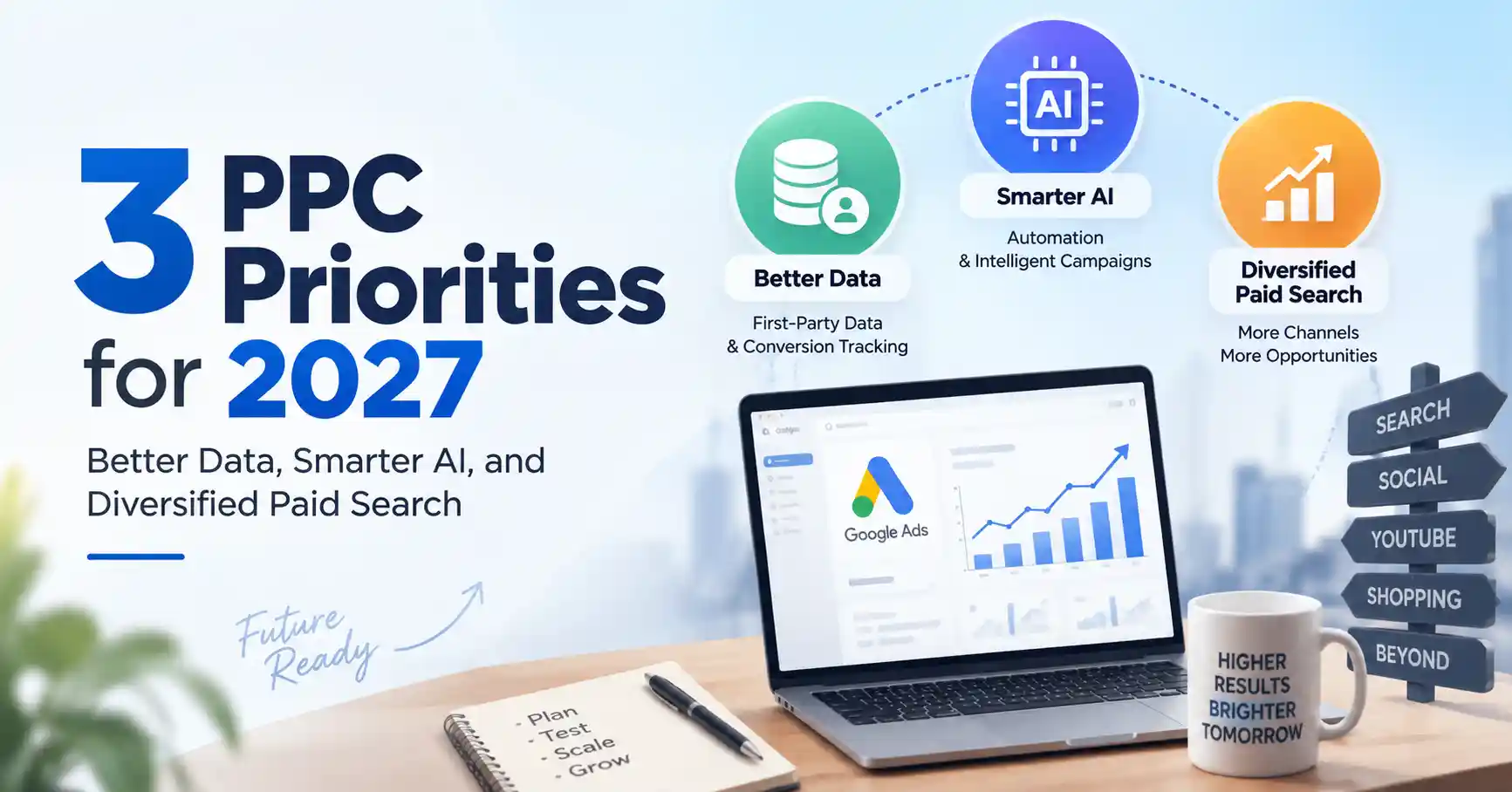
The answer comes down to three priorities: better business data, broader acquisition channels, and smarter use of AI.
What are the most important PPC priorities for 2027?
The three priorities worth putting near the top of your PPC roadmap are:
- Build stronger first party data and conversion signals.
- Reduce dependence on a single paid acquisition channel.
- Use AI to manage complexity instead of blindly handing over strategy.
The common thread is control.
You may have less control over individual auctions, but you can still control the quality of your data, your business goals, your channel mix and the way you evaluate automated decisions.
That shift is important because PPC platforms are increasingly designed to make decisions at scale. Search Engine Land’s recent analysis makes a similar point: as platforms take greater control of media buying, advertisers need to rethink where their strategic advantage comes from.
Why will first party data become a bigger PPC advantage?
If Google’s algorithms are making more decisions, what information are you giving them?
This is probably one of the most important questions for PPC teams going into 2027.
A simple form submission isn’t always a valuable conversion. For a B2B company, one form might turn into a twenty thousand dollar buyer while the next is just spam. Ecommerce works similarly. A five hundred dollar order isn’t automatically better than a two hundred dollar sale, Margins matter. Repeat potential matters too, Sometimes that smaller cart size wins long term.
That’s why first party data matters.
Your CRM records, qualified leads, customer purchases, revenue, product margins, repeat purchases and offline sales can tell advertising platforms much more about what a genuinely valuable customer looks like.
Google is also continuing to strengthen its conversion infrastructure. Its enhanced conversions capabilities allow advertisers to supplement conversion measurement with hashed first party customer information, while enhanced conversions for leads can connect offline outcomes back to advertising activity.
The practical lesson is simple: don’t just tell Google that somebody filled out a form. Where possible, tell it which leads became customers and what those customers were worth.
How should you improve conversion tracking for 2027?
Start with a conversion audit.
Ask yourself:
- Are we optimizing for actual business outcomes?
- Are low quality leads being treated the same as qualified leads?
- Can CRM or offline sales data be connected to campaigns?
- Do conversion values reflect revenue, profit or customer value?
- Are important conversion events being tracked consistently?
This is where conversion tracking becomes more than an analytics task. It becomes part of your bidding strategy.
Google’s documentation specifically positions enhanced conversions and offline conversion measurement as ways to improve the accuracy of measurement and provide stronger signals for bidding.
A useful rule for 2027: better inputs can matter more than more manual optimization.
Should your PPC strategy depend entirely on paid search?
Probably not.
Paid search still pulls its weight, snagging folks who already know what they want. Yet Google isn’t the only game in town.
Modern buyers sniff out products across YouTube, social feeds, newsletters, marketplaces, and even AI search tools.
Relying on just one acquisition channel? Massive risk. It leaves a business wide open to sudden, brutal shifts in algorithms and budgets.
Imagine your Google Ads CPA suddenly increases. Or search behavior changes. Or an AI search experience answers more queries before users reach traditional results.
If search is your only engine for demand, there aren’t many alternatives waiting in the wings.
This doesn’t mean abandoning paid search. It means building a more flexible acquisition system.
Your PPC strategy might combine Google Ads with YouTube, paid social, SEO, email, content, partnerships or other channels depending on your audience.
The goal isn’t to spend a little money everywhere. That’s just expensive chaos.
The goal is to understand which channels create demand, which capture demand and which assist the final conversion.
Paid social grabs attention first. Weeks later, paid search reels them in once desire strikes. Yet simplistic last click reporting flattens this complex journey. It absurdly crowns search the lone hero, completely ignoring the vital groundwork laid long before by discovery ads.
This is why cross channel measurement will become increasingly important.
How will Google Ads automation change PPC management?
Google Ads is becoming less like a collection of manual switches and more like an intelligent system that needs good direction.
Google Ads AI Max is a good example. Google says AI Max expands search campaigns through features such as search term matching, text customization and final URL expansion. Google has also introduced additional testing and planning capabilities to help advertisers experiment with budgets and ROI targets.
The implication for marketers is pretty straightforward.
You don’t necessarily need to fight automation. You need to learn how to guide it.
That means giving the system:
- Accurate conversion signals
- Useful customer data
- Strong creative assets
- Clear business objectives
- Appropriate budgets
- Sensible bidding targets
- Relevant landing pages
- Brand and business constraints
Google itself has described AI as increasingly central to Search advertising, including newer AI powered campaign and creative capabilities.
As PPC consultant Robert Simpkins argues in the Search Engine Land analysis, the advantage is shifting away from manually controlling every auction and toward controlling the information and strategy surrounding the platform.
That’s a much more useful way to think about automation.
Where does agentic AI fit into PPC priorities for 2027?
Here’s the fun part.
AI agents could become useful not because they replace Google Ads bidding system, but because they help marketers understand everything happening around it.
Imagine an AI agent checking campaign data, CRM information, analytics and product information and then asking:
“CPA improved, but did lead quality fall?”
Or:
“Revenue increased, but did profit actually improve?”
Or:
“Did conversion tracking break after the website update?”
Those are better questions than simply asking whether CPC went up or down.
An agent can potentially monitor campaigns, identify unusual changes, summarize performance and gather evidence for human review. The marketer can then spend more time making decisions instead of jumping between dashboards.
That fits right where paid search automation is heading. Search Engine Land highlights agentic AI infiltrating media workflows, Simultaneously, Google embeds intelligent tools deeper into its ad ecosystem. It moves relentlessly. Nobody blinks.
The human role doesn’t disappear. It becomes more strategic.
What should advertisers do now to prepare for 2027?
You don’t need to rip apart your ad setup overnight. Start small.
Fix your conversion tracking first. Are those optimization events actually driving real business value, Check them.
Second, connect your CRM and offline outcomes to your advertising data where practical. If Google only sees leads but your sales team knows which leads become customers, you’re leaving valuable information disconnected.
Third, review your acquisition mix. If one platform generates almost all your new demand, identify another channel you could realistically develop.
Fourth, test AI tools around your PPC workflow. Start with reporting, anomaly detection, research and repetitive analysis before giving an AI system permission to make high impact changes automatically.
Keep testing. That is the bottom line. The future of PPC isn’t some magic campaign structure that lasts forever. It’s building a living system, One that bends when search habits, ad platforms, and customer journeys shift.
FAQ’s
Bad data gums up automated ad platforms. It’s a simple fact. With systems taking over bidding and targeting, solid conversion data and real business results will be key. They’re the signals those machines need.
Sure, Google Ads dominates paid search, but staking your entire acquisition pipeline on a single tech giant is reckless. Don’t do it. Spreading budget across different channels curbs risk and keeps you independent.
First party data tells the raw truth about buyers. Hook it up right, and automated tools instantly sort high value conversions from absolute junk traffic.
AI will automate boring PPC tasks. Strategy, client calls, creative vision, and data analysis still demand a human touch. That is it. Roles are shifting entirely toward platform management and high level decisions.
Start with conversion tracking. Make sure the conversions you’re optimizing toward actually represent business value. Then review your first party data, channel mix, creative and automation strategy.
Conclusion
The fundamentals of PPC aren’t disappearing. People will still search, compare products, click ads and buy.
What’s changing is the machinery behind those interactions.
Platforms are automating more of the auction. Search is becoming more conversational. AI is influencing discovery. Last click attribution misses modern journeys entirely, so what actually matters for PPC by 2027? Clean your data. Diversify your channels. And let automation do the heavy lifting while you keep both hands firmly on the steering wheel.
The best PPC teams won’t necessarily be the ones making the most manual changes.
They’ll be the ones that understand their customers best, send better signals to advertising platforms and know when automation should be trusted and when it needs a human looking over its shoulder.

Kumar Swamy is the CEO of Itech Manthra Pvt Ltd and a dedicated Article Writer and SEO Specialist. With a wealth of experience in crafting high-quality content, he focuses on technology, business, and current events, ensuring that readers receive timely and relevant insights.
As a technical SEO expert, Kumar Swamy employs effective strategies to optimize websites for search engines, boosting visibility and performance. Passionate about sharing knowledge, he aims to empower audiences with informative and engaging articles.
Connect with Kumar Swamy to explore the evolving landscape of content creation!