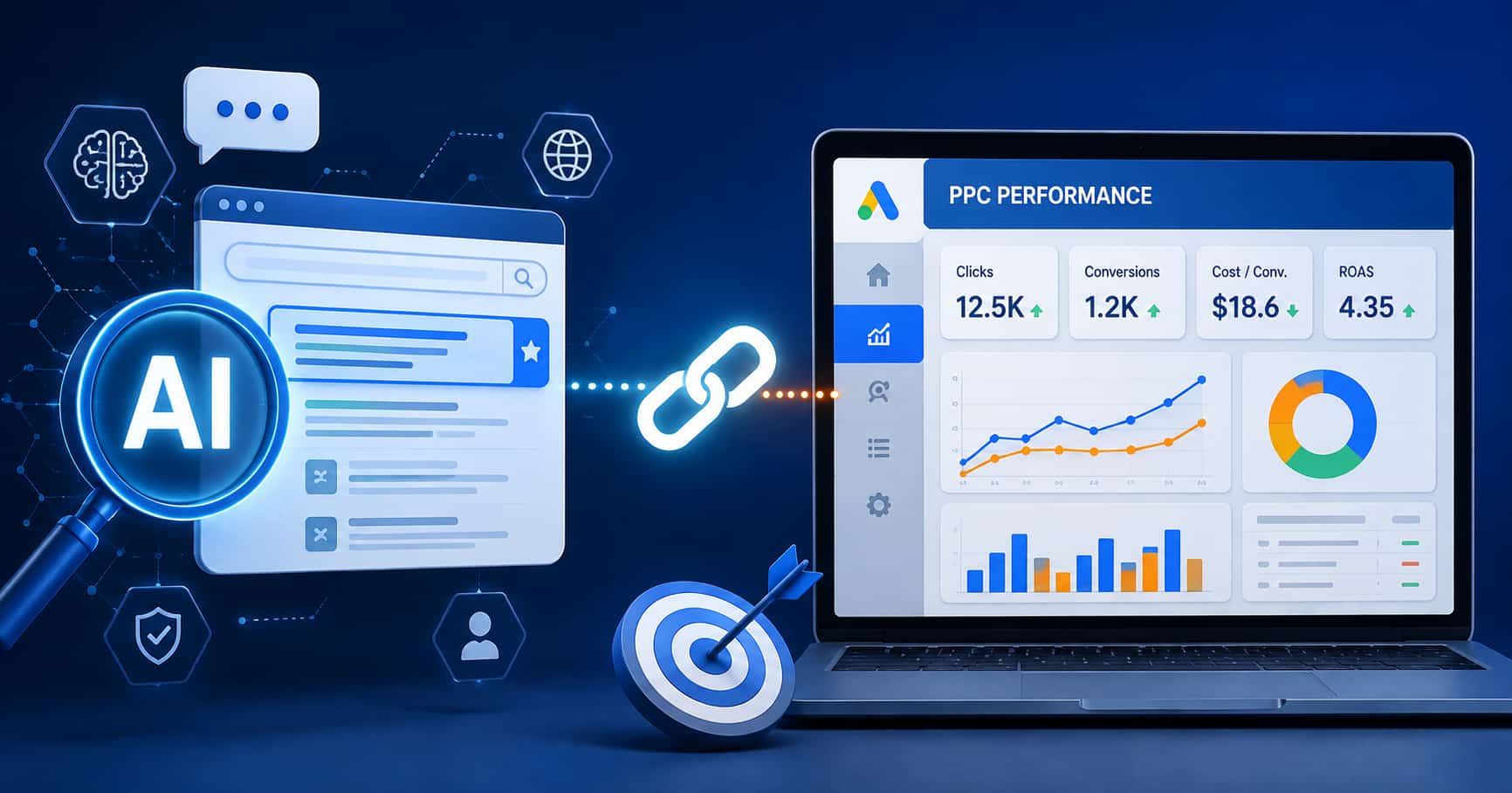
So, you’ve checked your PPC campaign. The click through rate looks decent, and the cost per conversion feels reasonable, but the leads still don’t quite land the way you expected, right?
It might not be the bids, the keywords, or even the ad copy that’s causing the problem. There is another layer happening first, long before anyone clicks: AI search visibility.
Think about Google AI Overviews, AI Mode, ChatGPT, and other AI driven discovery experiences. They are changing how people research products, compare brands, and decide what deserves their attention.
A potential customer can see your brand, a competitor, or even an entire product category inside an AI generated response. Later, they may perform the search that eventually leads to the PPC conversion you can track.
That’s the part many teams miss.
AI visibility adds context to PPC performance.
Instead of measuring only what happened after the click, you can begin to understand what may have shaped the customer’s thinking before the click even happened.
When you understand that bigger picture, PPC metrics can become much easier to interpret, and the “why” behind lead quality becomes clearer.
Why does AI visibility add context to PPC performance?
- Standard PPC reports usually tell you what happened after someone clicked your ad, including clicks, conversions, cost per acquisition, and return on ad spend.
- Those metrics are useful, but they leave out an important part of the journey: what happens while people are still researching.
- AI search visibility adds another layer by showing how your brand appears during the research and consideration stage. AEO tools for AI search can help monitor this visibility and identify opportunities to optimize your content for AI-generated answers and recommendations.
- An AI generated answer can introduce your business to someone before they ever perform a direct commercial search.
- A customer may see your brand inside an AI response, later search for your brand on Google, and eventually convert after clicking a paid ad.
- That creates a conversion attribution challenge because the last PPC click may not fully explain how the customer arrived there.
- The earlier AI exposure may have helped shape the customer’s decision even though that interaction was not directly captured as a PPC conversion.
- AI visibility can uncover the topics, questions, and searches associated with your brand.
- Grounding queries can provide insight into the prompts and background searches AI systems use to construct answers.
- Citation data can show which websites and sources AI systems rely on when discussing your brand or a specific topic.
- Competitor visibility can show where another brand is receiving more AI generated exposure.
- PPC teams can use these findings to understand what changed in campaign performance instead of looking only at final conversion totals.
How is AI search changing the paid search journey?
- The traditional journey was usually: Search → Ad → Click → Landing Page → Conversion.
- The newer journey can look more like: Question → AI Answer → Brand Discovery → Search → Ad → Click → Conversion.
- People can now research products, compare brands, check pricing, and evaluate alternatives before interacting with an advertisement.
- AI generated answers can influence which brands customers remember and later search for.
- A customer may read an AI generated answer without clicking any of the websites included in the response.
- They may return later through a branded Google search.
- The eventual conversion could then be attributed to paid search, even if AI visibility influenced the earlier consideration stage.
- AI search can make the customer journey less linear and harder to measure when relying only on last click attribution.
- PPC marketers should look beyond individual clicks and consider how brand presence, visibility, and reputation signals help create demand before the paid interaction.
- Search intent data, branded search trends, AI mentions, and PPC conversions can be reviewed together to identify broader patterns.
How do AI Overviews affect Google Ads and PPC reporting?
- AI Overviews change how users interact with Google Search by placing AI generated information directly inside the search experience.
- Users may receive useful information before deciding whether to click an advertisement or an organic result.
- AI generated answers can influence which brands customers consider during the research stage.
- Google Ads remains important, but advertisers need to understand how paid search fits into a larger AI influenced customer journey.
- A branded PPC conversion may sometimes represent demand that was created earlier through organic search, AI discovery, social proof, reviews, or third party exposure.
- Last click attribution can make the final paid interaction appear more influential than it actually was within the full customer journey.
- PPC teams should continue tracking click through rate, cost per click, conversion rate, cost per acquisition, revenue, and return on ad spend.
- These traditional metrics can be combined with AI visibility signals such as brand mentions, citations, grounding queries, topic associations, and competitor visibility.
- Comparing AI visibility trends with PPC performance can help identify whether changes in search behavior are influencing campaign results.
- AI visibility should be treated as an additional context layer for PPC reporting, not as a replacement for established advertising metrics.
Can competitors’ AI visibility explain poor PPC results?
Imagine two companies going after the same high value customer.
Your PPC campaign has strong ads, competitive bids, and landing pages that match search intent. Yet your competitor keeps appearing inside AI generated answers for the questions your audience is actually asking.
It can feel random, but it might not be.
That competitor may already be shaping the customer’s perception before the paid search auction even begins.
This is where competitor AI visibility becomes particularly useful.
Search Engine Land discusses share of authority, which can help marketers understand how often a brand or domain is being referenced compared with competitors for relevant topics and queries.
The key point is not simply:
“How can we appear everywhere?”
Instead, ask:
“Where do we need stronger evidence so qualified customers actually consider us?”
If competitors repeatedly appear in AI answers for valuable commercial topics, investigate what is supporting their visibility.
They may have:
- More detailed product pages
- Stronger customer reviews with specific experiences
- Better third party coverage
- More useful comparison content
- Clearer product information
- Stronger proof points
- Better topical authority
- Better alignment between content and search intent
For PPC teams, these findings can influence keyword research, ad messaging, landing page content, and campaign strategy.
What should PPC teams measure alongside traditional metrics?
AI visibility should not replace the PPC dashboard. It should sit beside it so you can see both sides of the customer journey.
Keep tracking the fundamentals:
- Click through rate
- Cost per click
- Conversion rate
- Cost per acquisition
- Return on ad spend
- Lead quality
- Revenue
Then add AI visibility signals that can help explain what may happen before the click:
- AI brand mentions
- Citation frequency
- Citation sources
- Grounding queries
- Topic associations
- Competitor share of authority
- Branded search growth
- AI influenced traffic, where measurable
The goal is not to build another vanity report.
The goal is to connect the dots.
For example, if PPC traffic increases while lead quality falls, AI visibility data can help determine whether your brand is becoming associated with the wrong audience or product category.
If branded conversions rise, broader AI visibility and organic presence may be helping amplify brand demand.
If competitors keep appearing in AI answers for important commercial topics, their visibility can reveal content gaps or areas where your brand needs stronger proof and supporting information.
What does this mean for the future of PPC?
- Paid search and organic search are becoming increasingly connected through AI powered search experiences.
- PPC teams will need to track not only ad performance but also how their brand is interpreted before a person reaches the ad.
- AI systems rely on signals from websites, product pages, reviews, content, and other sources to understand brands and topics.
- Clear and consistent website language can make it easier for both users and AI systems to understand what a business actually offers.
- Landing pages should clearly explain what the offering is, who it serves, what problem it solves, and why customers should trust it.
- Ad copy and landing page copy should reinforce the same value proposition rather than communicating conflicting messages.
- AI visibility data can give PPC teams a useful view into new search intent signals that standard keyword reporting may miss.
- Competitor AI visibility can reveal themes, questions, and commercial topics where other brands have stronger credibility.
- PPC reporting will increasingly need to look beyond the final click and consider the broader customer journey.
- The strongest PPC strategies will combine paid search data with SEO, content strategy, brand visibility, and AI search intelligence.
- The future of PPC is not about choosing between paid search and AI visibility. It is about understanding how both work together across the same customer journey.
Frequently Asked Questions
No. AI visibility complements traditional PPC reporting. It helps explain what may happen before you get to something measurable, such as a click or conversion.
AI search visibility measures how often and how prominently a brand appears in AI generated answers, recommendations, citations, and related search experiences.
They can change how users move through the search results page and where advertising opportunities appear. Advertisers should monitor both traditional PPC results and changes in AI powered search behavior.
It can highlight content gaps, incorrect brand associations, competitor advantages, and new search intent patterns. Those insights can guide keywords, ad copy, landing pages, and campaign strategy.
There is no single metric that works for every business. Grounding queries, citations, topic associations, and share of authority can be useful when connected to business outcomes such as qualified leads and revenue.
Conclusion
PPC performance is no longer just about what happens after someone searches and clicks.
AI search is increasingly influencing how people research and evaluate options before that measurable interaction. AI visibility adds context to PPC performance because it reveals how AI systems interpret your brand, which topics they connect with it, which sources they rely on, and where competitors may have an advantage.
The most capable PPC teams will not abandon traditional metrics. They will combine them with AI search visibility to understand the full customer journey, from the first moment of curiosity to the final conversion.

Kumar Swamy is the CEO of Itech Manthra Pvt Ltd and a dedicated Article Writer and SEO Specialist. With a wealth of experience in crafting high-quality content, he focuses on technology, business, and current events, ensuring that readers receive timely and relevant insights.
As a technical SEO expert, Kumar Swamy employs effective strategies to optimize websites for search engines, boosting visibility and performance. Passionate about sharing knowledge, he aims to empower audiences with informative and engaging articles.
Connect with Kumar Swamy to explore the evolving landscape of content creation!