
Introduction
- AI visibility now reaches in before the click, and your content can still influence what people see even if nobody ever visits your site.
- The Citations Dashboard gives tangible metrics on how often AI systems cite your content, a signal that sits beyond traditional SEO.
- For small businesses, this shifts how you measure performance, though the metrics remain proxy signals, not direct KPIs like revenue or traffic.
In AI-driven discovery, influence happens upstream of visits and clicks. That part now matters strategically.
The Citations Dashboard Explained (Practitioner TL;DR)
Answer: The Citations Dashboard shows when and how your content is mentioned in AI-generated answers across the supported AI systems. It pulls together citation counts, authority share, queries that trigger those citations, referral traffic trends, and page-level performance.
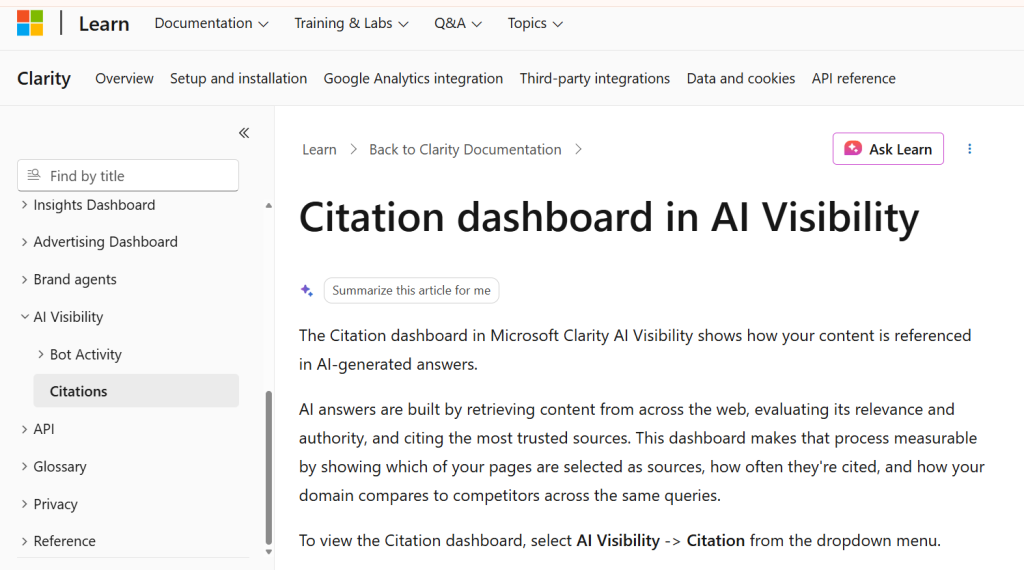
This is not exactly a classic analytics report. It doesn’t show impressions or ranking positions. Instead, it indexes how frequently generative systems pull your pages into their responses, basically tracking AI influence signals.
Citation counts ≠ clicks. They’re a new visibility layer.
Why It Matters: The Strategic Shift From SEO to AEO
Answer: Traditional SEO leans on rankings, impressions, and clicks. But AI agents often step in before the click, stitching together answers from multiple sources without actually sending the user to your site. That is the point where the Citations Dashboard becomes measurable.
Think of it as AI Engine Optimization (AEO), a layer of sway between possible user intent and eventual access to your site.
Example
A skincare brand optimized for “best routine for sensitive skin” might manage to hit #1 on Google Search, but an AI assistant could still pull in competitor content if that material is better structured or more contextually richer. This is why visibility inside AI answers doesn’t always line up with traditional search rankings, and only a tool like Clarity’s dashboard shows the real picture.
So yeah, it’s influence upstream; it moves demand generation signals, but it isn’t directly connected to your SEO KPIs right now.
What the Dashboard Actually Tracks
Answer: The dashboard gives you six core views to understand how AI influence works in practice:
- Page citations – how often your URLs show up in AI answers.
- Share of authority – your relative citation share compared to others for similar queries.
- AI referral traffic – the percentage of sessions that came from AI assistants.
- Queries used for grounding – which AI prompts or queries caused your content to get selected.
- My cited pages – citation counts at the page level, plus the context around them.
- Trendlines – how citation activity changes over time.
This is your supply of “trusted signals” inside AI discovery, not a click or conversion metric.
What Should You Do With This Data? (Step by Step)
Answer: Treat AI citations as influence signals, not performance KPIs yet, and use them to sharpen your content strategy and topic authority.
Action Steps for Practitioners:
- Map queries to intent categories, find the questions where your pages are not cited but should be.
- Audit high citation pages, adjust the flow, readability, and entity coverage so citations become more meaningful.
- Align with search metrics connect citation counts to organic visibility indicators.
- Feed insights back to content teams, push topic clusters where AI presence is low, but the opening is high.
- Build AI forward briefs, structure for grounding: clear definitions, canonical data, and entity references.
This maps the older, traditional content strategy over to AI discovery optimization in a practical way.
What This Doesn’t Tell You
Answer: Citation data does not guarantee traffic, conversions, or clicks. It only signals that an AI engine is referencing your content.
- Citations ≠ clicks. A lot of AI agents mention a source, but they do not create measurable click-through sessions.
- Some AI systems do not expose referrers at all, so the data might undercount your real AI footprint.
- Not every AI platform’s grounding signals get captured, which restricts full visibility.
Think of the dashboard as a thermometer, not a scoreboard.
What Small Businesses Need to Know
Answer: Clarity’s AI Citations Dashboard is free and accessible for small businesses, giving a low-friction window into how AI systems are using your content.
For small teams, the opportunity cost is not only to measure but to respond:
- Shift some of your KPIs away from pure clicks toward AI discoverability signals like references and mentions.
- Update content briefs so they carry entity-rich, neatly structured data that AI models can actually latch onto.
- Treat AI visibility the way voice search once was, meaning it signals brand presence in conversational discovery.
For lean teams, AI visibility can become a differentiator if it is built into content planning.
How Citations Relate to Traditional SEO Metrics
Answer: Citations are tracking AI reference signals, while SEO is usually focused on user access signals. They overlap, but they are not identical.
| Metric Type | What It Measures | Primary Insight | Business Use |
|---|---|---|---|
| Organic Rank | Position in search results | Visibility in search listings | Traffic generation |
| Impressions | Number of times shown | Exposure | Awareness measurement |
| Clicks | Click-through counts | Engagement | Traffic/conversions |
| AI Citations | Frequency of AI references to your content | Influence inside AI answers | Demand signal before traffic |
| AI Referral Traffic | Sessions from AI agents | Actual user visits | Direct traffic measurement |
Key point: AI citation counts show influence; usual SEO metrics show access and consumption.
What the Source Missed (Practitioner Perspective)
Answer: The source article described what the dashboard is but didn’t unpack the strategy implications enough.
- No linkage to content engineering how to systematically improve grounding signals.
- No talk about cross-platform AI behavior, not all AI systems are captured.
- Lacks competitive context, how citation share affects relative domain visibility.
So, understanding citation signals isn’t enough; you have to engineer content so it is grounding-friendly.
The Counter-Argument: Why Some Marketers Will Dismiss It
Answer: Skeptics claim there is no directly measurable human value that comes from AI citations, and most AI systems still route minimal sessions to websites.
This critique holds weight: citations can inflate content’s perceived value without actually upping real world ROI. Still, if you ignore these signals, you are basically throwing away early hints about AI discovery patterns, and then competitors will walk ahead, because they optimize for it more consistently.
Conclusion
- Citations data is an early indicator of how generative systems use your content different from traditional SEO but it remains strategically useful.
- Provides upstream visibility into discovery, which is a critical signal now that AI is becoming the default interface for queries.
- It is not a replacement for traditional metrics but rather an added layer.
- Small businesses can use this without extra cost, however they have to fold it into content planning and measurement workflows.

Kumar Swamy is the CEO of Itech Manthra Pvt Ltd and a dedicated Article Writer and SEO Specialist. With a wealth of experience in crafting high-quality content, he focuses on technology, business, and current events, ensuring that readers receive timely and relevant insights.
As a technical SEO expert, Kumar Swamy employs effective strategies to optimize websites for search engines, boosting visibility and performance. Passionate about sharing knowledge, he aims to empower audiences with informative and engaging articles.
Connect with Kumar Swamy to explore the evolving landscape of content creation!