
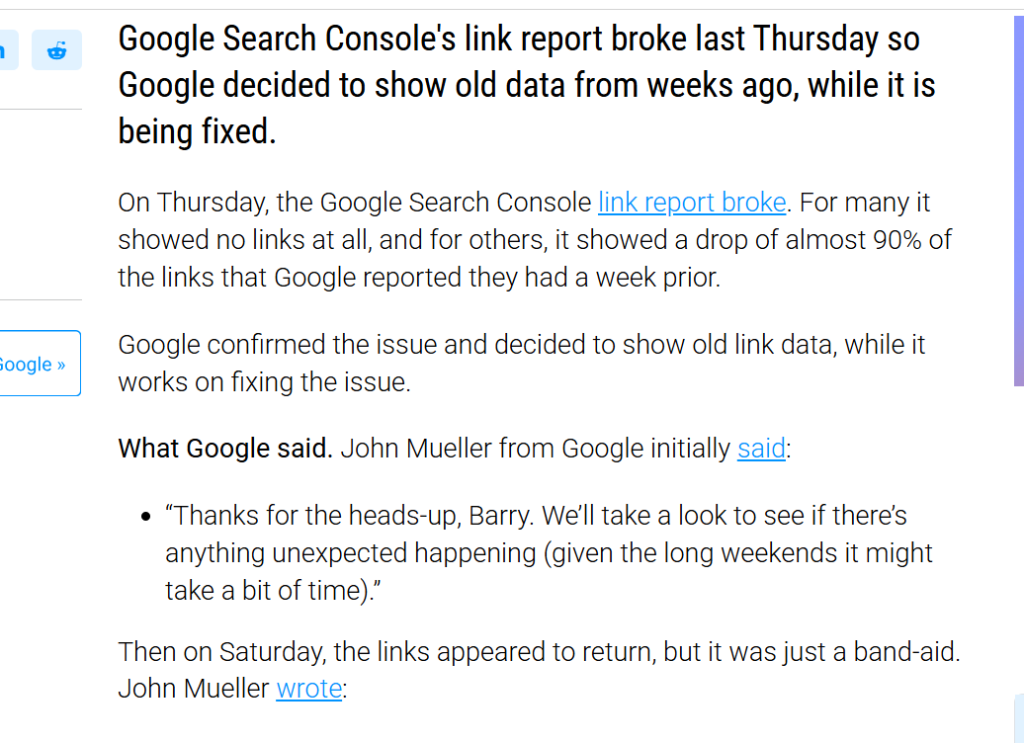
Last week SEO teams opened Google Search Console and noticed backlink counts going down, like overnight, just flat out collapse. Some properties showed drops of 60% , 80% , even 100% . External links looked like they disappeared. Internal links also seemed to vanish. Referring domains shrank without any warning. For agencies running enterprise clients, it felt like a total catastrophe, you know. However, the rankings did not crash. Traffic did not suddenly fall off a cliff. Later, Google confirmed it was a reporting bug tied to the Links report, and they temporarily rolled the system back to older historical data while their engineers worked on a fix.
That statement helped ease a few people, but it also highlighted a deeper problem sitting inside modern SEO workflows: too many organizations treat Google Search Console as if it is unquestionable source of truth. That part, is the real story here.
Key Introduction
• Google Search Console’s Links report temporarily showed outdated historical data because Google confirmed a reporting issue.
• The incident showed just how dependent SEO teams have become on one single reporting platform, like they can’t function without it.
• Smart SEO operations validate performance using multiple data sources before making decisions that actually matter.
So what happened to the Google Search Console Links report?
Direct answer: Google confirmed there was a reporting issue, the backlink data inside Search Console vanished or fell hard, then they temporarily put back older historical information while engineers worked on the correction.
• SEO professionals saw sudden declines in external backlinks, internal links, and also referring domains.
• Some sites displayed “0 external links”, even when rankings and traffic looked stable.
• The issue appeared across several industries at the same time, which pointed more to a platform-level reporting malfunction, not an algorithmic penalty.
• Google later acknowledged the same problem and briefly reverted the report to older historical datasets.
• The reporting issue did not seem to affect actual rankings, indexing, or crawl work.
• Quite a few businesses mixed up reporting visibility with true SEO outcomes, which caused unnecessary panic in the first place.
• The incident showed just how much SEO teams have become reliant on Search Console dashboards for decision making.
• Search Console reports are processed datasets, not a live readout of Google’s algorithm at all.
For many businesses, the emotional response was pretty immediate. Execs assumed authority had vanished. Agencies began checking disavow files right away. In house marketing teams started wondering if those recent link-building pushes had backfired. Yet the data problem was sitting inside the reporting layer, not necessarily inside Google’s ranking systems.
That separation matters more than most businesses imagine.
A dashboard is not the algorithm itself. It’s more like a representation, of processed information. When companies treat those dashboards like absolute truth, even temporary reporting troubles can create extra operational chaos.
This whole thing also showed, how many organizations still lean heavily on backlink counts as a main SEO KPI. That’s risky because links are increasingly contextual, quality-driven, and interpreted differently across various platforms.
A seasoned SEO team doesn’t panic just because one graph shifts overnight. They check the signal across rankings, traffic, crawl activity, referral sessions, and independent SEO tools before making any strategic calls.
Quotable summary: A reporting bug can trigger more panic than a real ranking fall.
So why are SEOs overreacting to this bug?
Direct answer: Many SEO teams mistakenly treat Google Search Console as a full backlink database, even though Google has never framed it that way.
Search Console is pretty handy, but it always felt partial, sampled, delayed, limited in scope. And Google never really promised that the Links report shows every single backlink or updates in real time. Yet, a big chunk of the SEO industry quietly created workflows expecting exactly that.
That reliance became obvious the second the reporting issue showed up. Agencies started digging fast, looking for vanished partnerships, nasty backlink patterns, and even possible penalties. A few businesses also wondered if their recent digital PR pushes had fallen flat.
The reaction says more about how the industry deals with data than about the bug itself.
Most orgs today lean hard on visual dashboards. Once charts dip hard, people instinctively think business performance dropped too. But SEO measurement is more layered than the dashboard story.
A seasoned SEO operator checks several signals before jumping to conclusions:
• Ranking movement
• Organic traffic trends
• Crawl behavior
• Levels of indexation
• Referral traffic
• Third-party backlink datasets
• Demand for the brand itself
If only one reporting source shifts while everything else stays the same , then it is likely observational, not truly algorithmic.
A real-world example that agencies will recognize
Picture a SaaS company that spends $20,000 every month on digital PR and “authority-building” campaigns. In their quarterly reporting deck they usually show:
• Referring domains
• Authority growth
• Earned backlinks
• Brand mentions
• Link velocity
Now imagine opening Search Console the day before a board meeting and finding that backlinks dropped by 80% .
Even if rankings stay steady, the SEO team has to defend the campaign results using other datasets right away. That kind of scramble makes things unclear, weakens stakeholder confidence, and pushes the discussion away from the actual business outcomes.
The source coverage around this issue focused mostly on that technical bug. What it largely missed was the organizational risk that gets created when businesses over-centralize reporting inside one single ecosystem, you know.
This is especially dangerous for small businesses. Many smaller companies lean almost entirely on free Google tools because premium SEO platforms feel expensive. When Search Console ends up with reporting instability, they do not have a secondary validation layer to check against, or at least they do not in any practical way.
Thats how reporting bugs turn into business problems, quietly.
Quotable summary: The danger isn’t inaccurate data alone. The danger is building decision-making systems around one platform.
So… can you trust Google Search Console for backlink analysis anymore?
Direct answer: Yes, but treat it as one validation layer only, not your primary backlink intelligence platform.
Google Search Console still gives unique value because it mirrors links that Google itself actually recognizes across parts of its own ecosystem. That makes it strategically important, even if you have a few other tools. But using it like a total backlink database has been kind of a mistaken idea from the beginning, and it is not really that complete.
A better path is to combine Search Console with independent crawling tools and then also pair it with performance metrics, so you get both verification and impact.
| Tool | Best Use Case | Biggest Limitation | Ideal User |
|---|---|---|---|
| Google Search Console | Google-recognized link validation | Incomplete and delayed datasets | SEO validation workflows |
| Ahrefs | Competitive backlink analysis | Premium pricing at scale | Agencies and enterprise SEO |
| Semrush | Integrated marketing workflows | Link freshness inconsistency | Multi-channel marketing teams |
| Majestic | Link quality and trust analysis | Less intuitive interface | Technical SEO specialists |
| Screaming Frog + APIs | Custom enterprise reporting | Requires advanced setup | Large-scale SEO operations |
Key Insight: No backlink platform offers perfect visibility, even Google’s own suite.
Interestingly, this incident also showed how third-party SEO platforms can keep running with more operational continuity during reporting disruptions than Google itself. That surprises a lot of small business owners, because they assume that Google-owned tools are always the most dependable, even when something goes weird.
But Google Search Console was never built to be a full, comprehensive, enterprise-grade reporting system. It’s more of a diagnostic platform, in practice.
And that distinction really matters.
When SEO teams are more mature, they separate business outcomes from reporting fluctuations. If the rankings look steady, organic traffic keeps its normal pattern, referral traffic still flows, indexed pages remain consistent, and crawl behavior appears healthy, then a reporting anomaly should not be treated like a reason for big strategic shifts.
That mental habit prevents emotional SEO decisions and it also helps protect businesses from overreacting to temporary platform instability.
It also shows a wider change in SEO itself. Modern search optimization is no longer about fixating on just one metric. Google looks at relevance, authority, user behavior, entity relationships, topical depth, and trust signals in a much more intricate way, than backlink totals alone can actually explain.
Backlink reporting is still useful, yes. but it is no longer enough by itself, I mean really.
Quotable summary: Search Console should support your SEO plan, not drive it.
So what should agencies and small businesses do right now?
Direct answer: don’t make reactive SEO moves based only on the current Search Console link data, and confirm performance by using multiple sources, not just one.
• Do not remove backlinks, or update disavow files, based only on what the current Links report shows.
• Don’t pause digital PR or link-building campaigns just because the links report looks different, unless rankings and traffic also dip.
• Cross-verify backlink info using Ahrefs, Semrush, Majestic, and referral traffic analytics.
• Compare organic rankings and keyword visibility, before jumping to authority loss conclusions
• Put reporting conversations on revenue, leads conversions, and traffic, not those vanity link numbers
• Keep backup reporting setups, instead of relying 100% on Search Console exports
• Save old backlink snapshots and crawl data so later comparisons are actually possible
• Build an internal SEO incident log to note outages, reporting weirdness, and algorithm changes
• Talk early with stakeholders so no one goes into panic when reporting shifts temporarily
• Treat Search Console as a check tool, not as the full source of SEO reality
This incident also made a common weak spot in agency reporting structures pretty clear.
In many monthly SEO reports still get prioritized:
• Total backlinks
• Domain authority
• Referring domains
• Link growth charts
These metrics help, but they do not equal business outcomes.
Clients care more about:
• Revenue
• Qualified leads
• Sales pipeline
• Conversion growth
• Organic visibility
• Brand demand
When reporting systems lean into vanity metrics too much, small platform hiccups can trigger disproportionate worry.
The smartest agencies treat link metrics as helpful supporting signals, not the main headline outcome they sell.
A more grounded reporting framework for 2026
Instead of building reports mainly around backlinks, today’s SEO reporting should blend together:
- Organic traffic quality
- Conversion performance
- Revenue attribution
- SERP presence
- Branded search momentum
- Topical authority expansion
- Technical SEO healthiness
- Link acquisition trends
That wider structure gives more resilience, if one reporting tool goes unstable for a spell.
Quotable summary: Strong SEO operations depend on resilient systems, not a single dashboard.
Is Google Search Console becoming less reliable?
Search Console is still valuable , but a lot of businesses are leaning on it like it’s the only reporting ecosystem they have, and that becomes a problem.
- Modern marketing teams increasingly lean on Google owned platforms like GA4, Search Console, Merchant Center, and Looker Studio for day to day decisions.
- When one reporting layer gets wobbly, the whole workflow around reporting can feel unstable, even when the rest of the stack is fine.
- Google also rarely gives detailed transparency about when link reports refresh, or what exactly changes during data processing.
- The Links report has shown delays, odd fluctuations, and sometimes incomplete backlink visibility over time.
- Search Console really was built as a diagnostic instrument, not as a complete enterprise SEO reporting framework.
- A lot of organizations expect real time and fully comprehensive backlink coverage from a free tool, which is usually not what they will get.
- Meanwhile, some third party SEO platforms provide more operational continuity when reporting disruptions happen, and teams can keep moving without as much friction.
- Even with its limits Search Console still gives those pretty singular insights into Google-recognized search and indexing data, you know.
- The problem is not that Search Console is bad, it is that there is too much dependence on one platform, which tends to happen.
More mature SEO teams usually double-check what they see across several systems before any big strategic move.
To be fair, Search Console is still among the most powerful free SEO tools ever made. It brings things like:
- query level search visibility
- indexation diagnostics
- crawl reporting
- canonicalization insights
- Google-recognized link samples
No free platform gets even close to that.
Again, the issue is not Search Console failing. The issue is that a lot of businesses now expect enterprise-grade reporting reliability from a free diagnostic ecosystem, and that mismatch creates operational problems all over the SEO industry.
There is also a bigger trend moving through digital marketing right now. Organizations keep consolidating more analytics, ads, SEO, and attribution workflows into Google owned ecosystems. This centralization improves efficiency but at the same time it raises dependency risk, a lot.
If one Google reporting layer turns unstable, even briefly, it can shake up entire performance narratives across agencies and in house teams.
That is exactly why more mature SEO operations add redundancy into their measurement systems, and don’t rely on a single pipeline.
Quotable summary: Search Console is a great diagnostic tool, but it can be a risky single source of truth.
The real lesson behind the GSC links report bug, is that.
Direct answer: The strongest SEO teams build systems that can survive uncertainty instead of assuming dashboards will always remain accurate.
This incident made a clear gap visible between tactical SEO and operational SEO maturity.
Beginner SEO tends to react emotionally when metrics disappear.
Experienced SEO validates signals first, before changing strategy.
That difference matters more now than ever, because modern search ecosystems are getting more noisy every week:
• AI Overviews change the click pattern
• Reporting systems lag behind
• Attribution models break in weird ways
• SERP layouts fluctuate
• Crawl visibility shifts constantly
• Analytics platforms sample data a little differently
Conclusion
So if your SEO strategy changes dramatically because one dashboard breaks for three days, then your operational process is kind of fragile, even if you thought it was steady.
The best SEO teams already assume:
• Data can arrive late
• Reporting can fail
• Dashboards can mislead
• Platforms can change suddenly
So they set up systems that lean on resilience rather than certainty.
That’s the deeper lesson hiding inside Google Search Console’s broken Links report. And honestly, it feels like a lesson the SEO industry probably needed.

Kumar Swamy is the CEO of Itech Manthra Pvt Ltd and a dedicated Article Writer and SEO Specialist. With a wealth of experience in crafting high-quality content, he focuses on technology, business, and current events, ensuring that readers receive timely and relevant insights.
As a technical SEO expert, Kumar Swamy employs effective strategies to optimize websites for search engines, boosting visibility and performance. Passionate about sharing knowledge, he aims to empower audiences with informative and engaging articles.
Connect with Kumar Swamy to explore the evolving landscape of content creation!