
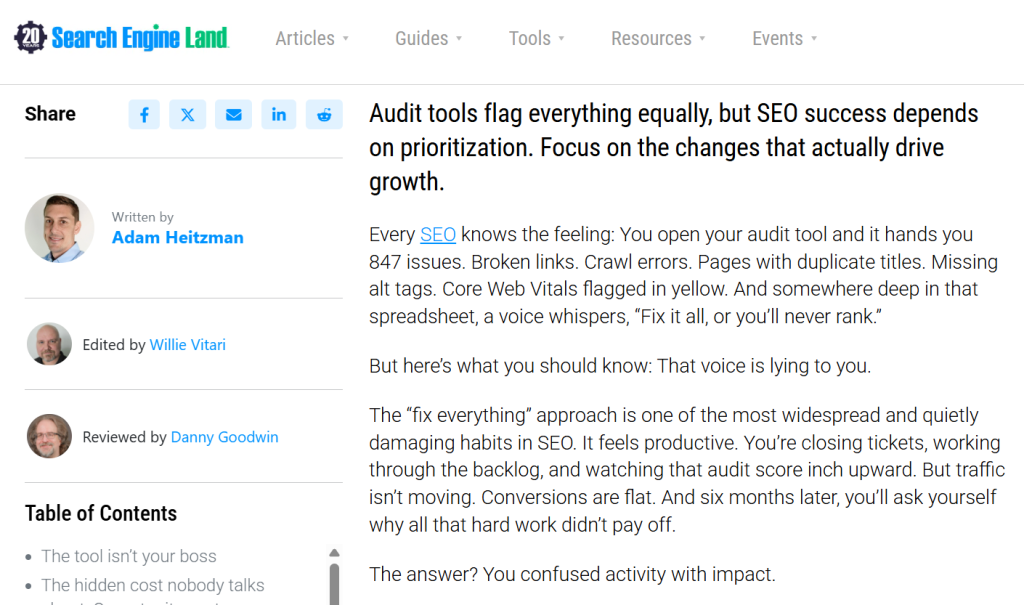
Most SEO roadmaps fail for the same reason product roadmaps fail: teams confuse busyness with outcomes. A technical audit finds 247 issues, the agency drops them into a spreadsheet, and suddenly everyone starts chasing missing alt tags, redirect chains, duplicate H1s, and shallow content pages while organic traffic stays flat for six months. That uncomfortable truth sits behind the recent take from Search Engine Land: “fix everything” sounds controlled and disciplined, but it is often the least effective SEO approach.
The issue is not that technical SEO doesn’t matter. The real problem is that most teams optimize for audit scores instead of business outcomes. In 2026, that difference matters more than ever. AI Overviews, zero-click searches, entity-driven ranking systems, and shrinking attention spans have quietly changed what “good SEO” means. You do not win by removing every single problem. You win by identifying the few constraints that are actually suppressing growth.
Introduction
- Most SEO issues have little or no ranking impact. Prioritization matters more than being fully comprehensive.
- High-growth SEO teams focus on leverage: indexing, internal linking, topical authority, and search intent alignment.
- Small businesses are especially vulnerable to the “fix everything” mindset because limited budgets get wasted on low-impact cleanup work.
Why Is “Fix Everything” a Bad SEO Strategy?
SEO impact is asymmetrical. A small number of changes usually drive most of the results, while hundreds of “best practice” fixes barely move rankings. This is one of the biggest mistakes SEO teams make: assuming every issue is equally important.
A crawl report might show:
But none of that matters if Google cannot properly understand your topical relevance or if your most valuable pages have weak search intent alignment.
SEO is not a compliance exercise. It is a prioritization exercise.
A good example is what happens with SaaS companies scaling content aggressively. Many teams spend months cleaning technical debt while competitors publish targeted comparison pages, integration pages, and bottom-of-funnel content that captures commercial intent traffic much faster.
Most of the time, the company with the imperfect website and stronger content-market fit wins.
The biggest SEO wins rarely come from fixing every small issue. They usually come from improving the primary bottleneck that blocks growth.
That is the difference between optimization and strategy.
So What Should You Focus on in SEO Instead?
Focus on the constraints preventing growth, not the things making your audit tool unhappy. The most successful SEO programs usually start with four areas:
- Crawl and indexing problems
- Search intent mismatch
- Internal link architecture
- Content depth and topical authority
After these are handled, everything else becomes secondary.
| SEO Area | Traffic Impact Potential | Effort Level | Priority |
|---|---|---|---|
| Pages not indexed | Very High | Medium | Immediate |
| Weak search intent alignment | Very High | Medium | Immediate |
| Internal linking gaps | High | Low | High |
| Topical authority gaps | High | High | High |
| Missing meta descriptions | Low | Low | Low |
| Minor Core Web Vitals issues | Medium | High | Medium |
| Alt text cleanup | Low | Medium | Low |
Insight: SEO priorities should be ranked by business impact, not by the number of errors detected by a tool.
This is where smaller companies actually have an advantage. Larger enterprises often get trapped in governance-heavy SEO workflows where every tiny issue becomes a ticket. Smaller teams can move faster by focusing only on what compounds traffic and conversions.
For example, a regional ERP software company might see stronger growth from publishing:
- industry-specific landing pages
- implementation comparison pages
- integration documentation
- customer use case stories
…than from spending two months fixing every accessibility warning in a crawler report.
Technical excellence matters, but relevance still beats perfection.
SEO performance is usually limited by visibility and search intent, not by audit cleanliness alone.
Are Technical SEO Audits Overrated?
• Technical SEO audits are useful diagnostic tools, but they become risky when teams treat them as the entire SEO strategy.
• Most SEO tools are built to flag every detectable issue, not determine what truly impacts rankings or revenue.
• Platforms like Semrush, Ahrefs, and Screaming Frog generate long lists of warnings, but they cannot always measure real business impact.
• Many companies spend months fixing low-value issues like missing meta descriptions, small schema warnings, or tiny Core Web Vitals improvements while competitors move ahead with stronger content and better search intent alignment.
• Improving page speed from poor to acceptable absolutely matters, but improving already decent metrics often creates very little ranking impact compared with strengthening topical relevance.
- Google increasingly rewards usefulness, authority, and intent alignment rather than demanding technical perfection.
- Even technically messy websites can rank well when the content solves user problems better than competing pages.
- One of the biggest mistakes SEO teams make is optimizing for audit scores instead of visibility, conversions, and revenue.
- Technical SEO should support the growth strategy, not replace it.
- Strong SEO teams use audits to identify blockers, not to create endless cleanup tasks.
High-priority technical issues usually include:
- pages not indexing
- broken crawl paths
- render-blocking JavaScript
- severe mobile usability problems
- duplicate content issues affecting rankings
Low-priority issues often include:
- minor metadata inconsistencies
- small accessibility warnings
- slight page speed improvements
- cosmetic HTML cleanup
A technically flawless website without a strong content strategy usually loses to a strategically focused site with better search intent targeting.
The goal of technical SEO is not perfection. The goal is removing obstacles that prevent growth.
What Does This Mean for Small Businesses?
Small businesses should stop trying to “do all of SEO” and start identifying the smallest set of actions that create outsized results. Limited resources make prioritization mistakes much more expensive. A local manufacturing company or niche B2B SaaS brand cannot afford six months of low-value optimization work.
Every sprint has opportunity cost.
| Low-Impact SEO Work | Higher-Leverage Alternative |
|---|---|
| Rewriting all meta descriptions | Publishing bottom-funnel comparison pages |
| Fixing minor schema errors | Building industry-specific landing pages |
| Compressing already-fast images | Strengthening internal linking to money pages |
| Cleaning duplicate category tags | Creating topical content clusters |
| Chasing a 100 SEO audit score | Optimizing conversion-focused pages |
Insight: For smaller businesses, strategic focus beats technical completeness almost every time.
This is especially true in competitive verticals like:
- ERP software
- staffing and recruiting
- legal tech
- logistics platforms
- construction SaaS
The companies that usually win are the ones consistently publishing specialized content, dominating niche topical clusters, aligning pages closely with commercial search intent, and building authority through genuine expertise.
Not necessarily the companies with the cleanest crawl reports.
A strong example comes from a B2B cybersecurity startup analyzed by growth consultant Eli Schwartz. The company focused heavily on intent-driven landing pages instead of broad technical cleanup. By targeting highly specific problem-aware searches, they reportedly increased organic signups by more than 300% within a year despite several unresolved technical issues.
That is the leverage mindset.
SEO maturity is not about fixing everything. It is about understanding what can safely be ignored.
How Do You Decide Which SEO Problems Actually Matter?
Use a business-impact framework instead of relying on severity scores from SEO tools. Here is a practical approach advanced teams use when they have too many tickets and limited resources.
1. Identify Revenue-Critical Pages
Start with:
- product pages
- service pages
- high-converting blog content
- comparison pages
- demo or signup flows
Ignore low-value pages initially. Focus on the pages directly connected to traffic and revenue.
2. Diagnose Bottlenecks
Ask questions like:
- Are pages indexed?
- Are impressions growing?
- Are rankings being suppressed?
- Is CTR weak?
- Is engagement poor?
- Are conversions low?
Each symptom usually points to a different priority.
3. Estimate Potential Impact
- Do not ask:
- “Is this an SEO issue?”
- Instead ask:
- “If we fix this, could it realistically increase traffic, rankings, or conversions?”
- That single question filters out most low-impact work.
4. Prioritize by Leverage
High-leverage work usually includes:
- scalable fixes
- template-level improvements
- high-intent content
- stronger internal linking
- clearer topical authority
Low-leverage work is usually cosmetic cleanup that will not meaningfully affect revenue.
5. Re-evaluate Quarterly
SEO environments constantly change because:
- competitors evolve
- SERPs shift
- AI Overviews change click behavior
- Google updates entity understanding
Your priorities should evolve too.
The best SEO teams are ruthless editors of their own workload.
The Counter-Argument: Can Ignoring Problems Backfire?
Yes, especially when foundational technical issues block discovery, crawling, or user experience. The danger is misunderstanding “don’t fix everything” as “technical SEO does not matter.”
It absolutely does.
There are issues you cannot ignore:
- broken indexing
- render-blocking JavaScript stopping crawling
- severe duplicate content problems
- poor mobile usability
- major page speed issues
- broken site architecture
The nuance is that not every technical issue is equally urgent.
A mature SEO strategy separates:
Many agencies blur these categories because exhaustive audits help justify larger retainers. Meanwhile, in-house SEO leaders increasingly think like product managers: constrained resources, measurable outcomes, and prioritization under uncertainty.
That mindset is healthier.
It also aligns more closely with how modern search actually works.
Google’s systems are increasingly probabilistic and intent-driven. They tolerate imperfection surprisingly well if users still find value in the content. That is why ugly websites, slow websites, and technically flawed pages still rank.
Relevance, trust, and usefulness can outweigh technical imperfections.
Google does not rank the cleanest website. It ranks the most satisfying result.
The Real SEO Skill in 2026 Isn’t Optimization, It Is Prioritization
• Modern SEO growth depends less on fixing everything and more on identifying high-leverage opportunities.
• The hardest SEO skill today is deciding what can safely be deprioritized.
• AI Overviews, zero-click searches, and entity-based systems have reduced the value of broad, generic optimization work.
Winning SEO teams focus on:
Most ranking growth comes from a small number of strategic improvements, not from hundreds of small fixes.
SEO prioritization now resembles product management more than traditional marketing.
Strong SEO leaders ask:
Low-performing teams often confuse movement with progress because completed SEO tickets look productive internally.
High-performing teams prioritize outcomes over output.
Conclusion
Anyone can run an audit. The difficult part is deciding what not to do.
That is the shift many SEO teams still have not fully accepted. Modern SEO success relies less on broad cleanup and more on strategic focus: which pages deserve investment, which search queries matter commercially, which technical issues suppress growth, and which tasks are simply noise.
The “fix everything” mindset feels safe because it creates visible activity. Stakeholders love spreadsheets filled with completed tickets and progress updates. But search growth rarely comes from large volumes of cleanup work.
It usually comes from identifying a small number of changes that unlock much larger outcomes.
Increasingly, those gains come from:
- intent alignment
- topical depth
- information architecture
- internal authority distribution
- differentiated expertise
Not from chasing a perfect audit score.
The smartest SEO teams today are not the ones fixing everything. They are the ones confidently ignoring the right things while still driving measurable growth.

Kumar Swamy is the CEO of Itech Manthra Pvt Ltd and a dedicated Article Writer and SEO Specialist. With a wealth of experience in crafting high-quality content, he focuses on technology, business, and current events, ensuring that readers receive timely and relevant insights.
As a technical SEO expert, Kumar Swamy employs effective strategies to optimize websites for search engines, boosting visibility and performance. Passionate about sharing knowledge, he aims to empower audiences with informative and engaging articles.
Connect with Kumar Swamy to explore the evolving landscape of content creation!