Introduction:
- Google has chosen to discontinue Dynamic Search Ads (DSA) in favor of AI Max campaigns that are driven entirely by automation and simplicity.
- Businesses must seriously consider their advertising strategies because AI Max removes much of the manual-input and targeting flexibility.
- For small businesses, these exciting opportunities throw up challenges and those who pick up on indicators fast will have a smoother sail through the waves.
Since Google has decided to discontinue Dynamic Search Ads (DSA) in favor of AI Max, the algorithmic rules that Google Ads will base on will change. This shift could either make or break small businesses. As AI Max aims to simplify ad management, how severely could it end the control and targeting flexibility? This article analyzes what this means to small businesses, how to move on, and whether AI Max is the correct strategy for each business.
What’s New in the March 2026 Core Update?
The Dynamic Search Ads are replaced. Google has AI Max instead, taking over campaign management, which is expected to perform better. But is it a “win” for everyone?
However, Dynamic Search Ads provided the opportunity to create ads dynamically based on information drawn like those from the websites. They were ideal for companies holding different items in large numbers or for those engaging in too many changes on their regular basis.
AI Max- an AI-powered machine learning technology– is tuned to automatically target optimized ad-selection, bidding, and copywriting techniques. In that being the case, as they could outperform, smaller businesses might now have their ways slightly more restricted in influencing the setting of campaigns. Unlike DSA, where the advertiser is given some control over where to expand campaigns and identify specific keywords, under AI Max, control in these aspects is completely out of their hands.
Counter State…
Small, while profitable for a penny, had something to offer if a livelihood were needed by one’s creative work. On the other hand, it might have the capacity for attracting too broad an audience if the likes of Google’s AI were controlled. With the much-needed fine-tuning still lagging, this could well drive up the dear campaign expense.
Will Advertising Be Affected by AI Max?
What AI Max does is far more simplifying than could be realized in terms of automating the process of performing campaigns for targeted ads, persistently kept in bids while also keeping on generating such ads. Thus, the focus of the future will become more of automatic and machine learning-based advertising thrusts.
Now that AI is implementing it, businesses will no longer have to select their keywords, set their bids &, manage their campaigns themselves. The AI uses data-driven algorithms to predict which users are likely to be engaged with the ad, thus ensuring that the ad reaches the most-precise audiences. While this can optimize for enhanced performance, it eliminates the ability of businesses to directly target anything.
Point of View:
AI Max ushers in efficiency and automation, but it requires that businesses trust Google’s predictive algorithms. Manual adjustments are now replaced with machine learning optimization, as commerce shifts from control to first-parity trust.
What are the advantages of AI Max for small businesses?
Operating on a principle that automation can streamline management of campaigns for small businesses with meagre marketing resources, AI Max represents some really attractive possibilities.
Few Perks:
- Increased efficiency: AI Max is faster than any human in managing ad campaigns, which makes store competition much easier for small businesses.
- Better targeting: AI Max is powered by predictive analytics, which forecasts who it thinks will convert, bringing more specific results.
- Lower costs: Through the optimization of bidding and better placement, AI Max can offer better performance at less cost.
For example, a boutique apparel e-commerce website could use AI Max to automate bidding, giving the technology real-time data to adjust bids. By allowing the AI to optimize the campaign, the e-commerce store could drive additional conversions while lowering costs.
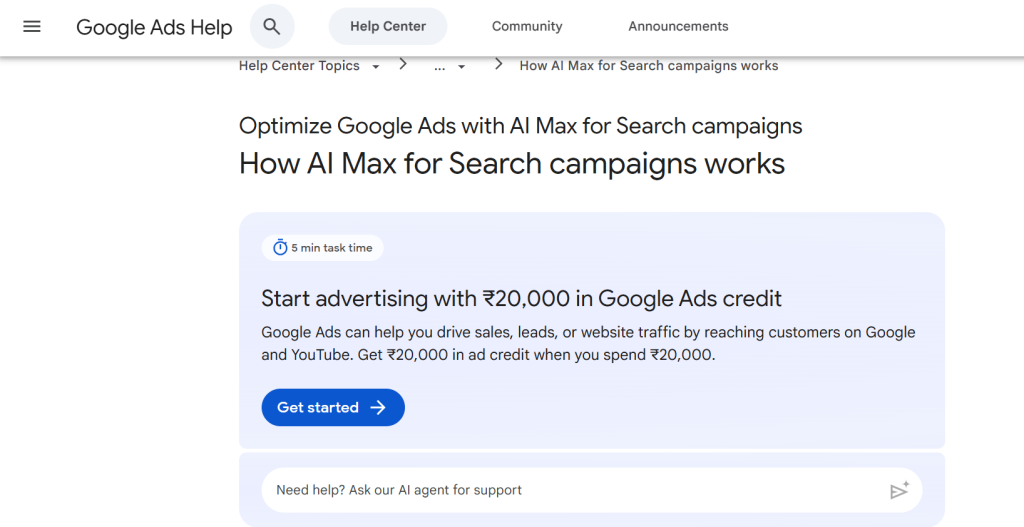
Here you go:
Thanks to AI Max, small businesses with limited marketing capacity can find greater efficiency and better performance at lower costs.
How Can Small Businesses Prepare for AI Max?
AI Max adaptation demands preparation, especially for businesses which still require manual management. To execute lucrative campaigns, small businesses need to position themselves for a win with their website content and data.
Consequently:
- Focus on content: Make sure your website content is top-notch and well-optimized for keywords; this way the AI can pinpoint advertisements that matter most.
- First-party data: Utilize Google Analytics or similar tools to furnish the AI with insightful data for targeting.
- Landing page optimization: Because AI Max automatically advertises any content on your website, your landing pages should be optimized for conversions.
For instance, a small tech store could optimize its website to target very-category specific products in such a way that AI Max would automatically target ads to users who are likely interested in that category. In turn, feeding that purchase data into Google Analytics means the store gets better targeting.
Small businesses are supposed to ingrain in their content optimization together with proper use of their data to make AI Max work to the best results.
Will AI Max work for all business setups?
There is no right or wrong answer to this question. For some of your businesses, automation to this extent is not going to pan out nice and precise.
Let’s suppose a local business engaged in very personalized kinds of services, particularly personal coaching. This business may find AI Max to be widely off base in terms of targeting. They are going to need to hold onto specific keyword control and highly focused targeting. On the contrary, AI Max will suit numerous enterprises with large product inventories, showing only broad-market targeting.
Key takeaway: This could be an excellent solution for businesses that generally need mere automation and simplicity but not specialized users.
AI Max vs. Dynamic Search Ads: Comparison
In order to understand the main differences between AI Max and Dynamic Search Ads, I would like to consider the advantages and disadvantages of both.
| Feature | AI Max | Dynamic Search Ads |
|---|---|---|
| Automation | Fully automated (targeting, bidding, ad copy) | Automated targeting, manual control over bidding |
| Control | Limited control, AI-driven decisions | Greater control over targeting and bidding |
| Flexibility | Less flexibility for niche targeting | More flexibility in targeting and customization |
| Targeting Precision | AI-based targeting, can be broad | Manually selected keywords and parameters |
| Best For | Businesses with broad targeting needs | Businesses with specific or niche targeting needs |
| Ease of Use | Extremely easy for businesses without dedicated marketing teams | Requires more manual involvement and expertise |
Bold takeaway: While AI Max is a great app for easy advertising, businesses requiring precision control will not get many of their needs met under AI Max and will find Dynamic Search Ads more suited than AI Max.
Frequently Asked Questions:
AI Max automates the full end-to-end process of ad creation, targeting, and push bids through machine learning, while DSA involves some manual control over targeting and bidding and its automation works from website content.
No, Not as much as they were able to when working with DSA. AI Max is based on machine learning making decisions on targeting and push bids; hence precision control is less.
When AI Max is not hitting the spot, other targeting tools or manually activated campaigns can be put together to maintain this control while leveraging some automation.
By all means ensure your website is well put away about high-quality copies, keyword-optimization, SEO, etc. Once done, you may provide this AI with first-party data retrieved from the Google Analytics platform to boost it for better targeting and ad performance.
AI Max functions well for businesses with broad targeting needs, but for those specializing in niche products or operating within niche markets, automation may not be precise enough.
Conclusion: What Does The Future Hold?
Thus the retirement of Dynamic Search Ads brings a paradigm change in Google Ads. The smaller businesses will have to go along with AI Max, with its automation and predictive capabilities. However, businesses with unique requirements or with very specific target audiences may find AI Max’s limitations when it comes to control bothersome. It is very important for most smaller businesses to prepare their content, optimize their landing pages, and develop ways to make the best benefit out of the new system.
In Summary: AI Max may offer automation and efficiency, but the business should consider initial needs towards this expected level. How well you embrace this change and ready yourselves is in the future.

Kumar Swamy is the CEO of Itech Manthra Pvt Ltd and a dedicated Article Writer and SEO Specialist. With a wealth of experience in crafting high-quality content, he focuses on technology, business, and current events, ensuring that readers receive timely and relevant insights.
As a technical SEO expert, Kumar Swamy employs effective strategies to optimize websites for search engines, boosting visibility and performance. Passionate about sharing knowledge, he aims to empower audiences with informative and engaging articles.
Connect with Kumar Swamy to explore the evolving landscape of content creation!