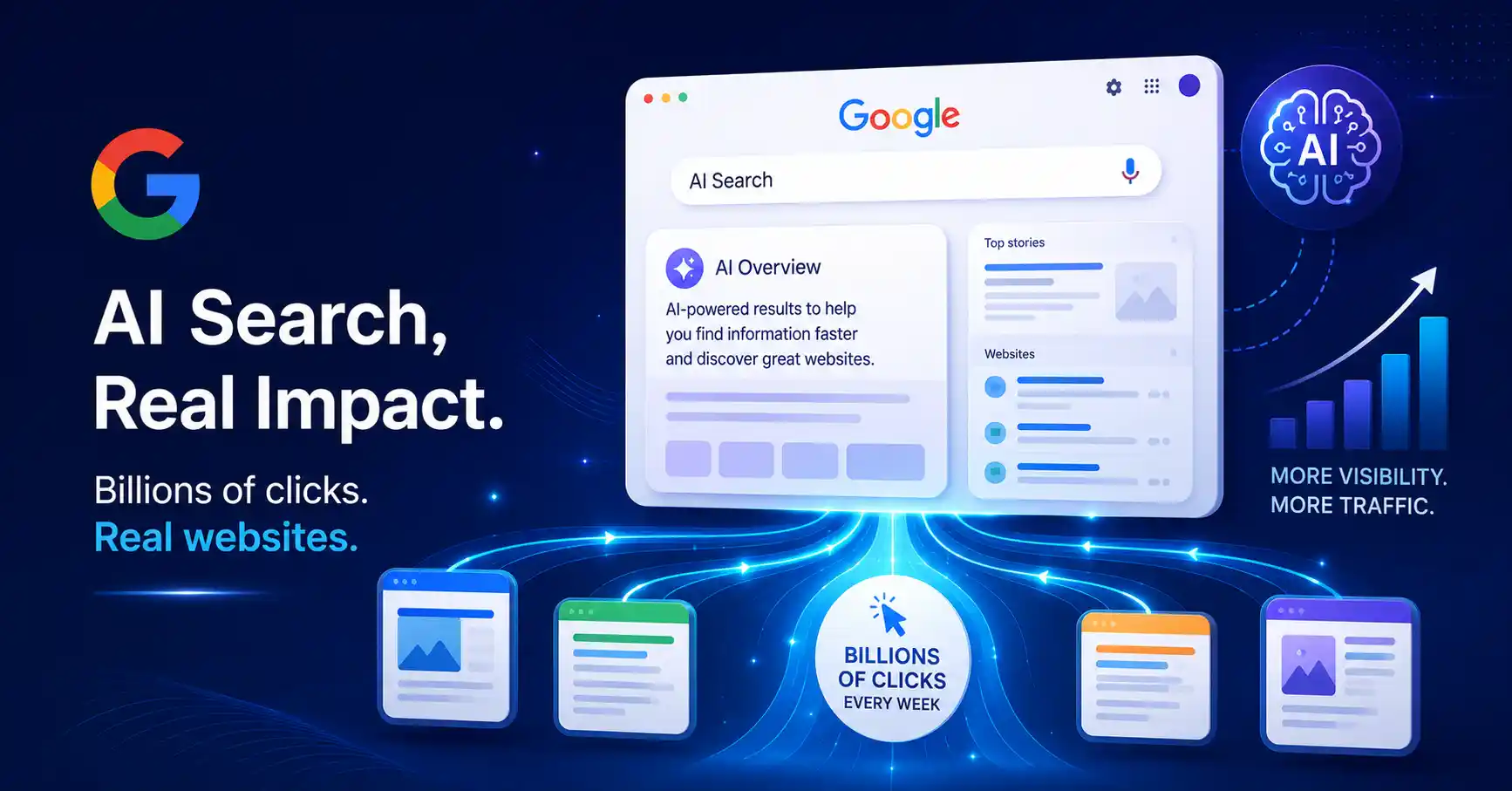
Have you noticed how Google Search has been answering more questions right there on the results page? Like, an AI overview, a follow up hint, or even a more chatty search feel. It’s pretty clear that AI is shifting how people stumble onto information online. So of course, lots of site owners have been asking, Will AI reduce website traffic?
Google recently spoke to this worry by saying its AI powered search features are sending billions of clicks to websites every week. While publishers are still going back and forth about how AI affects organic reach, Googles latest message makes it sound like AI Search isnt “replacing” websites, it may just be changing the way users notice and engage with them.
So what does that mean for businesses, marketers, and SEO folks? Even more, what should you adjust in your SEO strategy so you remain visible in this AI-first search reality?
Ok lets unpack it.
What did Google mean by saying AI Search sends billions of clicks to websites?
According to Google, features like AI Overviews, AI powered search experiences, and other intelligent search capabilities together generate billions of clicks for publishers and businesses every week. The company also makes the point that the AI is there to help people find solid, high-quality content, not to replace it.
Instead of just throwing up a list of blue links , Google’s AI now reads the search intent, summarizes the key points, and points users toward relevant websites if they want to dig into a topic further.
As SEO consultant Rachel Adams puts it,
“AI isn’t removing websites from search it’s changing the route users take before they click.”
So for website owners, this means visibility is less about ranking for one single keyword and more about building credible, well rounded content that actually matches what the user is trying to do.
How is AI Search changing organic search traffic?
One of the biggest worries for publishers is whether AI Search will trim organic traffic, and honestly it does feel a bit tricky to estimate. The reality is more nuanced though, not just a straight line.
People now get fast answers right inside the search results, but many still tap through when they want deeper breakdowns, product comparisons, step by step tutorials, or credible expert insights.
So the win is no longer only about positions in the SERPs, rankings, or whatever you were tracking last quarter. Businesses instead should concentrate on being the exact resource Google trusts enough to surface in AI driven search experiences.
Modern SEO now revolves around several important factors:
- Search intent optimization
- Helpful, people-first content
- Topical authority
- User experience
- Content freshness
- Structured information
Rather than competing for keywords alone, websites are competing to become the most reliable answer.
If you’re strengthening your website’s technical foundation alongside AI-focused SEO, it’s worth understanding Technical SEO ROI.
Why should businesses care about AI-powered search optimization?
With AI powered search showing up more and more, companies can’t just lean on old style keyword optimization, not anymore.
Google is increasingly looking at whether the content actually shows expertise , along with lived experience, authority, and trustworthiness, that EEAT idea. It also seems to check if people land on the page and genuinely find it helpful in real terms.
Successful businesses are now investing in:
- Comprehensive topic coverage
- Semantic SEO
- Entity optimization
- Conversational content
- Internal linking
- Regular content updates
Instead of writing multiple articles that chase nearly the same keywords, focus on building full resources that answer connected questions in a natural way.
Digital marketing strategist Melissa Carter notes,
“The websites winning in AI Search arent necessarily publishing more, they are publishing better.”
How can you optimize your website for Google’s AI Search features?
The good news is that the fundamentals of SEO still matter. But now they also need to be mixed with approaches that help AI grasp your content, a bit more deeply than before.
First off, figure out what your audience is really trying to achieve, not just what they are searching.
Instead of making pages only for keywords, answer the full question. Arrange the material with clear headings, short paragraphs, examples, relevant statistics, and actionable guidance.
Other best practices include:
- Build topical authority around your niche.
- Improve Core Web Vitals and page speed.
- Use descriptive internal links.
- Keep content updated.
- Add structured data where appropriate.
- Create original insights instead of rewriting existing articles.
Maintaining existing content is just as important as publishing new pages. Regular SEO maintenance helps ensure your content remains relevant as Google’s algorithms continue to evolve.
Which SEO strategies matter most in an AI-first search landscape?
Since AI-powered search experiences started showing up, a few SEO best practices have become even more crucial then before, really.
Focus on search intent
Understand why someone is searching rather than simply matching keywords.
Build topical authority
Create clusters of related content that establish expertise in your industry.
Improve user experience
Fast loading mobile friendly pages keep doing better, because they build a strong user experience, people feel it immediately.
Write naturally
AI can understand context, a lot more than before. But when people keep stuffing keywords everywhere, it may reduce readability, and it does not really help rankings much.
Strengthen internal linking
Well-connected content helps both users and search engines discover additional valuable information.
For businesses looking to understand Google’s recommendations directly, reviewing the official Google Search Central documentation is an excellent starting point.
What does the future of AI Search look like?
Google’s AI Search is going to keep growing, and honestly it will probably keep changing, pretty fast.
More conversational search vibes, plus multimodal search, personalized AI outcomes, and tighter blending where the AI generated summaries sit next to the usual listings. That blend will feel more natural over time.
Instead of treating this like a threat, businesses might want to see it as a chance to publish content that performs better. Better clarity, better intent, better usefulness, yes.
Sites that routinely release original research, answer the questions customers are actually asking, and show real know-how will keep pulling in the right kind of visitors.
The goal hasn’t moved.
Google still wants to connect people with the best possible information it has, it’s just using smarter ways to recognize it and surface it.
Conclusion
Google’s statement that AI Search features create billions of clicks every week points to a real change, and it feels like search is not being treated the same anymore. Even if the AI shifts the whole user journey, it doesn’t remove the need for useful, high-quality websites.
Companies that lean into helpful content, match the search intent, build topical authority, and keep a solid technical SEO base in place will probably have the best chances, as AI-based search keeps getting better and faster.
Rather than chasing each and every algorithm change, aim to become the most valuable resource in your audience’s day-to-day questions. That approach tends to lead to lasting organic growth , not just short-term wins.
Any thoughts about Google’s AI Search, or questions on how to optimize a website? Drop them in the comments, we would genuinely like to hear what you think.
FAQs
1. What are Google’s AI Search features?
Google’s AI Search offers a few AI Overviews and other AI powered experiences, that help people locate relevant information while also finding useful websites more efficient. It’s basically designed so users get relevant answers faster without running around as much, and it makes discovery feel more methodical.
2. Does AI Search reduce website traffic?
Not really. Sure, people may see quick answers right inside the search results, but a lot of them still pop over to the websites for the more detailed rundown, specialist perspectives, and thorough references.
3. How should businesses optimize for AI Search?
Focus on helpful content, search intent, topical authority, technical SEO, internal linking, and excellent user experience.
4. Is keyword optimization still important?
Yes, but semantic SEO and understanding user intent are now just as important as exact-match keywords.
5. What secondary keywords are most relevant to this topic?
You can also lean on some useful secondary terms like AI-powered search, those AI Overviews, organic search traffic and then search intent optimization, plus SEO best practices.

Kumar Swamy is the CEO of Itech Manthra Pvt Ltd and a dedicated Article Writer and SEO Specialist. With a wealth of experience in crafting high-quality content, he focuses on technology, business, and current events, ensuring that readers receive timely and relevant insights.
As a technical SEO expert, Kumar Swamy employs effective strategies to optimize websites for search engines, boosting visibility and performance. Passionate about sharing knowledge, he aims to empower audiences with informative and engaging articles.
Connect with Kumar Swamy to explore the evolving landscape of content creation!