
While managing Google Ads at scale, here’s an uncomfortable truth: one hacked account can wipe out ad spend in the range of six-figure overnight chaos. This has already happened on multiple occasions through API access rather than the UI.
That’s the backdrop to Google’s taking the decision to require Multi-Factor Authentication (MFA) for all Google Ads API access: on paper, it’s a security update; practically, it’s a drop that has rocked the Agencies, SaaS tools, and in-house teams that have everything on g0 with automation.
This is no simple task of meshing with 2FA. This is about the entire identity architecture, lifecycle management of tokens and access governance pics.
Introduction
- MFA will be made mandatory for ALL Google Ads API users- no exceptions; robot accounts and automatic workflows too.
- Current integrations may break as well, depending on single OAuth factors or shared credentials.
- Teams who just tick it off as compliance will suffer; those who work on adapting access workflows will actually improve.
What exactly is changing with Google Ads API authentication?
Here’s the short answer: There is now multi-factor authentication (MFA) enforced and required across any authenticated request from Ads API, which must now be secured by MFA.
This change goes beyond UI logins. Parallel workers either use OAuth tokens produced from accounts that do not generally require MFA, especially for backend systems, scripts, and third-party tools. Google is now tightening the knot.
Thus:
- OAuth flows should be generated from MFA-enabled Google Accounts
- Refresh tokens tied to non-MFA accounts may become invalid
- Service account workarounds will face more stringent retroactive verification
- Access control guidelines should not involve only simple token proof, but more of an identity-based approach to access verification.
This is in line with the broader industry transition from the conventional network perimeter and often leaves security concerns in the hands of layered protocols that are built to defend smartly with the zero-trust title.
So, if your API safekeeping system hinges on medium truth-of-being token-issue-then-forget ideologies, as this always finds itself under attack through procrastination.
Why now?
Short answer: API attack numbers have increased, and the approach of authenticating as a single safety barrier for spending ad budget and consumer-spent data no longer assures enough defense.
Google is not working alone in this respect. Across the SaaS spectrum, there is a pattern:
- Abuse of APIs is catching up with, and often even beating, attacks on UI
- Automated access tools are becoming more sophisticated
- Credential stuffing and token theft require increasingly advanced incursion strategies
What was underemphasized in the source?
But the biggest threat is not merely account takeover but also covert abuse.
The attacker might not even block you out of the system. All they need to do is the following:
- Introduce untruthful campaigns
- Dislocate your budget
- Pilfer your campaign figures
In 48 hours, an eCommerce brand lost $120,000 on the same day due to a vulnerable API authentication (integration through a third-party tool). A breach was triggered, but no UI alerts were shown.
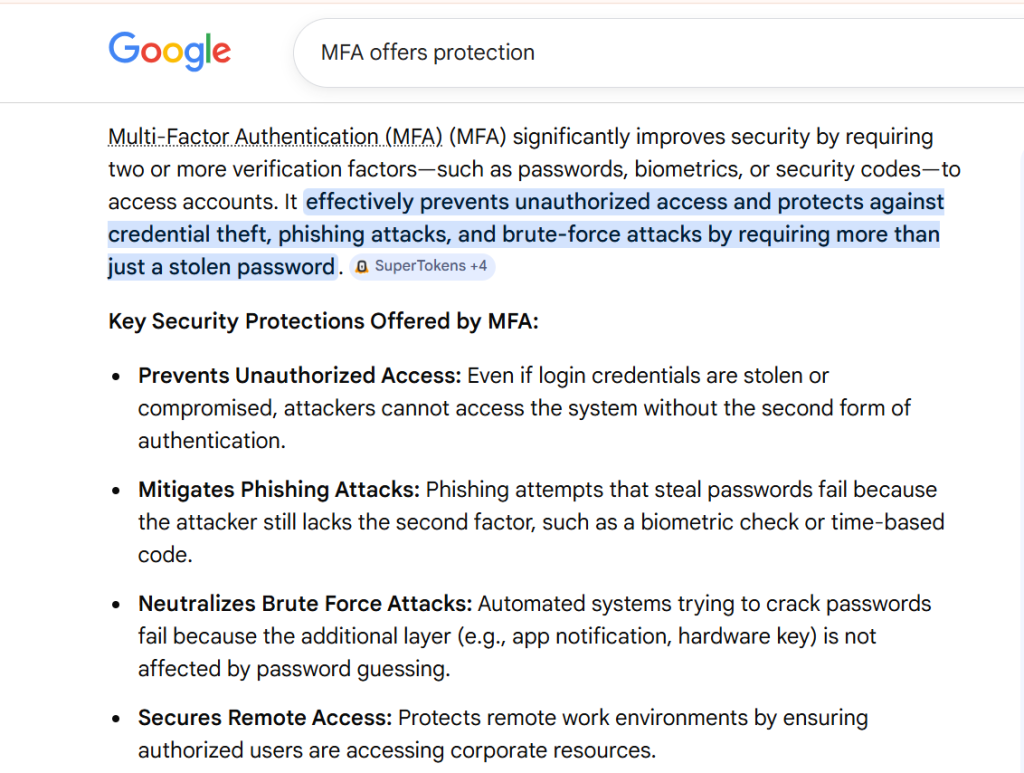
MFA offers protection by:
- Adding an additional security layer of auth into the request
- Diminishing the usefulness of tokens
- Creating an obstacle for automated attackers
On that point, the implications are fairly more concerning: This is not merely after-the-fact compliance; it is about securing high-transaction volume automatic workflows.
Is this going to break your present automation set-up for Google Ads?
Short answer: Yes, if it uses basic non-MFA-compliant OAuth authorization, shared accounts, or permanent credentials.
Teams generally undersize the resiliency of their automations.
Typical attack spots include:
- Team-wide use of shared Google accounts
- Long-lived consent tokens coded into scripts
- Third-party software that supports outdated auth method
- Internal dashboards programmed with aged connectivity to APIs
Here is a typical case history:
You interface a custom reporting system for pulling data from the Ads API.
Today:
- The refresh token from 18 months ago, the same token that the app uses right up to today, is still valid.
- The account is just indifferent on enforcing MFA.
- The whole subject of auth has never been revisited ever since day one of deployment.
The new enforcement:
- The refresh token becomes invalidated.
- Excessive API calls fail silently to return an auth error.
- Reports will break down for partway through the cycle.
This isn’t a theoretical discussion anymore. It is, in fact, the most common manifestation of the same in numerous setups.
Bottom line: If you haven’t audited your API auth for at least 6 months, assume that something will fail.
How should agencies and SaaS platforms adapt?
Short answer: Go from credential-based to identity-based access with controlled token management.
That’s where most teams will rather tend to apply a patch or go on to mature the same.
Step-by-step: Future-proof your setup
- Audit all API entry points
Map out every system, script, or tool utilizing the Ads API services.
- Understand how you authenticated
Identify and mark any usages that are clearly marked as non-MFA accounts.
Examples include:
- Shared credentials
- Legacy OAuth implementations.
- Enforce MFA across all Google accounts
- In no case should exceptions be made for “system” accounts.
- Redesign OAuth flows by ensuring tokens are generated from MFA-compliant identities.
- Implement Token Rotation Policies mean you’re not relying on long-lived typically-issued refresh tokens forever.
- Use Role-Based Access Control (RBAC) whereby permissions are restricted into users/system instead of highly-accessible permissions.
- Evaluate third-party vendors to ensure that they are compliant with the MFA requirement.
Strategic shift
Stop thinking of “API keys” and start thinking of identity + permissions + lifecycle.
The challenge is that the teams that consider authentication over configuration are the ones that stand to adapt the quickest.
Is MFA enough for securing ads accounts?
Short answer: No. MFA is necessary but insufficient to the larger security modelits only one contributing factor.
- People tend to overestimate the extent to which MFA protects.
- It is effective against mundane attacks, but what it doesn’t do is.
- Insider threats
- Permission misconfiguration
- Compromised devices
- OAuth token theft
Comparison: Security Layer with Google Ads API
| Security Layer | What It Protects Against | Weakness | Priority Level |
|---|---|---|---|
| MFA | Credential theft | The system fails to protect against token misuse | High |
| OAuth Token Management | Unauthorized API access | The system remains vulnerable to token leaks | High |
| RBAC (Permissions) | Over-privileged accounts | The system requires exact setup procedures to operate | High |
| IP Restrictions | The system protects against unidentified access points | Users can bypass this security through proxies | Medium |
| Activity Monitoring | The system detects abnormal activities | The system only responds to incidents without beforehand protection | Medium |
| Device Trust Policies | The system protects against compromised endpoints | The system requires difficult execution methods | Low-Medium |
Key Insight: MFA is only for the door, not for the house itself.
So, think of MFA as your baseline, but not your end goal.
How is this different for small business rather than an enterprise model?
Short answer: Small businesses will face pain at setup the enterprises will at scale.
The pain isn’t the same with a small business:
- Many times, outsourced work may be done for a single person/account.
- Usage of a shared login (now broken)
- No-structured access management.
Risk: Operational friction and confusion.
Enterprise teams:
- Tens (or hundreds) of accounts are managed
- Dependent on Automation Pipelines
- Simultaneously, many tools and integrations are used
Risk: Complete shutdown of services loss in case; they do not have authentication centralized.
The angle nobody thinks of:
This shift might lend more dependency on certified tools and platforms that are suitable in managing online account access securely.
Basically, it brings forward minor changes:
- Lesser do-it-yourself (DIY) automation
- Greater dependency on SAAS (being a bouquet of short services) ecosystems
- Higher switching barriers
At the end of the day, MFA acts as the natural push to the barriers for custom-built solutions, thus favoring mature platforms.
Counterpoint: Google Overcorrecting?
Short answer: Could possibly be, but arguably necessary given the ante.
Some practitioners posit that:
- MFA slows the light-speed of delivery
- It breaks automation maintenance
- Auth issues become more difficult to debug
Point well taken.
But then, the trade-off is:
- A slower pace in work
versus
• Catastrophic loss borne from account being hacked
One can well see, from Google’s standpoint, the asymmetry of risks.
Not in that article, but what is it about?
Actually, the chief responsibility has moved in this reservoir.
Before:
- Security was merely an option
Now:
- Security is inbuilt
This reduces liability further with Google.
Finally, it’s not just about shielding your interests, but rather is about protecting the overall system.
Conclusion : This option is a putting mechanism, not just a feature update.
Most organizations will subsequently work this into their checklist:
- Enable MFA
- Change the tokens
- Move on
This is not the way.
This is an enabler for so many things:
- Have access sprawl tidied up
- Measure its automation architecture again
- Put in more resilient systems.
Should you do it the right way, you would not just stay compliant; you would reduce risk; you would enhance control, and you would future-proof your stack. If you make a mess of all of this, you also have to set about scratching heads for the coming six months. Big Insight: MFA is not the change. The real change is how you manage identity within your martech infrastructure.

Kumar Swamy is the CEO of Itech Manthra Pvt Ltd and a dedicated Article Writer and SEO Specialist. With a wealth of experience in crafting high-quality content, he focuses on technology, business, and current events, ensuring that readers receive timely and relevant insights.
As a technical SEO expert, Kumar Swamy employs effective strategies to optimize websites for search engines, boosting visibility and performance. Passionate about sharing knowledge, he aims to empower audiences with informative and engaging articles.
Connect with Kumar Swamy to explore the evolving landscape of content creation!