Have you noticed how search results today differ from those a few years ago?
Often, the first item shown is an AI-created answer. Other times, it’s a sponsored link, a product idea, or a summary of content from different places. It’s often hard to tell where paid ads end and regular, unpaid results begin.
This change happened for a reason.
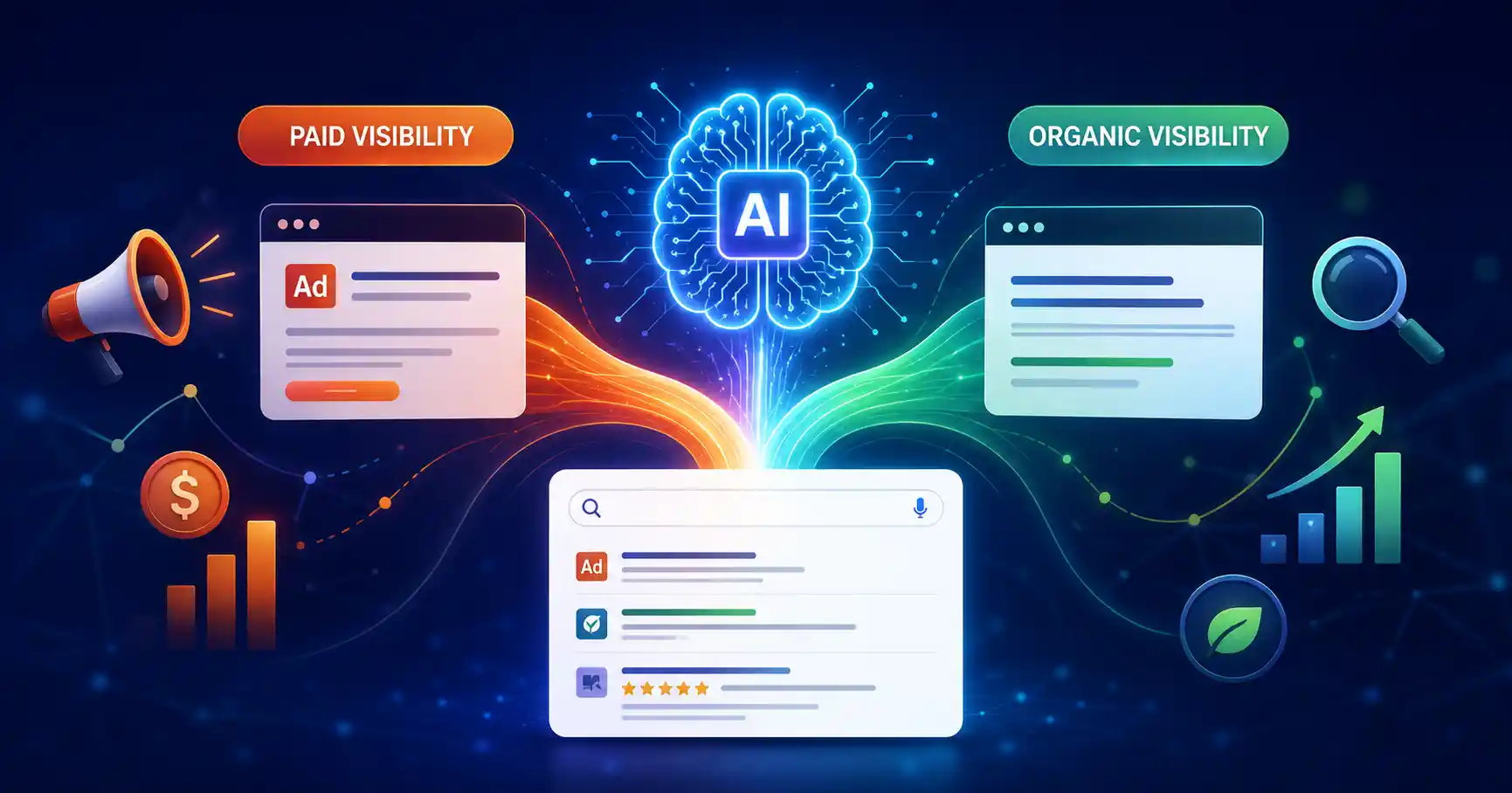
AI is changing how search engines, social media, and other discovery tools show information. Because of this, the clear line between SEO and paid ads is blurring.
For marketers, businesses, and publishers, it’s important to understand how AI combines paid and unpaid visibility. Companies that adjust quickly might gain a big edge in the coming years.
What does it mean when AI merges paid and organic visibility?
Digital marketing used to exist in two distinct spheres for many years. One side concentrated on SEO, letting companies gain exposure through excellent content and credibility. The other side focused on paid advertising, where brands purchased visibility through ads.
AI is changing that model.
Today’s AI-powered search experiences often combine:
- Organic content
- Sponsored placements
- Product recommendations
- Brand mentions
- AI-generated summaries
AI now presents information diversely, not just as basic links. Companies need to coordinate their SEO and ad tactics, since they aren’t distinct activities anymore.
As marketing strategist Nina Lopez explains:
“AI doesn’t see marketing channels. It sees information sources.”
That mindset is rapidly reshaping how brands compete online.
Businesses exploring these changes should understand the growing SEO GEO gap between AI search and organic traffic as AI-driven discovery continues to evolve.
Why are AI search engines changing the relationship between SEO and paid advertising?
Search engines previously organized pages based on specific user queries. Artificial intelligence tools function quite differently. They merge information from numerous sources to generate unique responses, rather than just providing a list of clickable links.
This creates new opportunities for brands to appear through:
- Organic citations
- Sponsored placements
- Product feeds
- Brand mentions
- AI recommendations
As AI gets more involved in content discovery, the exposure you see is more and more driven by both organic, and paid signals it seems.
For marketers, that means SEO and PPC initiatives can’t really run alone anymore, like they used to.
The brands that are doing best are starting to connect these two tracks around similar objectives, instead of treating them as separate paths.
How does AI powered search affect search engine optimization?
Many businesses initially worried that AI would replace SEO.
The reality is more nuanced.
AI-powered search actually increases the importance of high-quality content because AI systems need reliable information sources.
However, optimization is changing.
Modern search engine optimization increasingly focuses on:
- Entity recognition
- Topical authority
- Content quality
- Brand trust
- User experience
Instead of targeting individual keywords alone, businesses now need to build broader topic expertise.
This is especially important as AI systems summarize information from multiple websites rather than sending users directly to a single page.
Research already shows that users behave differently in AI Overviews and AI Mode, highlighting the need for a more integrated visibility strategy.
Why is digital advertising becoming more connected to organic visibility?
AI doesn’t evaluate channels separately.
It evaluates signals.
That’s why digital advertising increasingly supports organic performance and vice versa.
Consider a user who:
- Sees a sponsored ad
- Encounters brand mentions in AI results
- Reads organic content
- Receives AI-generated recommendations
Each interaction contributes to overall brand visibility.
This creates a compounding effect.
Brands with strong visibility across multiple channels may appear more trustworthy to both users and AI systems.
For marketers, the lesson is clear: success no longer comes from dominating one channel. It comes from building visibility everywhere your audience interacts.
Barry Adams, a respected SEO expert, has often emphasized that brand authority is becoming one of the most important signals in modern search ecosystems.
AI is accelerating that trend.
What role does content marketing play in AI driven visibility?
Content remains at the center of everything.
Whether visibility comes from organic search, AI answers, or paid placements, content often provides the foundation.
Strong content marketing helps brands:
- Build authority
- Improve discoverability
- Earn citations
- Support advertising campaigns
- Strengthen brand recognition
AI systems frequently rely on well-structured, informative content when generating responses.
This means businesses should focus on creating content that is:
- Helpful
- Accurate
- Comprehensive
- Easy to understand
- Frequently updated
The brands that consistently publish valuable content are more likely to appear across both organic and AI-powered experiences.
For marketers seeking additional guidance, Google’s official documentation on AI generated content and search offers useful insights into how AI and content quality intersect.
How should marketers adapt to this new visibility landscape?
The merging of paid and organic visibility doesn’t mean SEO is dead.
Nor does it mean advertising becomes less important.
Instead, marketers need a more unified approach.
Practical steps include:
Build brand authority
AI systems frequently surface trusted brands. Authority matters more than ever.
Align SEO and PPC teams
Shared data and coordinated campaigns can improve overall visibility.
Focus on user intent
Understand what users actually want instead of chasing individual keywords.
Strengthen content strategy
Create content that supports both organic discovery and advertising objectives.
Monitor AI visibility
Track how brands appear in AI-generated answers and recommendations.
This approach supports AI marketing, brand visibility, and long-term growth across multiple discovery channels.
What does the future look like as AI continues merging paid and organic visibility?
The future of digital marketing is going to be less about single channels and more about the general presence overall. And in practice it will feel less tied to one tactic, and more connected to how people experience everything.
Users won’t care whether information came from:
- Organic search
- Paid ads
- AI summaries
- Social recommendations
- Product feeds
They’ll simply care whether the answer is useful.
AI systems are drifting in the similar direction, not just a little but a consistent pull.
For business owners, this means visibility tactics need to become more stitched together, more customer oriented, and more able to change on the fly, even when things feel uncertain.
The winners won’t be only the brands that have to pick between SEO and advertising. They’ll be the brands that manage to blend both approaches in practice, and keep them moving together.
Final Thoughts
AI is fundamentally changing how people stumble across information online, and honestly it feels faster than before, not just more automated but also more intuitive in a weird way.
That old line between paid and organic visibility is starting to blur, because AI powered search experiences mix content, suggestions, and advertising into one continuous path for the user, like they are all in the same stream.
For marketers this brings a real mix of headaches and opportunities. On one hand you have less room for easy shortcuts, on the other hand you can win by aligning what you publish with what the AI surfaces.
Going forward, success seems to lean more on building authority, producing honestly useful content, and staying present across several channels, rather than wagering everything on just one singular play
How do you think AI will nudge the tradeoff between search engine optimization and paid ads? Put your thoughts in the comments, and join the discussion.
FAQs
What does AI merging paid and organic visibility mean?
It refers to AI-powered search experiences that weave natural content , sponsored placements , and suggested pathways, into one single user experience.
Is SEO still important in AI search?
Yes. It stays true that high quality content and real authority still matter a lot , since AI systems lean on sources that can be trusted when they generate answers.
Does paid advertising help organic visibility?
While ads don’t directly improve rankings, increased brand presence can help broader visibility across search and AI systems, even if it isnt instant.
What is the biggest challenge for marketers?
The biggest challenge is adapting to a world where SEO and advertising are getting more and more intertwined, it feels like everything is connected. You have to accept it, and move with it, instead of treating them as separate pieces.
How can businesses prepare for AI-driven search?
Focus on content quality, brand authority, user experience, and integrated marketing strategies.

Kumar Swamy is the CEO of Itech Manthra Pvt Ltd and a dedicated Article Writer and SEO Specialist. With a wealth of experience in crafting high-quality content, he focuses on technology, business, and current events, ensuring that readers receive timely and relevant insights.
As a technical SEO expert, Kumar Swamy employs effective strategies to optimize websites for search engines, boosting visibility and performance. Passionate about sharing knowledge, he aims to empower audiences with informative and engaging articles.
Connect with Kumar Swamy to explore the evolving landscape of content creation!