Have you ever watched an SEO team use five different AI tools, each with its own rules, prompts, data settings and idea of what “good content” means?
It sounds productive. Until someone uploads sensitive client data into the wrong tool, publishes an AI generated mistake, or discovers that 50 automatically created pages say almost the same thing.
That’s where an AI governance framework for SEO comes in.
AI can make keyword research, content planning, analysis and optimization dramatically faster. Reckless speed wrecks SEO instantly. A practical framework gives squads needed guardrails, freeing them from endless approval loops while they test AI. Here is how you can forge a functional approach right now, before things spiral out of hand.
What is an AI governance framework for SEO?
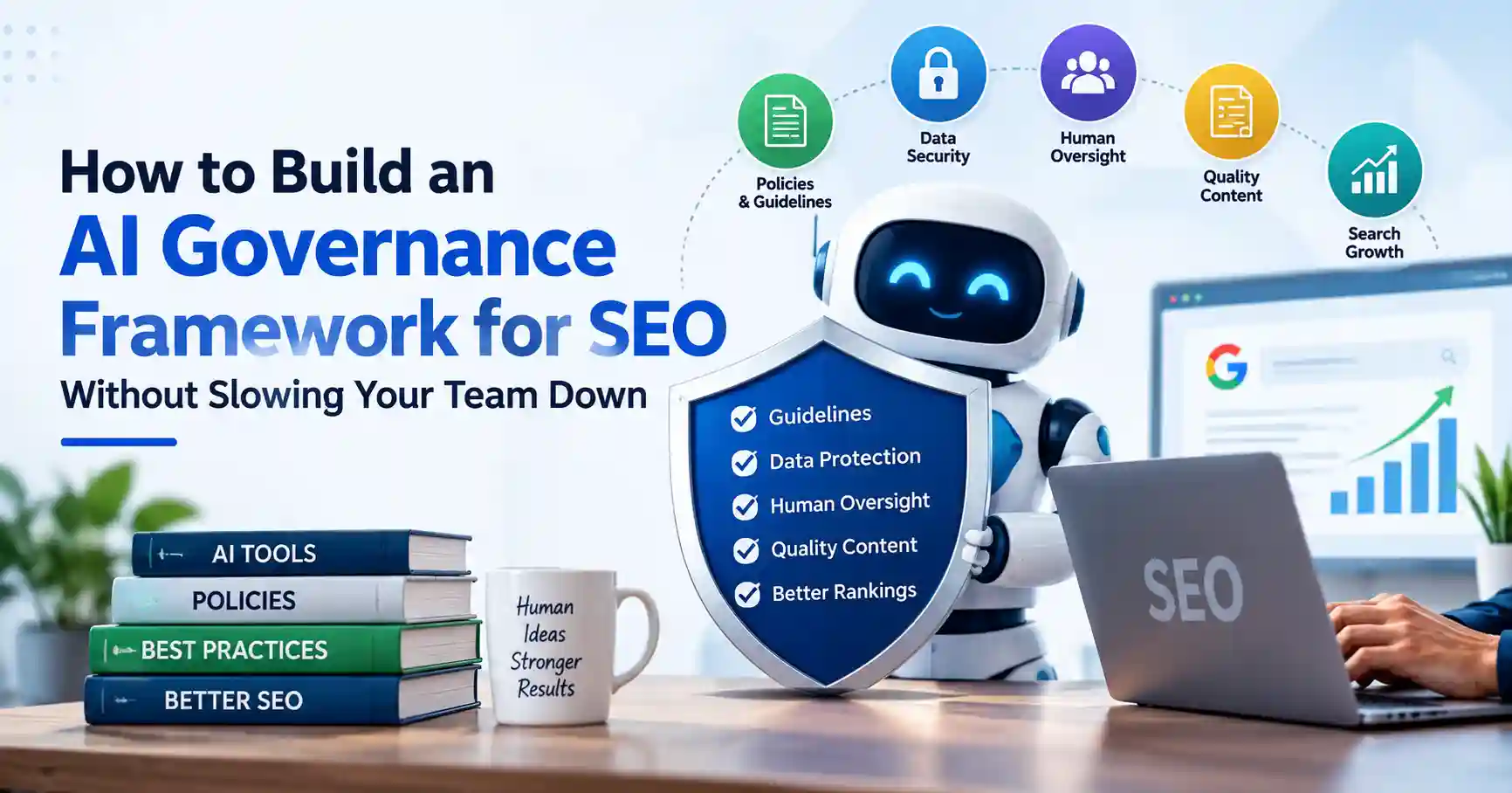
An AI governance framework for SEO is simply a set of rules, responsibilities and checks that determine how your team can use AI safely and effectively in SEO.
Think of it as a guardrail rather than a roadblock.
Your framework should answer basic questions:
- Which AI tools are approved?
- What information can employees upload?
- When does AI need human review?
- Who checks factual accuracy?
- Which SEO tasks can be automated?
- What happens when AI produces something incorrect?
- How do you protect customer and company data?
The goal isn’t to stop people from using AI. It’s to stop random, uncontrolled AI usage from becoming part of your SEO process.
That distinction matters.
A useful AI governance in SEO policy should encourage experimentation while making accountability clear. AI can research, summarize, classify, suggest and draft. The human team still owns the final decision.
Why does SEO need AI governance now?
SEO has always involved automation, but generative AI has pushed that automation much further.
An SEO professional can now generate keyword clusters, content briefs, title ideas, competitor summaries, schema suggestions and even complete articles in minutes.
That’s useful. It can also create problems.
AI systems can confidently produce incorrect statistics, invented sources, outdated recommendations or misleading statements. They may also reproduce bias or turn a company’s content strategy into a collection of generic pages.
Google’s guidance focuses on the quality and usefulness of content rather than simply whether AI was involved. It also warns against using generative AI to produce large amounts of content without adding value for users.
In other words, the problem isn’t “AI wrote this.”
The bigger problem is “Nobody checked what AI wrote.”
That’s why AI SEO best practices should include human review, factual verification and clear ownership.
As a simple rule: AI can assist the SEO process, but it shouldn’t become the SEO decision maker.
What should your AI SEO governance policy include?
You don’t need a 70 page corporate document that nobody reads.
Start with five practical areas.
1. Approved AI tools
Create a simple list of AI tools your team can use for SEO.
For example, you might approve different tools for research, content drafting, analytics, image creation or technical SEO.
Also explain why certain tools aren’t approved. If employees understand the reason, they’re more likely to follow the policy.
2. Data privacy rules
This is one of the most important parts of AI governance.
Tell your team exactly what shouldn’t be pasted into public AI tools. This implies fragile consumer records, secret passwords, shipping logs, company secrets, unpublished blueprints, plus private files.
A useful rule is simple: If you wouldn’t paste it into a public website, don’t casually paste it into an AI chatbot.
3. Human review requirements
Not every AI task needs the same level of review.
A keyword grouping task may need a quick check. A medical article, legal topic or financial recommendation needs considerably more scrutiny.
Create risk levels:
Low risk: brainstorming, formatting, basic categorization.
Medium risk: content briefs, keyword analysis, SEO recommendations.
High risk: publishing factual content, client data analysis, sensitive industries or automated website changes.
The higher the risk, the stronger the human review.
4. Accuracy checks
Make fact checking part of the workflow instead of something people remember after publishing.
Check statistics, names, dates, sources, product specifications, search data and claims before publication.
This is particularly important because AI can sound incredibly confident while being completely wrong.
5. Incident reporting
Something will eventually go wrong.
Someone will upload the wrong file. A tool will generate incorrect information. An automated process will publish something it shouldn’t.
Don’t create a culture where people hide these mistakes.
Give your team a clear place to report AI problems and near misses. A simple internal channel can work surprisingly well.
How do you balance AI automation with human oversight?
This is where many AI governance projects go wrong.
Teams either automate everything or create so many approval steps that nobody wants to use AI anymore.
Neither approach works.
Instead, use a human in the loop SEO workflow.
For example:
AI researches → SEO specialist reviews → AI assists with drafting → editor improves → subject expert verifies → human publishes.
Your exact steps depend on the business. Yet the core rule holds firm: automate tedious chores while leaving actual decisions to humans.
As Google points out, production methods hardly matter, Is it accurate, and genuinely useful to real people? That is the real test.
This also connects with your wider AI search optimization strategy. Content that’s easy for humans to understand, verify and trust is generally easier to structure for emerging AI powered search experiences too.
For more practical ideas, see our guide on 7 Ways to Use AI for SEO That Actually Improve Rankings and Search Visibility.
How can AI governance improve content quality and AI search visibility?
Good governance isn’t only about preventing mistakes. It can actually improve your SEO.
Running drafts through this rigorous pipeline lets your crew catch weak arguments, repetitive paragraphs, and tedious fluff. Long before publication day, Exactly.
You can also build quality checks around:
- Search intent
- Original insights
- First hand experience
- Factual accuracy
- Author expertise
- Internal linking
- Clear content structure
- Helpful examples
- Accessibility
- Brand consistency
That’s especially useful as search becomes more conversational.
AI Overviews and other AI powered search experiences increasingly need content that is clear, structured and trustworthy. Your governance framework should therefore cover both traditional SEO and AI search visibility.
Your technical foundation matters too. Crawlability, indexability, structured content and clear page organization still provide the infrastructure AI systems need to understand your website.
Our guide to Technical SEO for AI Search explains that side of the equation in more detail.
What should an SEO team measure after implementing AI governance?
Don’t measure governance only by how many rules people followed.
Measure whether the system is making your SEO operation better.
Track things such as:
- AI assisted content error rates
- Number of content revisions
- Publishing speed
- Percentage of AI outputs reviewed by humans
- Data or privacy incidents
- Content quality scores
- Organic traffic
- Search rankings
- AI search visibility
- Content refresh frequency
You can even review your governance framework every quarter.
Ask the team: What worked? What created unnecessary friction? Which AI tools are actually useful? Where are people still taking risky shortcuts?
That turns governance into a living system rather than a forgotten PDF.
What does a practical AI governance framework look like?
If you’re starting from scratch, keep it simple.
Your first version could fit on one page:
Purpose: Supercharge SEO via artificial intelligence, while strictly maintaining uncompromising, secure, brilliant standards.
Approved uses: Idea digging, grouping keywords, quick brainstorming, making short summaries, writing simple outlines, and choosing a few key optimization jobs.
Restricted uses: Careless posting reveals hidden, sensitive facts daily.
Human review: Verify every online tip thoroughly prior to publication.
Quality standards: Sharp focus, fresh ideas, real utility, brand fit.
Incident process: Spot something weird, Speak up.
Review cycle: Revisit the policy every three to six months.
That’s enough to get started.
AI tools mutate endlessly. Because fresh models and automation platforms launch daily, a static policy rots almost immediately. You wrote it down once, sure, but ignoring updates guarantees swift failure, Adapt or quit.
FAQ’s
This is a collection of guidelines and steps for how an SEO group can use AI in a safe and useful way. It covers research, writing support, data review, and task automation.
Using it lowers hallucinations, cuts down on privacy risks, and reduces poor quality output. It also helps rein in actions that run without control, plus a few other issues. At the same time, your teams can still use AI in a practical way.
Yes, Google pays attention to whether a piece of content is helpful and high quality. It is not only about whether the work involved AI. If a page is made mainly to game search results, it can break Google’s spam rules.
Content rules for AI mean setting limits for how AI made material is gathered, written, checked, revised, and posted. The goal is to keep the work at a solid quality level, aligned with the brand voice, and fit for search needs.
Check it often. Do it when your team brings in a new AI platform. Also update it when your workflow shifts. Revisit it again if there are big changes in AI features or in how data is handled.
Conclusion :
Avoid piling on governance that outweighs the actual issue. The ideal AI framework for SEO hands your crew room to experiment, though a strict few lines cannot be crossed. Protect user data, verify facts, cling to human intuition, and ship material that truly serves readers. Exactly.
Artificial intelligence should speed your search optimizers up without breeding sloppiness. That forms the core of responsible AI implementation: let machines chew through the grinding routine, lock down what matters. And leave humans entirely on the hook for the final call.

Kumar Swamy is the CEO of Itech Manthra Pvt Ltd and a dedicated Article Writer and SEO Specialist. With a wealth of experience in crafting high-quality content, he focuses on technology, business, and current events, ensuring that readers receive timely and relevant insights.
As a technical SEO expert, Kumar Swamy employs effective strategies to optimize websites for search engines, boosting visibility and performance. Passionate about sharing knowledge, he aims to empower audiences with informative and engaging articles.
Connect with Kumar Swamy to explore the evolving landscape of content creation!