Have you ever searched for a restaurant, dentist, hotel, or service “near me” and wondered why one business appears right at the top of Google Maps while another barely shows up?
It’s easy to assume the answer is simply reviews, distance, or a well optimized Google Business Profile. Those things still matter, but Google Maps is doing a lot more behind the scenes.
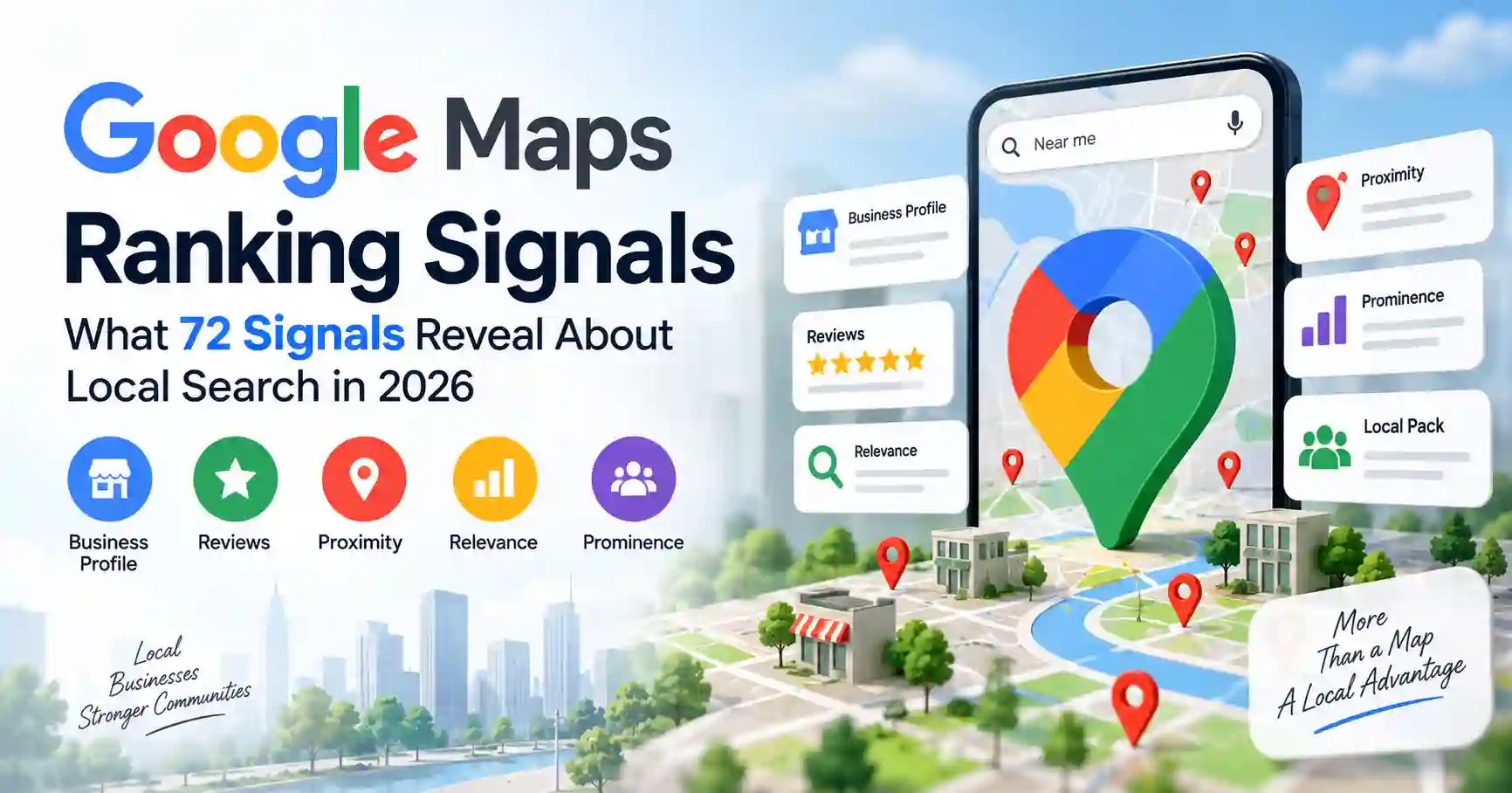
A new analysis of Google’s internal geographic infrastructure has revealed 72 ranking signals associated with a system called Oyster Rank, along with a much bigger architecture involving entities, web data, geographic context, semantic matching and even on device signals. The important takeaway for businesses is simple: Google Maps ranking isn’t controlled by one magic factor. It’s the result of many pieces of evidence coming together.
What are the 72 Google Maps ranking signals actually telling us?
The newly recovered Google data identifies 72 signals connected with Oyster Rank, Google’s internal ranking system for geographic entities. The signals include things such as Google reviews, search volume, listing impressions, listing opens, direction requests, website clicks, chain membership, popularity, prominence and even road usage.
But there’s an important catch.
The discovery identifies the signals, not their exact weights. In other words, seeing a “Google reviews” signal doesn’t mean we now know precisely how much reviews contribute to a specific Maps search.
That distinction matters.
As Search Engine Land’s analysis points out, the 72 signals aren’t the entire Google Maps algorithm. They appear to be one part of a much larger process that includes query understanding, semantic matching, candidate generation, geography, reranking and final presentation.
So don’t treat the 72 signals as a 72 point checklist. Think of them as clues about how Google builds an understanding of a real world business.
How do Google Maps SEO and local SEO ranking factors work together?
For years, local SEO has been explained using three familiar ideas: relevance, distance and prominence.
Google itself still describes these as the main foundations of local ranking. Relevance is about how well a business matches the search. Distance considers how close the business is to the searcher or the location in the query. Prominence reflects how well known and established the business appears to be.
The new research adds some useful depth to that model.
Imagine someone searches for “Italian restaurant near me.” Google doesn’t simply find every restaurant within a fixed radius and sort them by distance.
It needs to understand what “Italian restaurant” means, determine which businesses are actually relevant, consider geographic context, evaluate information about those businesses and then decide which candidates deserve to appear.
That’s why a business slightly farther away can sometimes outrank a closer competitor.
The research even found that Google’s geographic search area can change depending on the query and the environment. A common local search may produce a tighter geographic footprint in a dense city, while the search area can expand in a less populated location.
In practical terms, proximity matters, but proximity alone isn’t enough.
What does Google Business Profile optimization have to do with entity ranking?
This is where things get really interesting for local businesses.
Most owners think their Google Business Profile is the business entity Google uses for ranking. In reality, the profile is more like the visible interface customers interact with.
Underneath it, Google can build a broader representation of the business using information from multiple sources.
That can include your website, business directories, reviews, user contributions, third party data and other publicly available information. Google confirms that Business Profile information can be compiled from several sources rather than coming exclusively from the business owner.
This explains why consistency matters so much.
If your Business Profile says one thing, your website says another, and third party listings contain outdated information, Google has to reconcile those signals.
For businesses, good Google Business Profile optimization therefore means more than adding a few photos and choosing a category.
Make sure your:
- Business name, address and phone number are accurate.
- Primary category genuinely represents the business.
- Services and attributes are complete.
- Opening hours are current.
- Website clearly describes what you offer.
- Reviews reflect genuine customer experiences.
- Location information is consistent across important sources.
If you want a deeper look at profile level signals, our analysis of 1.8 million Google Business Profiles also highlights the importance of categories, completeness and additional categories for local visibility.
Why are reviews, clicks and local search ranking factors becoming more important?
Reviews are obviously important for customers, but the new Maps data suggests that user interactions can also form part of Google’s understanding of a place.
The recovered signals include reviews, listing impressions, listing opens, direction requests and website clicks. Again, that doesn’t mean every click directly boosts rankings. It means Google has systems capable of using these types of observations when evaluating geographic entities.
This changes how businesses should think about reviews.
Don’t chase reviews simply because you want to increase your star rating. Pay attention to what customers consistently talk about.
For example, customers might repeatedly mention:
“same day service”
“vegan options”
“emergency plumbing”
“friendly staff”
“parking”
Those descriptions help build a richer picture of what the business actually does.
As a practical rule, ask for honest reviews after genuine customer experiences and respond naturally. Never try to manufacture keywords in reviews. Google and customers can both spot that kind of thing.
Our earlier guide on reviews and customer sentiment in local SEO explores why the language customers use can provide useful relevance and trust signals.
Does ranking in Google Maps guarantee Google Local Pack visibility?
No, and this is one of the most overlooked points.
The new research separates ranking from what users actually see on the map.
Google’s Maps infrastructure includes a rendering layer called Mapcore. Its job involves deciding which labels and visual elements can actually appear on the map. The analysis identified tens of thousands of map and label styles, showing just how complicated the presentation layer can be.
So there are really several questions:
Is the business relevant?
Is it geographically eligible?
Does Google have enough evidence about the business?
How does it rank against other candidates?
And finally, does it actually get displayed in the visual map experience?
That’s why screenshots and local rank grids don’t always tell the entire story.
A business may have strong underlying signals while its visible map label changes depending on zoom level, location and the search itself.
For marketers, this means Google Local Pack performance should be measured alongside broader organic visibility, profile interactions and real world conversions.
What should businesses do with these Google Maps ranking signals?
The biggest lesson isn’t “optimize all 72 signals.”
That would be impossible, and frankly, it would miss the point.
Instead, build a consistent and complete digital identity for your business.
Start with the basics: accurate Business Profile information, the right category, useful services and attributes, genuine reviews, strong local content and a trustworthy website.
Then go one step further.
Create location pages that clearly explain who you are, where you operate and what you actually offer. Keep business information consistent across important websites. Earn relevant local mentions and links. Publish useful content around the services customers genuinely search for.
Most importantly, think beyond keywords.
Google increasingly needs to understand the entity behind the listing: what the business is, what it offers, where it operates, which concepts are associated with it and why customers should consider it.
That broader approach is becoming increasingly important as Maps moves toward conversational and AI powered experiences. The recovered architecture already contains many of the ingredients needed for richer questions and recommendations.
For Google’s official explanation of the fundamentals behind local visibility, businesses can also review its guidance on improving local ranking.
FAQ’s
Google says local results mainly depend on relevance, distance and prominence. New research shows that Google’s underlying systems use many additional signals and stages.
Not necessarily. The recovered data contains 72 signals, but 25 are explicitly marked as deprecated, and the exact current weighting of the signals isn’t known.
A complete, accurate and verified Business Profile helps Google understand the business and match it with relevant searches. However, a profile is only one part of Google’s broader local search system.
Google says review count and review scores can contribute to prominence. The newly recovered Maps data also identifies Google reviews among the Oyster Rank signals, although the exact weighting isn’t public.
They overlap heavily. The new research shows connections between Maps entities, web documents, semantic information and the Knowledge Graph. So strong local SEO increasingly requires both a well optimized business profile and a website that clearly supports the same business entity.
Conclusion
The 72 Google Maps ranking signals are fascinating, but the bigger story is what sits around them.
Google isn’t simply ranking a business listing. It’s building a picture of a real world entity from many different sources, connecting that entity to the web, understanding search intent, evaluating geography and deciding how the result should appear.
That’s a much bigger challenge than simply stuffing keywords into a Business Profile.
For businesses trying to win local search in 2026, the goal should be straightforward: make your business easy for Google to understand and easy for customers to trust.
And that means strong Google Maps SEO, accurate business information, useful local content, authentic reviews and a consistent presence across the web.

Kumar Swamy is the CEO of Itech Manthra Pvt Ltd and a dedicated Article Writer and SEO Specialist. With a wealth of experience in crafting high-quality content, he focuses on technology, business, and current events, ensuring that readers receive timely and relevant insights.
As a technical SEO expert, Kumar Swamy employs effective strategies to optimize websites for search engines, boosting visibility and performance. Passionate about sharing knowledge, he aims to empower audiences with informative and engaging articles.
Connect with Kumar Swamy to explore the evolving landscape of content creation!