Artificial intelligence is reshaping how people search for information, how marketers develop content, and how businesses compete for organic visibility. For SEO professionals, these changes create new opportunities, but they also raise questions about job security, workloads, and the future of search.
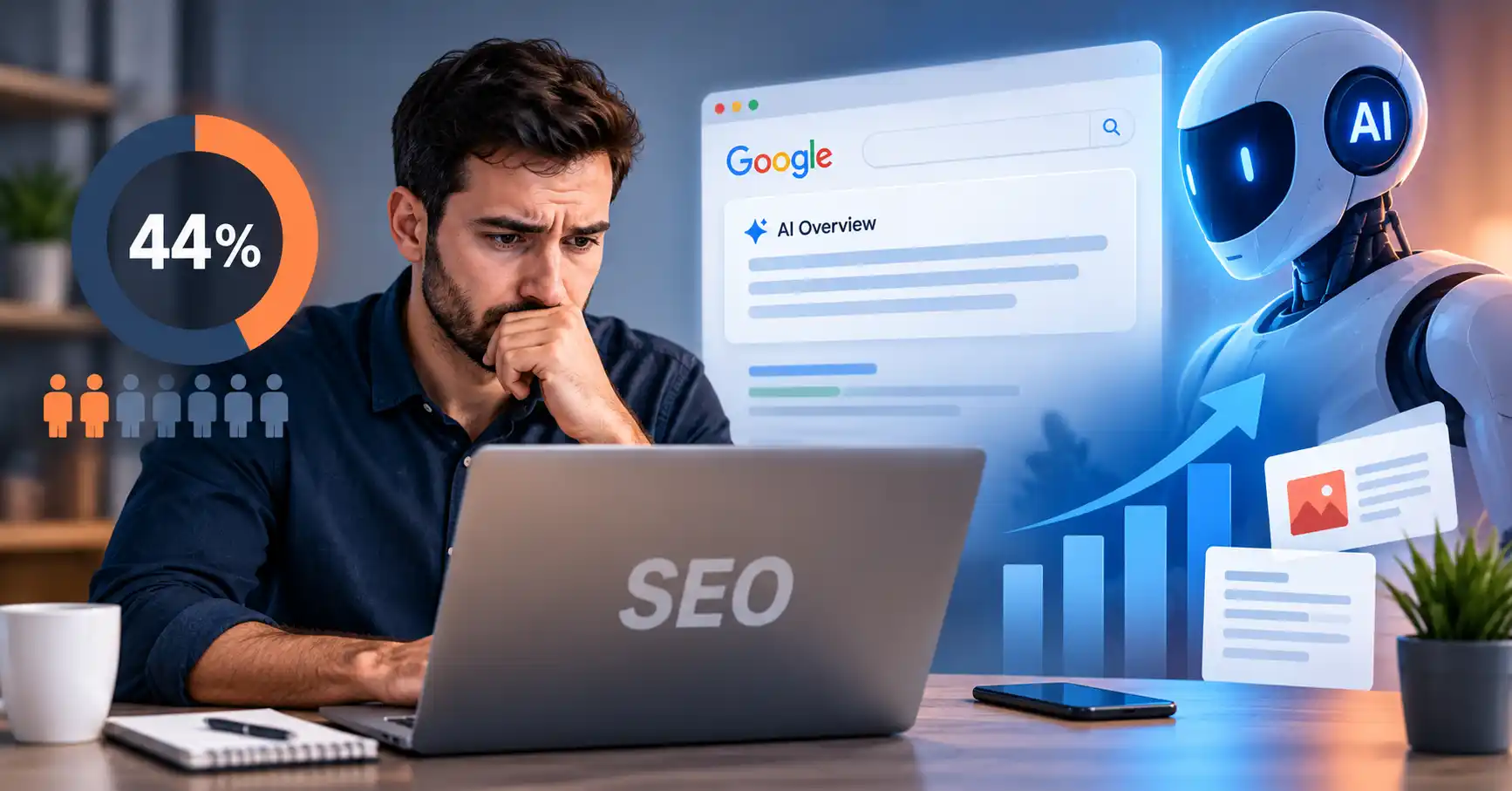
A recent survey from SEOjobs.com found that 43.7% of SEO professionals surveyed were more worried about AI than they were 12 months earlier. Their concerns go beyond the possibility of losing their jobs. Many are also thinking about smaller teams, tougher competition, and the challenge of keeping up with rapidly evolving technology.
What does this mean for the future of SEO? Should bloggers and marketers be concerned about AI replacing their work, or is it time to rethink their approach to search optimization?
Let’s look at what the survey reveals, why these concerns are growing, and how SEO professionals and businesses can respond.
What Does the Latest Survey Reveal About AI and SEO?
SEOjobs.com conducted the survey between October 6 and October 24, 2026, collecting responses from 279 SEO and search professionals. The results offer a snapshot of how these respondents view AI’s growing influence on their work.
Nearly 44% of SEOs Say Their Concerns Have Increased
The survey found that 43.7% of respondents were more concerned about AI than they had been a year earlier. Although the headline rounds this figure to 44%, the distinction matters: the survey measured whether concerns had increased, not whether respondents believed AI would eliminate their jobs.
The findings also need context. Responses were collected voluntarily through social media and email, so the results shouldn’t be treated as representative of the entire SEO industry.
The Biggest Fears Are Smaller Teams, AI Skills, and Competition
The survey highlighted several concerns among SEO professionals.
| Concern | Respondents selecting it |
| Smaller SEO teams | 45.5% |
| Keeping up with AI | 44.8% |
| Increased competition | 44.1% |
| SEO role elimination | 24.4% |
Source: SEOjobs.com survey. Respondents could select multiple concerns.
The results point to an important distinction. More respondents were concerned about smaller teams, changing skill requirements, and increased competition than about their roles disappearing entirely.
Consider a marketing team that continues to employ SEO specialists but expects each person to manage more websites, analyze larger amounts of data, and oversee AI assisted content production. The roles remain, but the workload and expectations change.
That’s an important consideration when evaluating the AI impact on SEO.
Why Are SEO Professionals Becoming More Worried About AI?
AI is changing several parts of the search ecosystem, although the effects vary depending on a business’s audience, website, and reliance on organic traffic.
AI Is Changing How People Discover Information
Google’s AI Overviews and AI Mode give people additional ways to find information without relying exclusively on traditional search results.
When users find answers directly in a search experience, they may have less reason to visit every website that contributed information. That creates uncertainty for publishers and businesses that depend on organic visits.
Google’s Search Console documentation provides guidance on monitoring search performance in this changing environment, although reporting and attribution have limitations.
This doesn’t make traditional SEO obsolete. Websites still need useful content, accessible pages, clear information, and sound technical foundations. The challenge is understanding how search behavior changes and responding to actual performance data rather than assumptions.
Teams Face Pressure to Produce More With Fewer Resources
AI tools can speed up research, generate content outlines, summarize information, and assist with routine reporting. Businesses may use these efficiencies to reduce repetitive work or increase output without expanding their teams.
But producing content faster doesn’t necessarily produce better results.
Imagine a small business publishing educational articles. AI can help its marketing team organize keyword research and prepare initial outlines. Someone still needs to verify facts, check product claims, understand customer problems, and make sure each article offers genuine value.
If the business measures success only by the number of articles published, AI might increase output without improving content quality or conversions.
SEO Skills and Expectations Are Evolving
Knowing how to use AI tools is increasingly useful, but familiarity with those tools alone doesn’t make someone an effective SEO strategist.
Professionals also need to understand search intent, technical SEO, content quality, conversion behavior, and business priorities. These skills help them identify which tasks can be automated and which require human judgment.
For freelancers and marketers, the opportunity lies in combining AI assisted efficiency with sound analysis, original insights, and measurable business outcomes.
Will AI Replace SEO Jobs in 2026?
AI can automate some SEO tasks, but the survey doesn’t establish how many professionals will lose their jobs or how quickly that might happen.
A more useful question is how responsibilities will evolve and which skills will remain valuable as search technology develops.
Which SEO Tasks Can AI Help Automate?
AI tools can assist with repetitive or time consuming activities, including:
- Grouping keywords by search intent.
- Preparing initial content briefs and outlines.
- Summarizing competitor content.
- Identifying potential content gaps.
- Drafting routine reports and flagging unusual performance changes.
These tasks still need oversight. AI generated keyword groups can be inaccurate, competitor summaries can miss important details, and suggested content updates may not align with business goals.
Automating a task doesn’t eliminate the need for someone who understands its purpose and can evaluate the results.
Which SEO Responsibilities Still Require Human Judgment?
SEO professionals need to connect search performance with business outcomes. That means deciding which pages deserve attention, investigating traffic changes, and assessing whether content helps customers make informed decisions.
An AI tool might recommend updating 50 articles. An experienced strategist should determine which updates are worth the effort, which pages generate qualified leads, and which articles need original research rather than another rewrite.
Technical expertise, editorial judgment, and business understanding remain important when making these decisions.
What the Survey Can and Cannot Tell Us
The survey captures the concerns of 279 respondents. It doesn’t establish how many SEO jobs AI will eliminate, how quickly businesses will adopt automation, or whether employment across the industry will decline.
Because the sample was self selected, its findings also have limited generalizability.
SEO professionals should prepare for changing expectations without treating every prediction about AI and employment as an established fact.
How SEO Professionals Can Adapt to AI
Adapting to AI doesn’t mean abandoning established SEO practices. Google’s official guidance confirms that SEO fundamentals remain relevant to AI Overviews and AI Mode, including technical accessibility, internal linking, and helpful, reliable content.
Build Practical AI Skills Around Existing SEO Expertise
Start with tasks that consume time and have clear ways to check the results. For example, use an AI tool to group keywords, then review those groups against actual search results and user intent.
Measure whether the workflow saves time without sacrificing accuracy. If the output requires extensive corrections, the efficiency gains may not justify the effort.
For practical ideas, explore these ways to use AI for SEO.
Strengthen Content Quality and Original Insights
AI makes it easier to produce articles, but publishing more pages doesn’t automatically make a website more useful.
Google’s guidance on creating helpful, reliable, people first content emphasizes original information, meaningful analysis, and value for readers.
For bloggers and businesses, that means providing useful examples, original research where possible, informed commentary, and answers that reflect the audience’s actual needs.
Avoid publishing dozens of similar articles simply because AI makes production cheaper. A smaller collection of genuinely useful resources may serve readers better than a large library of repetitive content.
Track Search Visibility Beyond Rankings Alone
Rankings matter, but they don’t tell the whole story. Review several performance indicators together:
- Google Search Console: Organic impressions, clicks, click through rate, and average position.
- Analytics: Engaged visits, qualified leads, purchases, and other meaningful conversions.
- Content performance: Which pages attract relevant visitors and help them achieve their goals.
- AI visibility: Relevant mentions, citations, and referral traffic where these can be measured reliably.
Google explains that traffic from its AI search features is included in the overall Search Console performance report under the Web search type. Interpret these figures alongside other search performance data rather than assuming every change is caused by AI.
A decline in organic clicks doesn’t automatically mean AI is responsible. Seasonality, changing demand, competitor activity, technical problems, and search result changes can all affect performance.
What Bloggers, Marketers, and Business Owners Should Do Next
Rather than overhaul an entire SEO strategy because of industry uncertainty, businesses should test improvements systematically and evaluate the results.
A Practical 30 Day Action Plan
Week 1: Establish a baseline. Review organic clicks, impressions, conversions, and your most important landing pages. Identify which topics and pages contribute to business goals.
Week 2: Test one AI workflow. Choose a repetitive task, such as keyword clustering or preparing content briefs. Track the time saved and the amount of human correction required.
Week 3: Improve existing content. Update a small group of priority pages with accurate information, clearer answers, stronger internal links, and original insights.
Week 4: Evaluate and refine. Review workflow efficiency and early performance signals. Document what worked and decide which activities to continue, change, or stop.
Example: Improve an Existing Blog Instead of Publishing More
Imagine a business blog experiencing declining organic clicks on several product related articles. Rather than immediately generating 20 new posts, the team could investigate the affected pages, compare current search intent with existing content, verify outdated claims, and strengthen relevant internal links.
AI can help with the initial audit, but the team should review its recommendations before making changes. After updating the pages, monitor performance over an appropriate period.
The principle is straightforward: use AI to improve the work, not simply to increase the volume of content before understanding what readers need.
FAQ’s
According to the SEOjobs.com survey, 43.7% of respondents were more concerned about AI than a year earlier. Leading concerns included smaller teams, keeping up with AI developments, and increased competition. These findings reflect respondents’ concerns, not proof of industry wide job losses.
The survey doesn’t establish that AI will replace SEO professionals at a specific rate. AI can automate parts of research, reporting, and content preparation, but businesses still need people to evaluate strategy, validate information, and connect SEO activities with commercial goals.
Prioritize technical SEO, search intent analysis, analytics, content evaluation, AI assisted research, and conversion optimization. Being able to assess AI generated output critically is just as important as knowing how to produce it.
Yes. Google states that established SEO fundamentals remain relevant to AI search features. Websites still benefit from crawlable pages, useful content, clear internal links, and a strong user experience. Businesses should continue monitoring how changing search experiences affect their traffic and conversions.
Conclusion
The finding that 43.7% of surveyed SEO professionals are more worried about AI than a year ago reflects uncertainty about changing workloads, competition, and skill requirements. But concern about the future doesn’t mean SEO is disappearing.
For bloggers, marketers, and business owners, the priority is to use AI where it improves efficiency, invest in original and useful content, and measure results instead of chasing every new trend.
The question isn’t whether SEO will change. It’s how effectively you can adapt while continuing to deliver value to your audience.

Kumar Swamy is the CEO of Itech Manthra Pvt Ltd and a dedicated Article Writer and SEO Specialist. With a wealth of experience in crafting high-quality content, he focuses on technology, business, and current events, ensuring that readers receive timely and relevant insights.
As a technical SEO expert, Kumar Swamy employs effective strategies to optimize websites for search engines, boosting visibility and performance. Passionate about sharing knowledge, he aims to empower audiences with informative and engaging articles.
Connect with Kumar Swamy to explore the evolving landscape of content creation!