You ever use ChatGPT or some other AI chatbot for the latest on a story, grab a decent enough summary? And then… you just… never actually make it to the original news site? You’re not the only one.
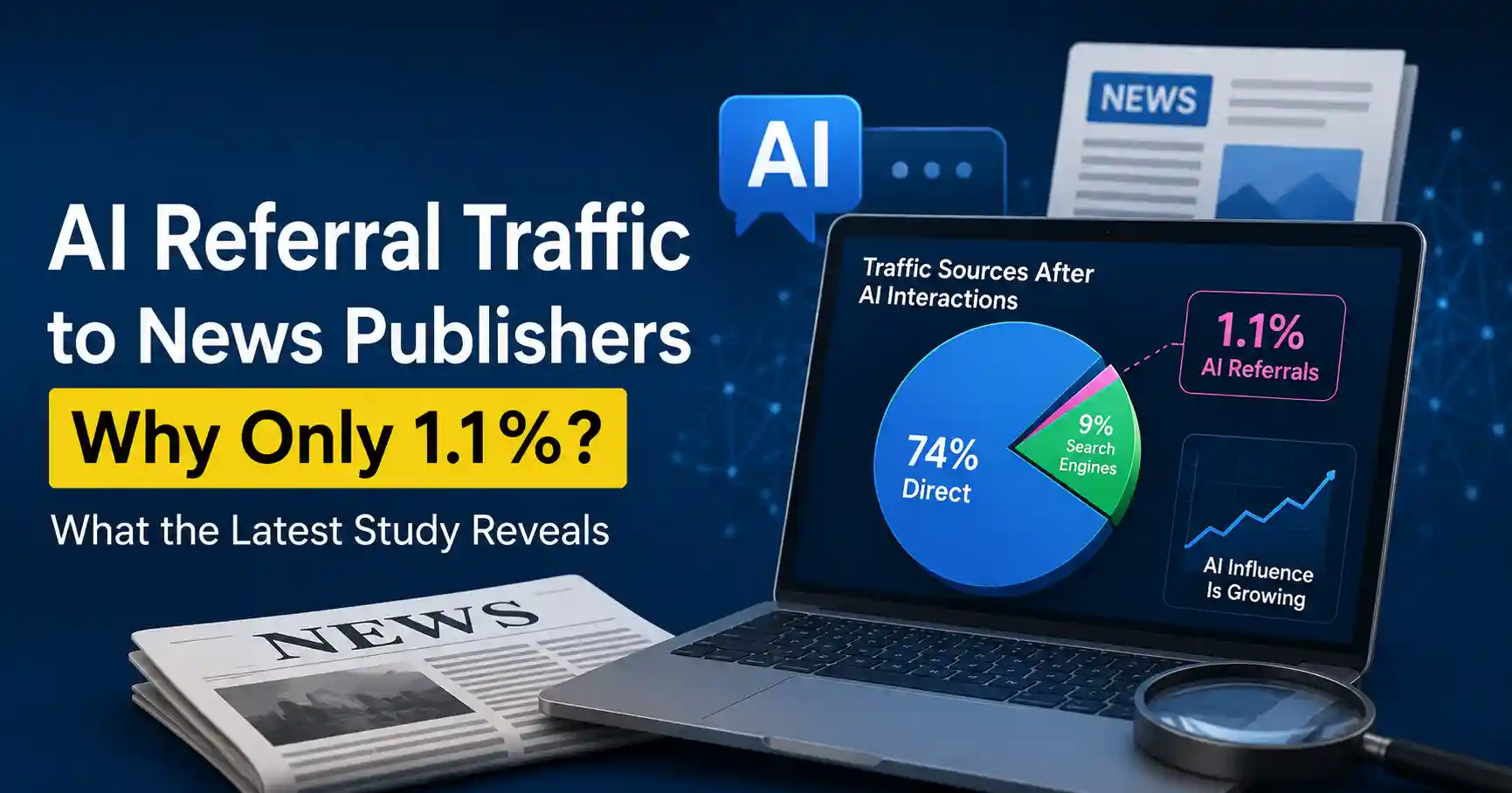
A new study actually puts some numbers behind this exact behavior. Turns out, AI referral traffic to news outlets barely registered at 1. 1% of visits after interactions with AI assistants, according to a Scrunch study that Search Engine Land reported on. But the really interesting part isn’t just that AI sends hardly any traffic directly. The bigger point is how AI might be subtly nudging people towards where they ultimately land, even when the analytics don’t directly show AI as the final stop.
That specific distinction? It’s pretty significant for publishers, SEO folks, and anyone trying to figure out the future of website traffic, say, by 2026.
So, what’s the deal with this 1, 1% AI referral traffic figure?
That 1. 1% number is surprisingly easy to get wrong.
Scrunch dug into millions of searches, AI chats. And visits to publisher sites, using a privacy compliant, opt in panel from February to June 2026. They found that of all the visits to news publishers happening after someone had chatted with AI, a huge three quarters came from direct navigation. About 9% trickled in from good old search engines. And a tiny 1. 1% showed a traceable AI referrer.
In simple terms, someone might read a story summarized by an AI, remember the publication’s name. And then later, they might just type that name straight into their browser. Standard analytics would almost certainly count that as “direct traffic.”
So, if a publisher just glances at their referral reports and says, “AI isn’t sending us anything,” that conclusion might be a bit too simple.
The study itself specifically points out that referral data only captures that very last click before a site visit. It can’t piece together the whole sequence of events from an AI chat to a later website visit.
That’s a pretty big blind spot, don’t you think?
Is AI search really sending fewer people to news sites?
For now, yes, that does seem to be the case, at least when we’re talking about direct, trackable referrals.
But never, ever assume AI search has zero influence.
The study did show that readers were 20. 5 percentage points more likely to visit a news publisher in the week after a news related AI conversation compared to after a non news one. Now, that doesn’t prove AI caused those visits. But it definitely highlights a clear connection between AI interactions and people looking for news afterward.
This is exactly where the old SEO playbook starts to feel a bit dated.
For years, publishers could mostly follow this predictable path:
Search engine query → link click → article → user engagement.
Now, though, a different route is appearing:
AI answer → brand recall/awareness → direct site entry or follow up search → article.
That middle part, the brand recognition piece, can be almost totally hidden in typical attribution reports.
Other recent industry research backs up this exact observation. Search Engine Land’s own deep dive into millions of sessions driven by large language models showed that publisher traffic coming from standalone AI platforms remains quite small compared to organic search traffic, even as those AI driven sessions keep going up.
So, the truly smart question to ask isn’t just, “How many direct clicks did AI send us?”
It’s also, “How often is AI helping people discover or simply remember our brand name?”
What effect are AI Overviews having on publisher traffic?
This is where things get even more interesting.
The Scrunch study found that AI Overviews showed up for about one in every four news searches during the research period. They were especially common for practical queries, like checking the weather, stock prices, or for explanatory topics.
On the surface, that sounds like potentially bad news for publishers. If Google just gives the answer directly, why would anyone bother clicking through to the publisher’s site?
But the numbers need a bit more examination.
News searches that included an AI Overview still led to publisher clicks about 20% of the time. Searches without an AI Overview resulted in clicks about 30% of the time. However, when Scrunch compared the exact same search query, both with and without an AI Overview, that difference shrank to only about two percentage points.
What does that tell us? It suggests that AI Overviews often appear for searches that were already less likely to result in publisher clicks anyway.
Google’s own advice even reinforces that basic SEO principles are still important for AI Overviews and AI Mode. As Google puts it, “Best practices for SEO remain relevant for AI features.”
Therefore, publishers absolutely should not just ditch SEO strategies because AI has entered the picture.
Why are major publishers getting more attention from AI search?
Publishers find themselves in a rather odd situation with AI search right now. One recent study, for instance, turned up something a bit awkward: not everyone gets the same kind of attention.
It turns out that major publishing houses were mentioned 82% of the time their names actually popped up with AI assistants. And get this: a huge 97% of the clicks that came after those mentions? They all went to those big players.
Even stranger, when an AI assistant happened to bring up a publisher no one had explicitly asked about, visits to that specific site shot up by more than ten percentage points the very next day. Over the course of a week, that number almost doubled compared to similar sites that didn’t get that unexpected AI nod.
Now, you can’t just say with absolute certainty, “Yep, AI did that,” but it’s definitely something publishers ought to be keeping a very close eye on. A mention from an AI system can, quite naturally, introduce a reader to a publication they weren’t even looking for.
This is a pretty big shift from how regular search used to work. Back then, someone would type in what they wanted and then choose from a list of results. With AI search, though, the assistant simply weaves the sources right into the answer it provides.
So, how visible a publisher is within those AI generated responses is becoming extremely important. And this might just explain why simply looking at direct AI referral traffic doesn’t really give you the full story.
So, what’s a news publisher supposed to do when faced with these zero click search scenarios?
Honestly, the most significant strategic consideration here is the sheer prevalence of zero click searches. People don’t always need to go on a whole website journey to get the basic idea of what they’re looking for. An AI assistant, a quick search summary, a featured snippet, or an AI Overview can just hand them all the information they need right then and there.
This doesn’t mean publishers should just give up and stop creating content. What it does mean is that the content they produce needs to offer something exceptional, something that truly motivates a reader to click through.
Breaking news, the kind that’s everywhere and easy to find, is becoming remarkably simple for AI systems to summarize. But original reporting? That’s an entirely different matter.
The same goes for:
- Expert opinions
- Unique data
- Firsthand accounts
- Strong viewpoints
- In depth analyses
- Compelling visuals
- Truly novel information
Those are the things AI finds much harder to simply repeat.
Google itself is reinforcing this with its new guidelines for generative AI search: focus on content that’s unique, valuable, and created for people to read. Don’t just churn out another version of what’s already out there.
For publishers, this establishes a pretty clear boundary.
If an AI can easily boil down your article into three short sentences, and the reader feels like they’ve gotten what they needed, then yes, you have a potential traffic problem.
But if that AI generated summary sparks curiosity, making the reader think, “Huh, I really want to read the whole thing,” then you’ve successfully created a strong reason for them to click.
Publishers can also get better at tracking their overall AI search presence, moving beyond just relying on those outdated referral reports.
Does all this mean SEO is becoming less important for publishers?
Not exactly; it’s more like it’s becoming… broader.
Standard SEO remains absolutely crucial for search engines to find, understand, and rank content. But now, publishers also have to consider how AI systems will understand and mention their published work.
This isn’t about stuffing articles with keywords or creating strange, “AI friendly” versions of every single webpage. The core of it really comes down to the basics:
- Presenting information that is both original and clearly trustworthy.
- Making sure the most critical information is easily visible on the page.
- Using clear headings and organizing content sections in a sensible way.
- Connecting related stories with solid internal links.
- Keeping key content easily accessible for search engine bots.
- Clearly demonstrating your expertise in the topics you cover.
- Giving readers a real incentive to look beyond the AI generated summary.
Google specifically advises making content discoverable through internal links and ensuring vital information is in plain text.
Publishers can also pick up useful advice from special guides on optimizing for AI search.
The main objective isn’t to “trick” AI. It’s about building a publication so fundamentally valuable that both search engines and AI systems see a strong reason to highlight it. And, most importantly, that human readers see a genuine reason to visit.
What does that small 1, 1% figure really signify for what’s coming?
The most direct interpretation is this: while AI referral traffic might be small in numbers right now, AI’s wider influence could very well be much more significant than that simple statistic implies.
The 1, 1% shouldn’t be mistaken as proof that AI isn’t important for publishers. It just shows that the AI referrals we can directly measure today are a tiny fraction of the post AI conversation visits publishers receive.
At the same time, people who use AI for news seem more likely to visit news publishers afterward. Plus, these AI assistants can introduce readers to publications they hadn’t specifically searched for.
This situation creates a whole new measurement challenge.
A publisher might get an AI mention today, a direct visit tomorrow, and then notice a branded Google search the week after. Standard analysis tools might see these as three completely separate events.
This really highlights why publishers need to look beyond just simple clicks.
It’s essential to track:
- Brand mentions
- AI visibility
- Branded searches
- Direct traffic
- Organic traffic
- Engagement metrics
- Subscription rates
- Conversion data
And conversion data in a truly integrated manner.
While the traffic report might say 1. 1%, the actual impact, well, that could indeed be considerably larger.
FAQ’s
Not really, not yet anyway. One study showed that only 1, 1% of publisher visits after AI interactions came from an AI referrer. But AI might be subtly steering people toward direct and search based visits later on.
This is website traffic that occurs after a user clicks a link from an AI assistant or an AI powered platform, like ChatGPT, Gemini, Claude, or other answer generating engines.
AI Overviews can definitely reduce click through rates for certain types of searches. However, the available data suggests they often appear in news related queries where publisher click rates were already quite low.
Absolutely not. SEO remains critically important for both traditional Google Search functions and Google’s evolving AI search experiences. The focus just needs to shift toward creating valuable, original content that is well organized, rather than simply chasing ranking positions.
Focus on original reporting, demonstrate solid expertise, structure your website logically, utilize internal links effectively, build brand recognition, ensure visibility within AI systems, and develop content that gives readers a strong reason to visit beyond just the basic answer.
Conclusion
That 1, 1% figure might immediately catch your eye. But the bigger point is actually much more interesting: AI isn’t necessarily making publisher visits obsolete. In many cases, it might just be changing the route people take to get where they’re going.
If publishers can smartly track that entire user journey, instead of just fixating on the final point of referral, they’ll gain a much clearer understanding of AI’s actual effect on their audience engagement.

Kumar Swamy is the CEO of Itech Manthra Pvt Ltd and a dedicated Article Writer and SEO Specialist. With a wealth of experience in crafting high-quality content, he focuses on technology, business, and current events, ensuring that readers receive timely and relevant insights.
As a technical SEO expert, Kumar Swamy employs effective strategies to optimize websites for search engines, boosting visibility and performance. Passionate about sharing knowledge, he aims to empower audiences with informative and engaging articles.
Connect with Kumar Swamy to explore the evolving landscape of content creation!