
- Like, the brands generated through AI could transform every search, making organic search more brand’s favoured results.
- If they are to step up their content and branding in time, small businesses may run the risk of being overshadowed.
- At the same time, innovative marketing strategies are the only way your business will benefit and survive in a world that is rapidly transitioning into a matrix run on AI.
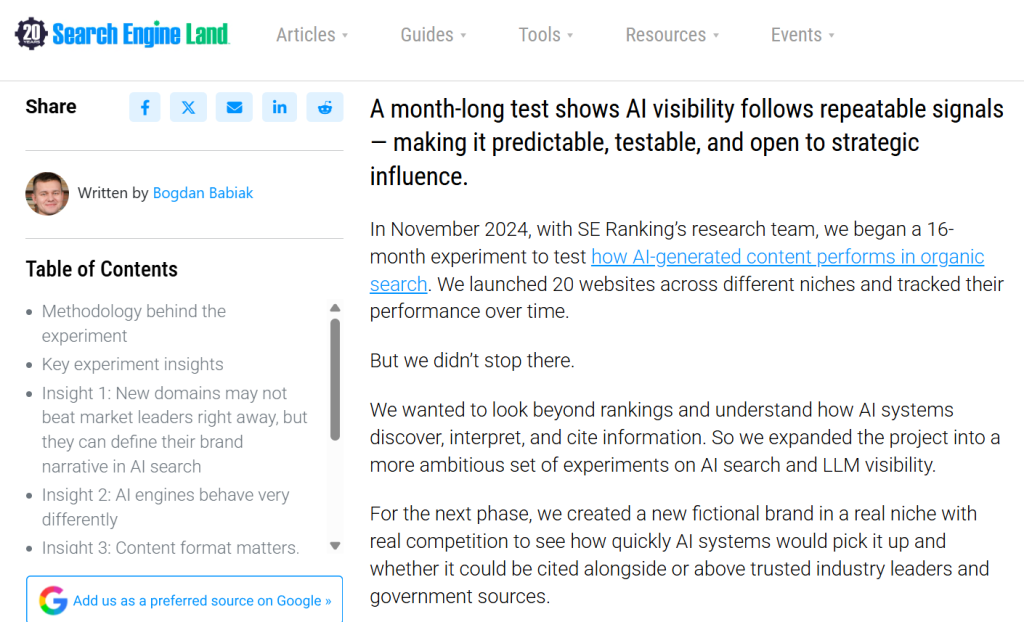
Artificial intelligence is indeed impacting digital marketing in ways that are barely imaginable! In a recent experiment about “Artificial Brand Search,” as revealed by Search Engine Land, artificial technologies are talked into inventing entirely new, fake brands and presenting them in search results. Like complete nuisances, fake brands could divert proper business organizations and authentic content. But what would all of this mean for small businesses unable to manage severe online competition?
The following article proposes an analysis of this AI experiment’s possible significance, along with certain challenges that business of the smallest statues may confront, not to mention the ways in which big companies may have to take a re-look in their strategies to chase theirs.
But, what does a fake-brand AI search experiment mean’?
As a concept, it laid the groundwork for the potential rise of fake brands via AI, which show up during organic searches. They are fictional brands that bear absolutely no connection to any real company, with AI being responsible for giving them the verisimilitude of authentic brands.
Search Engine Land’s experiment shows that AI does have the power to propel brand-like content all over search results. Given the advent of technology, it is uncomplicated to fabricate such high-quality, brand-like content within just a few minutes, spelling the potential death-knell for businesses looking to employ SEO strategies.
When considering the presence of these AI-designed brands in SERPs with real-sounding names, logos, and descriptions, the challenge arises concerning the real difficulty: How will real businesses fare in a competitive environment in which fake brands lead search results?
Main Takeaway: As we see more AI integration into search engines, small businesses are going to find it tougher to remain discoverable without opting for AI several leagues above what is “small business finance.”
How Can AI-Generated Brands Impact Small Businesses?
The rise of AI-generated fake brands could be bad news for the small quantity of small businesses that get most of their search traffic from organic sources. If eventually the AI-generated content starts taking the lead in search engine results, small businesses could quite likely have their online visibility curtailed by content coming from these non-real brands.
Thus, for example, instead of searching for days with SEO strategies under development, a very small, local bakery might suffer defeat as some artificial brands maintain dominance. Able to climb near the top of search results via deep learning, these Pygmalion brands carry a great advantage over highly nurtured organic SEO (gold standard until recently) pretty rapidly, and when they outrank the real products being regenerated via search and SEO, do not look real at all.
So what might small businesses need to do to stave off that threat?
Small businesses will have to up the ante with SEO, employing AI tools to supercharge their strategy. They may have to concentrate more on scenes or hyper-local keywords that the AI companies fast ruled out. On the other hand, stressing the user experience and true content together with a competent personal touch would separate the small business from AI-a generated brand.
Key Insight: Small businesses will have to embrace AI to keep up with the competition and stress “real” and “local” at each and every level.
Will AI further dominate search engines?
The Counter-Argument: Could Fake Brands Improve the User Experience? Could fake brands better user experience, resulting in manipulation of search results?
At least theoretically, the rise of AI-generated brands may give rise to some interesting angles. Some are claiming that the flooding of genuine brand labels will entail increased fake brand presence at places where real businesses naturally provide less coverage in their businesses.
For instance, instead of landing on irrelevant search results against a very specific product or service, an AI-generated brand might at least provide extra resource names or possibilities to satisfy the need of the consumer. Companies piggybacking AI, which are fake in every sense, can be intermediaries offering goods and services that many actual businesses haven’t touched yet-and that can only make the user experience better.
When it comes to the contents’ quality and transparency, though, the waters start getting murky. User engagement might be tabulated with some settings that are irrelevant in the prospect of businesses with products or services that do not exist. Such illegitimate and deceitful actions might lead to ebbing of trust and distort the overall value of search results.
Which way will small businesses head?
AI-created brands could be good for some search experiences, but the primary menace is blocking the small businesses that would otherwise take precedence in organic search results. AI can help significantly towards concretising niches within emerging sectors in that it expedites setting the stage while involved companies must compete with fictitious solutions posing low authenticity or physical relevance.
| Aspect | AI-Generated Brands | Real Businesses |
|---|---|---|
| Creation | Instant, AI-driven | Time and effort required |
| SEO Ranking | Can rank quickly | Needs ongoing optimization |
| Authenticity | Not real, fake brands | Genuine, real brands |
| User Trust | Risk of low trust | Higher trust, established |
| Competitive Edge | Can dominate quickly | Needs unique value |
| Impact on SMBs | Can overshadow small biz | May get pushed down |
Key Insight: AI-generated brands may ideally guide a user in improving user experience, while it remains that they could lead to mistrust and negate the chances of small businesses to survive much of the search visibility battle.
How Small Businesses Can Use AI to Fight Back
Instead of worrying about the obliteration of AI-created content, small businesses must consider how AI tools might be utilized to nourish their branding. AI brings on board the possibility for processing automation to help businesses in handling content development, search engine optimization, and personalization of communication with customers.
For example, businesses can automatically enhance their websites with the help of AI tools for the purpose of better SEO in generating blog postings, variously affecting meta-descriptions and selecting top-performing keywords-in small businesses with limited media-marketing teams.
Simultaneously, AI-driven chatbots, customer service tools, and personalized marketing options are some other suggestions to keep a connection alive with customers and boost business performance in marketing.
Key Takeaway: Although AI can help streamline different operations and improve competitiveness for smaller businesses, they must pay as much attention to maintaining authenticity as possible.
Future of Search Engines: AI or Human Based?
While it is evident the AI-driven algorithms will play a much bigger role in determining search engine results, the $60,000 question remains; will we see controlled AI-generated content or will search engines finally find a way to curtail AI?
A possible scenario in the future is that search engines would now impose more stringent criteria related to the use of AI for search ranking to ensure that only legitimate brands are put to higher-ranking spots. Indeed, the advancement in AI could be such that it shall be automatic for businesses – and many literally have to use it in order to compete in such a highly competitive market.
What we can guess could be a likelihood of AI contributing to something beyond generating content but rather being the driving force behind personalized search results, therefore creating more opportunities for end-users but compelling businesses to adapt with lightning speed toward adopting all new technologies so as to stay in business.
How should small business owners look into the future?
In the long run, small businesses will be forced to watch the trends of AI and proactively incorporate new technologies into their strategic sides. Whether such integration comes in the form of highly developed SEO techniques, AI-driven personalized marketing, or through the production of AI-conceived content, companies will continue to leverage a dynamic competitive edge.
Key Insights: The future of search engines is going to be defined by AI, and small businesses must remain malleable in this fast-paced environment in order to stay afloat.
Conclusion: Preparing for the Future with AI
The “fake brand AI search” experiment really demonstrates that AI could totally turn the conventional SEO approach topsy-turvy. It does give small businesses an opportunity-plus-benefit approach to accessing these technologies and the unwanted choice of leaving those who are too poor behind. Small businesses should gear up for golden objects in AI tooling for SEO, branding, and marketing while keeping their brands and products human and willing.
At the end of the day, achieving a balance will determine how well you reap the rewards: allow AI to work for you while you stay true to your brand and mission. Furthermore, the game is good now and those who adapt early will be the first ones among the beneficiaries.

Kumar Swamy is the CEO of Itech Manthra Pvt Ltd and a dedicated Article Writer and SEO Specialist. With a wealth of experience in crafting high-quality content, he focuses on technology, business, and current events, ensuring that readers receive timely and relevant insights.
As a technical SEO expert, Kumar Swamy employs effective strategies to optimize websites for search engines, boosting visibility and performance. Passionate about sharing knowledge, he aims to empower audiences with informative and engaging articles.
Connect with Kumar Swamy to explore the evolving landscape of content creation!