Have you ever opened Instagram and then just, wondered why your feed suddenly feels full of stuff you never asked for?
Youre not alone.
For years, people have been saying that social media algorithms feel like they have minds of their own. One day you are interested in travel videos, and the next day your feed is packed with random posts that feel totally unrelated. It’s frustrating because it makes you feel like the app is guessing instead of listening.
Instagram looks like it’s trying to fix that.
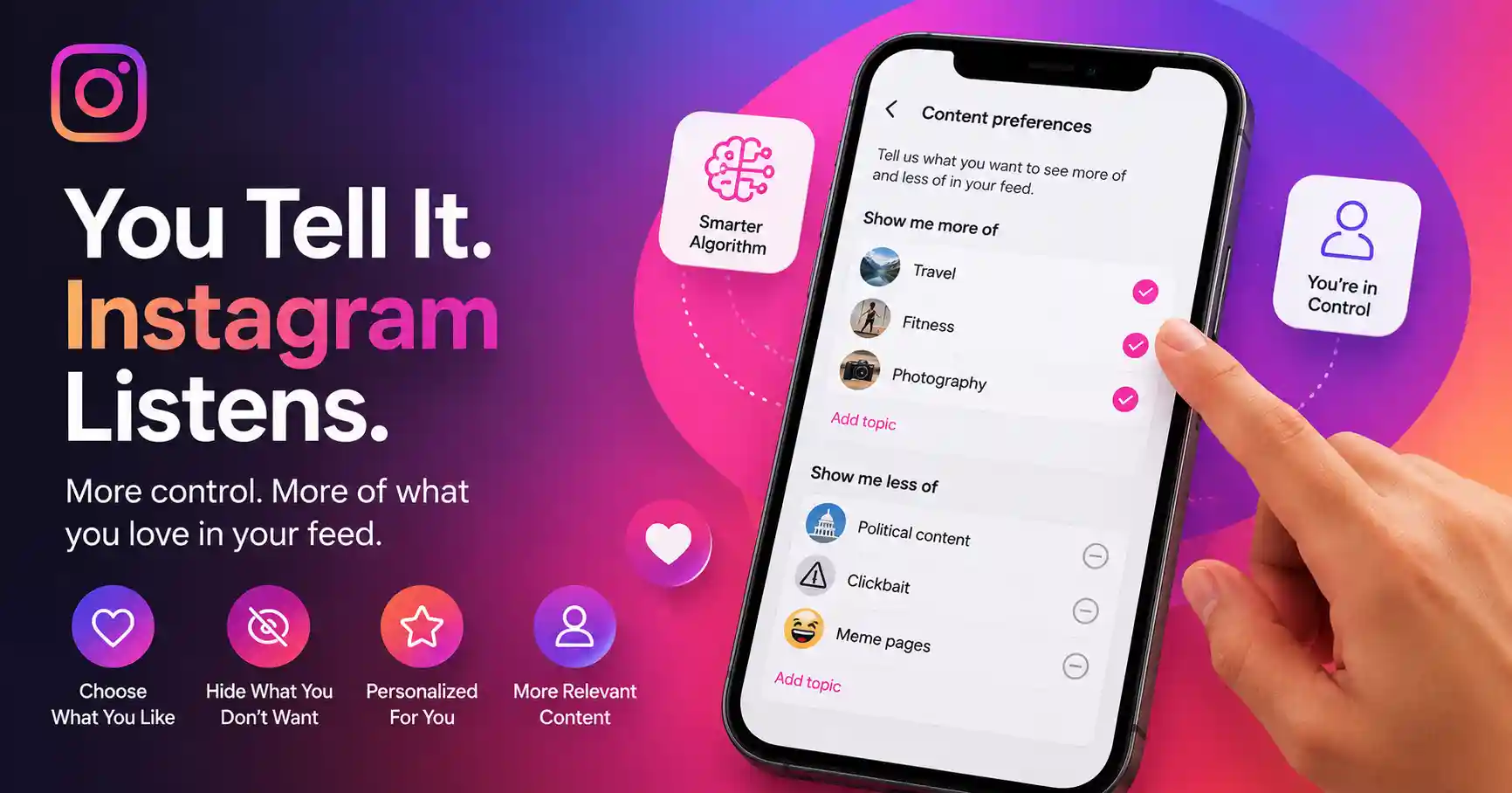
The platform has rolled out new controls that let you steer what you see in your feed, more directly. Instead of depending only on algorithmic guesses, you can now send stronger signals about the posts you want to watch, and also the ones you want to avoid.
At first glance, this can seem like a plain user experience tweak. But in practice, it could create real ripple effects for content creators, brands, digital marketers, and the broader social media playbooks that run everything.
The update shows a wider trend going on across the digital landscape. Platforms are getting more personalized, a bit more user driven, and also AI assisted, in ways that feel pretty natural, for people.
What Does “Instagram Now Lets Users Tell the Algorithm What They Want” Actually Mean?
Instagram’s latest update gives people more control, over what they see in their recommendations. Instead of letting the algorithm do all the choosing, users can directly nudge the recommendation system toward the topics and content categories they actually prefer. This tends to make the whole experience more customized, so what shows up feels more aligned with each person’s interests. It is a lot like streaming platforms that ask you to like or dislike something, or even rate it later on.
Instagram is essentially applying a similar concept to content discovery.
The platform wants to better understand:
- What topics users enjoy
- Which creators they prefer
- What content formats they engage with most
- Which recommendations should appear less often
This creates a feedback loop that helps Instagram, gradually tune its recommendation engine, over time though it feels continuous. For users it means the feed becomes more well matched to what they actually look at, and for marketers it means knowing what the audience like really matters even more.
Why Is Instagram Giving Users More Algorithm Control?
The quick answer is user satisfaction , or maybe even like user calm? But yes, satisfaction.
Social media platforms compete very hard for attention, and if people feel annoyed by recommendations that are just irrelevant, then engagement goes down.
Instagram’s action fits in with a wider wave across digital spaces, where personalization turns into a real competitive advantage.
More and more people want the algorithms to grasp what they prefer, not only guess.
At the same time, people also want transparency, and they want some say in what happens next.
By giving users more control, over what shows up in recommendations, you can balance those expectations, a little better.
As one social media strategist recently put it:
“Users don’t necessarily want to replace the algorithm. They just want the algorithm to listen.”
That’s exactly what Instagram seems to be going for, in a general sense though.
By letting people tune the suggestions more directly, the platform can make things feel more relevant, and at the same time boost their engagement .
How Could This Change Content Discovery and Social Media Marketing?
This update could have a larger impact than many marketers initially realize.
For years, creators focused heavily on understanding the Instagram algorithm itself.
Now there’s an additional factor to consider: audience preference signals.
Content creators may need to think more carefully about:
- Audience intent
- Content relevance
- Niche authority
- Topic consistency
- Long-term engagement
If users can actively indicate what they want to see, generic content may struggle to maintain visibility.
Instead, highly relevant and interest-driven content could gain an advantage.
This trend follows changes that are happening in search plus AI driven discovery, kind of, you know. Companies are already moving toward more and more personalized recommendation engines. If you get the contrast between AI Search versus Organic Traffic , you can help marketers read how discovery led by users is reshaping digital visibility across each platform, really.
The common theme is simple: relevance matters more than ever.
Will This Make Instagram’s Algorithm Better at Personalization?
Most likely, yes.
Algorithms perform best when they have high-quality signals.
Historically, Instagram relied heavily on indirect signals such as:
- Likes
- Comments
- Shares
- Watch time
- Follows
Those metrics are useful, but they don’t always tell the complete story.
A user might watch a video out of curiosity without actually wanting more content on that topic.
Direct feedback creates a stronger signal.
When users explicitly indicate preferences, Instagram gains a clearer understanding of their interests.
This could result in:
- Better recommendations
- More engaging feeds
- Higher user satisfaction
- Improved content relevance
In a lot of ways, Instagram is moving closer to those recommendation models that AI powered systems use , and to the modern content platforms too. It feels a bit like the same logic is showing up there.
What Does This Mean for Brands and Content Creators?
For brands, this update reinforces a lesson that kind of sits in the background:
Making content for everyone ends up connecting with no one, and it feels kind of ironic.
As Instagram’s recommendation systems become more tailored, niche focused content strategies may end up working even better, at least in practice, and in the way people discover things online.
Brands should focus on:
Understanding Audience Interests
The better you understand your audience, the more likely your content will align with user preference signals.
Building Topic Authority
Consistent content around a specific subject helps platforms understand your expertise.
Encouraging Meaningful Engagement
Comments, saves, shares, and interactions continue to provide valuable recommendation signals.
Creating High-Value Content
Users are more likely to indicate positive preferences when content consistently delivers value.
Google has already demonstrated similar trends within search experiences. Understanding how Google AI Overviews Preferred Sources are selected shows how modern recommendation systems increasingly prioritize trust, expertise, and relevance.
These same principles are becoming important across social platforms as well.
Could User-Controlled Algorithms Become the Future of Social Media?
There’s a strong possibility.
People are starting to notice that algorithms kind of shape their online experiences, more and more.
Some users like personalized recommendations, but they also want more say in how those decisions get made, not just passively receive it.
Services that can offer personalization together with clear transparency could end up with a competitive edge, because the whole flow feels more controllable and legible.
This trend isn’t limited to Instagram.
We’re seeing similar shifts across:
- TikTok
- YouTube
- Google Discover
- AI-powered search platforms
- Recommendation engines
The future may not be about platforms controlling recommendations entirely.
Instead, it could involve collaboration between users and algorithms.
“The smartest algorithms of the future may be the ones that listen as much as they predict.”
That shift would, basically, change how people discover content across the internet in a fundamental way.
According to the Instagram official announcements page, the platform keeps putting money into tools that enhance user control and also refine content personalization, even more.
FAQs
Can users completely control the Instagram algorithm?
No, Instagrams recommendation system is still powered by AI plus engagement signals, however users have gained a bit more sway over what shows up , and how content gets pushed forward in feed, so the results can feel more user-controlled than before.
Why is Instagram making this change?
The aim here is to make the content feel more on point, boost user satisfaction, and lift overall engagement by letting people have more direct control over what gets recommended, to them.
Will this affect content creators?
Yes. Creators may need to focus more on audience interests, niche expertise, and content relevance to maintain visibility.
Does this mean engagement metrics no longer matter?
Not at all. Likes, comments, shares, saves, and watch time remain important signals for the algorithm.
Is this similar to AI-powered recommendation systems?
Yes, this update reflects the wider currents in personalization, and in recommendation tech across digital platforms, like you know, it’s becoming more tailored.
Final Thoughts
Instagram decision to let users guide the algorithm feels like another step forward, toward something more personal and more transparent on social media, even if it’s a little messy in practice.
For users it means more control about what shows up in their feeds, and for creators or brands it also means audience clarity, plus content relevance, and that trust is getting more and more crucial, not just a buzzword.
As these recommendation systems keep evolving across social platforms, search engines, and AI tools, one thing looks clearer, the future of discovering content won’t be shaped only by algorithms but also by the actual people using them.
So, what do you think about Instagram new approach? Will user controlled recommendations improve the platform, or will the algorithms still know people better than people know themselves? Drop your thoughts in the comments below.

Nishanth Kumar is the Lead SEO Strategist at iTech Manthra. With over a decade of experience in the digital marketing landscape, he specializes in technical SEO, link-building strategies, and search engine algorithms. Nishanth has helped hundreds of businesses scale their organic presence through data-driven marketing and sustainable “white-hat” techniques. He is passionate about decoding Google’s ever-changing updates to help brands stay ahead of the competition.