For years, established brands have relied on strong backlink profiles, high domain authority, and digital PR to maintain search visibility. Companies with thousands of referring domains often had an advantage over smaller competitors.
AI search is changing how brands get discovered.
A business can rank well on Google and have an impressive backlink profile yet struggle to appear in ChatGPT answers, Google AI Overviews, or Perplexity recommendations. Meanwhile, a smaller competitor with more focused content and stronger category relevance may earn citations.
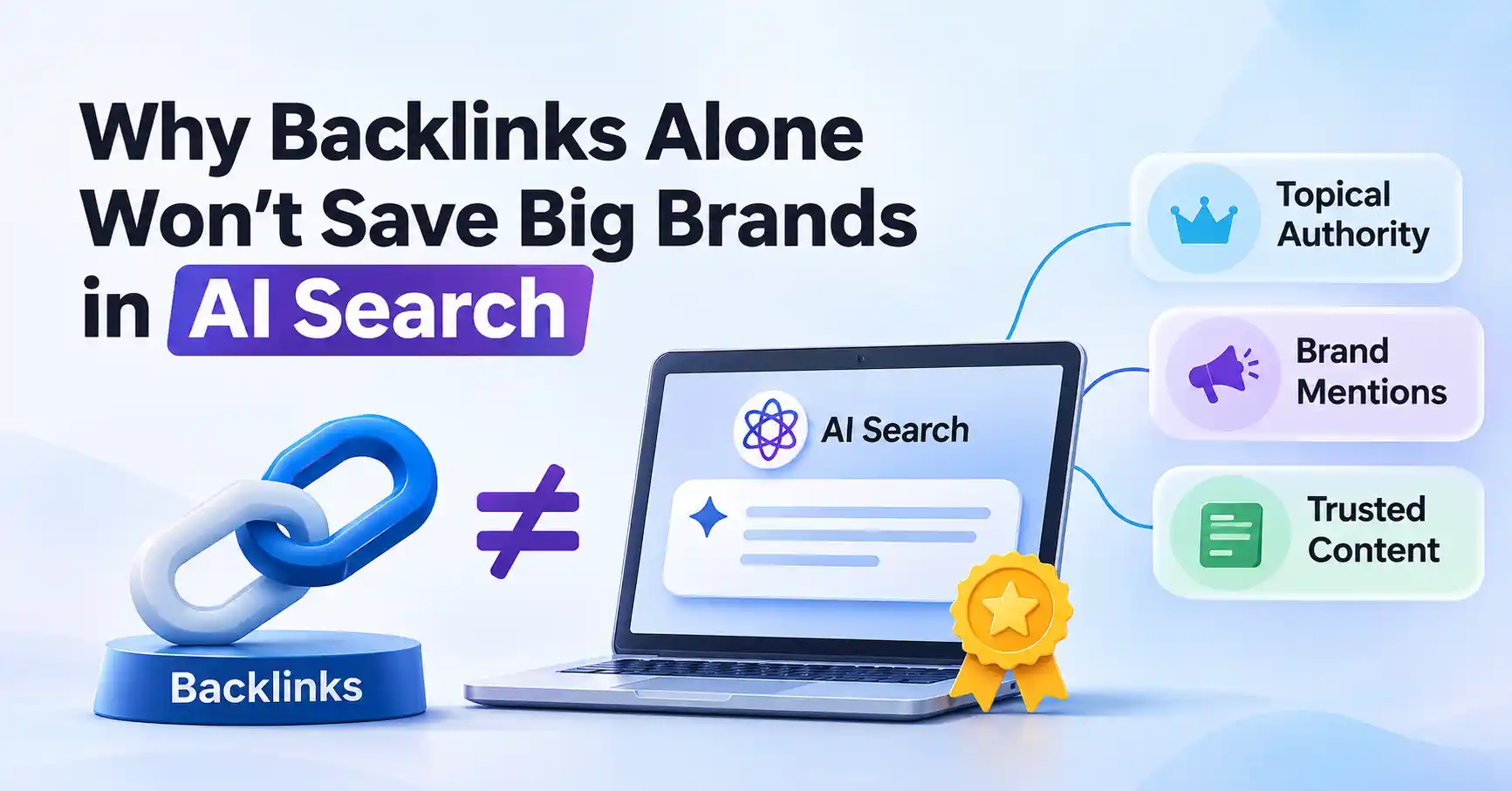
The issue isn’t that backlinks have stopped mattering. Backlinks alone cannot make a brand relevant, credible, or useful enough to appear in every AI generated answer.
For marketers, this means building authority requires more than link acquisition. Brands also need useful information, consistent positioning, and credible recognition across the web.
Why Backlinks Still Matter in AI Search
Backlinks remain an important part of SEO. Google’s ranking systems documentation explains how link analysis systems, including PageRank, help Google understand relationships between pages and identify useful search results.
Research also points to a relationship between backlinks and AI visibility.
A Semrush study of 1,000 domains found that domains with stronger backlink authority tended to receive more mentions in AI generated answers. However, the relationship varied across authority levels and AI platforms.
The distinction is important: backlinks can support AI search visibility, but they don’t guarantee AI citations.
Backlink quality matters more than raw volume
Thousands of unrelated backlinks don’t necessarily make a brand more relevant to a specific question than a specialist with fewer, more relevant links.
Consider two cybersecurity companies:
- Company A has a large backlink profile built through corporate PR and general business coverage.
- Company B has fewer backlinks but receives coverage from cybersecurity publications, technical communities, and security researchers.
When someone asks an AI assistant about endpoint detection tools, Company B may have more relevant information and stronger contextual associations with that topic.
That doesn’t mean Company B will always appear in the answer. It shows why backlink counts alone provide an incomplete picture of competitive authority.
Why Big Brands Can Still Lose AI Search Visibility
Brand recognition isn’t the same as topical authority
A recognizable company isn’t automatically the most relevant answer to every question in its industry.
A large software company might be well known for enterprise applications but lack detailed information about a particular integration, technical workflow, or specialized use case.
A smaller competitor that documents these subjects thoroughly can offer more useful material for specific questions.
This matters for brand visibility in AI search, where the relevance of available information plays an important role in whether a brand is included.
AI answers need information, not just authority
AI search experiences can retrieve relevant pages, synthesize information, and provide answers with supporting citations. Google explains that its AI search experiences can use query fan out to explore related searches and sources.
This creates opportunities for pages that address specific questions, comparisons, and technical details.
Imagine a SaaS brand with a highly authoritative homepage but limited product documentation.
A competitor might publish detailed feature comparisons, integration requirements, pricing explanations, implementation limitations, and practical use cases.
When users ask specific questions about these subjects, the competitor has information that the larger brand may not provide.
A strong backlink profile cannot compensate for missing answers.
Competitors may have stronger category specific credibility
AI systems encounter information about brands across different sources, including editorial publications, review platforms, and websites.
When a brand is consistently discussed in connection with a particular problem, its association with that category becomes clearer.
This is why marketers should look beyond rankings and backlinks when evaluating competitors.
For a deeper look at external signals, read our guide to off page AI search visibility audits.
What Matters Beyond Backlinks in AI Search?
Effective AI search optimization involves more than increasing domain authority. Brands need to make their expertise recognizable across the web and publish information that directly answers customer questions.
Brand mentions and third party validation
Brand mentions help establish associations between a company, its products, and its expertise.
Ahrefs analyzed 75,000 brands and found a stronger correlation between branded web mentions and Google AI Overview visibility than between raw backlink counts and visibility. The study reported correlations of 0.664 for branded web mentions and 0.218 for backlinks. Read the Ahrefs research.
These figures represent relationships, not confirmed ranking weights. A brand may receive more mentions because it’s already popular, trusted, or commercially successful.
Still, the findings offer a useful direction for digital PR: focus on relevant coverage that explains what your brand does, rather than pursuing mentions simply because they include a link.
Topical association and consistent brand positioning
Brands should be consistently associated with the topics they want to be known for.
For example, a subscription billing software company should publish useful material covering recurring billing, failed payments, subscription analytics, and billing integrations.
Its external coverage should reflect those areas wherever possible.
When product descriptions, company profiles, editorial coverage, and documentation communicate consistent expertise, customers can understand the brand’s positioning more easily.
Original research and information worth citing
Original content gives publications and AI search systems something more valuable than another generic explanation.
Consider publishing:
- Industry surveys with transparent methodology.
- Product benchmarks with clear testing criteria.
- Technical implementation guides.
- Expert analysis of emerging industry problems.
- Detailed comparisons based on measurable features.
Original research can support editorial coverage, relevant backlinks, brand mentions, and stronger content differentiation.
The key is to produce research that genuinely adds value instead of creating content solely to attract links.
Clear, useful, and extractable website content
Important information should be easy to find and understand.
Use descriptive headings, specific explanations, meaningful examples, and accurate product information. Avoid hiding essential facts beneath promotional language.
Google’s official guidance on AI features reinforces that established SEO fundamentals remain relevant, including crawlability, internal linking, and content available in textual form.
Google also states that there are no additional technical requirements or special AI specific optimizations necessary to appear in AI Overviews.
For a broader understanding of how these approaches connect, read our guide on GEO vs. SEO.
How Big Brands Can Improve AI Search Visibility
The answer isn’t to abandon link building. It’s to broaden the strategy.
Here are five practical steps marketing teams can take.
1. Audit where competitors appear in AI answers
Start with realistic questions customers ask.
For example:
- What are the best tools for automated subscription billing?
- Which platforms support usage based pricing?
- How do businesses reduce failed subscription payments?
Test these questions across relevant AI search platforms and record:
- Which brands appear?
- Which websites are cited?
- What information supports each recommendation?
- Where does your brand appear, if at all?
Repeat the exercise periodically. AI answers can vary, so a single response shouldn’t be treated as definitive evidence of visibility.
2. Identify third party sources influencing brand discovery
Go beyond traditional backlink reports.
Review industry publications, comparison articles, product reviews, expert discussions, and community conversations.
Look for places where competitors are consistently discussed and investigate why.
The goal isn’t to manufacture mentions. It’s to contribute useful information to publications and communities that matter to your audience.
3. Publish content competitors cannot easily replicate
Replace generic articles with resources that demonstrate genuine expertise.
A SaaS company, for instance, could publish a detailed integration guide covering configuration requirements, supported workflows, limitations, and troubleshooting examples.
Such content helps customers make decisions and gives external writers something meaningful to reference.
4. Strengthen brand positioning across the web
Ensure your website, product documentation, company profiles, and editorial materials clearly explain:
- What your business does.
- Who your product serves.
- Which problems it solves.
- What differentiates it from alternatives.
Clear positioning is more useful than describing every product as an all in one, industry leading solution.
5. Measure AI visibility and business outcomes separately
Track brand mentions, citations, and visibility across relevant AI platforms.
Then connect those observations with website traffic, qualified leads, conversions, and customer acquisition.
Google AI Overview traffic is included within overall Web search reporting in Search Console rather than appearing as a separate search type. Google’s measurement guidance explains how to monitor performance.
More AI mentions don’t automatically translate into more revenue. Visibility matters when it reaches the right audience and supports meaningful business outcomes.
Backlinks vs. AI Search Authority: What Should Marketers Prioritize?
The difference between traditional link building priorities and a broader AI search visibility strategy is becoming clearer.
| Traditional SEO focus | Broader AI visibility strategy |
| Backlink quantity | Relevant, high quality backlinks |
| Domain authority metrics | Brand and topical visibility |
| Homepage link acquisition | Relevant page level citations |
| Link building campaigns | Digital PR and credible mentions |
| Keyword rankings | Mentions, citations, and business outcomes |
| Generic content supported by links | Original, useful, expert led content |
These approaches complement each other. A brand with strong technical SEO, relevant backlinks, useful content, and credible external recognition is better positioned than one relying exclusively on a single authority metric.
FAQ’s
Yes. Research from Semrush and Ahrefs suggests that backlink authority is associated with AI visibility. However, backlink quantity alone isn’t a reliable indicator of whether a brand will appear in AI generated answers.
Yes, for specific questions or topics. A smaller business with relevant expertise, detailed content, and strong category associations may be more useful for a particular answer than a larger company with generic information.
Some research has found stronger correlations between brand mentions and AI visibility than raw backlink counts. However, mentions and links aren’t interchangeable, and correlation doesn’t establish causation. Both can contribute to a brand’s broader authority.
Test relevant customer questions across ChatGPT, Google AI Overviews, Gemini, and Perplexity. Record brand mentions, cited URLs, competitor appearances, and recurring source websites. Repeat the process to identify patterns rather than relying on individual responses.
Conclusion
Backlinks remain valuable, but they aren’t a sufficient strategy for brands competing across AI search experiences.
The opportunity is to build authority that extends beyond link metrics.
That means publishing useful information, earning credible industry recognition, developing stronger topical associations, and making important facts easy to understand and reference.
For big brands, the advantage isn’t simply having more resources or a stronger backlink profile. It’s using those resources to create expertise that customers, publishers, and search systems can recognize.
The real question for marketers isn’t how many backlinks their brand has. It’s whether the web contains enough useful, credible information to explain why that brand deserves to be mentioned.

Kumar Swamy is the CEO of Itech Manthra Pvt Ltd and a dedicated Article Writer and SEO Specialist. With a wealth of experience in crafting high-quality content, he focuses on technology, business, and current events, ensuring that readers receive timely and relevant insights.
As a technical SEO expert, Kumar Swamy employs effective strategies to optimize websites for search engines, boosting visibility and performance. Passionate about sharing knowledge, he aims to empower audiences with informative and engaging articles.
Connect with Kumar Swamy to explore the evolving landscape of content creation!