
Key Insights:
- Explaining bad SEO news is inevitable, but how you break the news remains the pivot of client relationships toward future cooperation.
- Transparency, empathy, and actionable solutions are very key to deflecting rebuke when doom comes to golden heights.
- Explain using your data that support from actionable examples is always useful to show someone the way on how to salvage a situation.
Dishing out SEO Bad News Is Not All About Filling the Negative Side
It’s something everyone dealing with websites and SEO has had to cope with: telling your client that their Google rankings have dropped, that traffic is waning, or that an update just messed up their entire site. You do not enjoy the conversation, yet it is part and parcel of the job. The important thought to keep in mind is that we should not shy away from. Rather, it must be about how to approach the whole issue. Rather, how you handle these situations can make or break the relationship with a client.
The first thing one can do is accept bad news as a piece of SEO. Algorithms will change, better players will steal from you, and sometimes, no matter how hard you try to pull from your sleeve, something just won’t stick. Those variables cannot be controlled, but the way they communicate a message and manage the situation from now on is well in their control. Let us look at how to put across any bad SEO news to clients while getting some constructive conversation rolling around further possibilities.
How Do I Prepare a Client for SEO Breakdowns?
Short answer: Set expectation early and prioritize over-communication on potential pitfalls.
- From the start, an ideal way to console clients against somewhat unpredictable SEO fears is to set clear, realistic expectations.
- With these, clients should accept that if they are to capitalize on SEO, they need wholly to put patience and stretching a hand to the long-term strategy, not the quick fix.
- This often comes into use when the subject of setbacks is broached.
For example, in recent work with an e-commerce client, traffic dropped after a Google algorithm update. However, considering the fact that we had informed the client about the perils of relying exclusively on organic search and had indeed engaged in a strategy to diversify traffic channels, the client was rather receptive to the situation. The catch, you see, is that expectations cannot be managed “at the outset.”
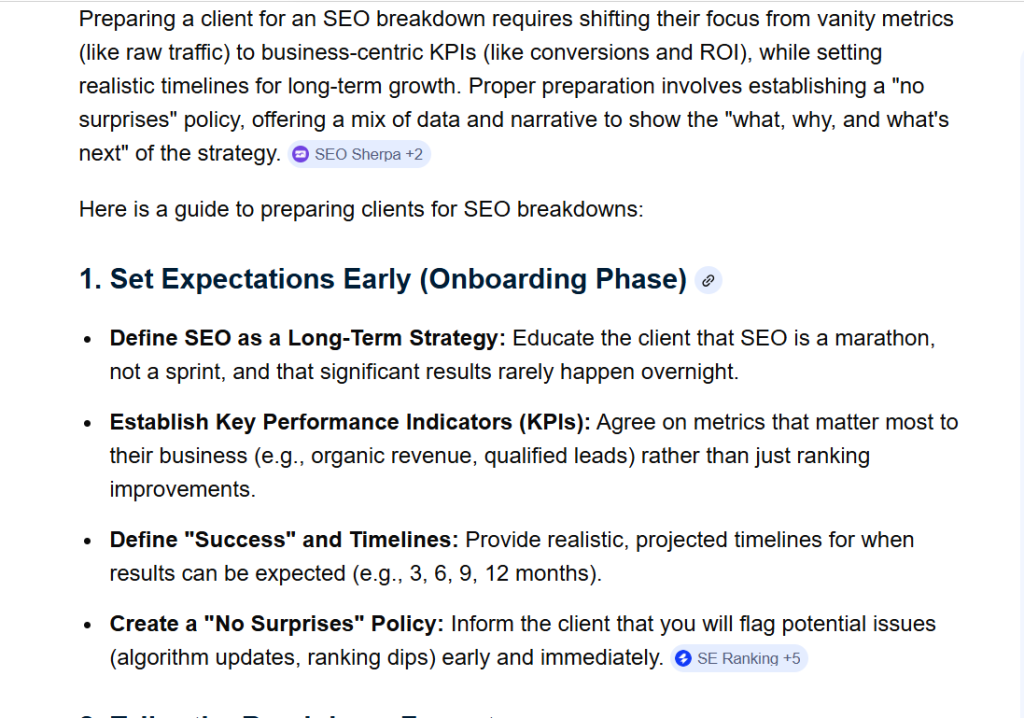
Neglect not the volatility talks on SEO. When trouble starts, the clients should not experience a feeling like they have been blindsided. Be sure to spell out the risks in your audits and reporting.
Key Point: Lowering client expectations somewhat before the issue sets in helps diminish the level of shock whenever that issue does crop.
Breaking the News: Transparency, Empathy, and Data
- Don’t forget that providing bad SEO info requests the sounds of sugarcoating.
- Clients always like honesty, and they really would like to hear all the things so they can then make judgments that would lift their feet forward.
- Be bold enough to voice what exactly went wrong, why it went that way, and what can actually be done to redeem the situation.
Being empathetic is also a must-do. You have to realize that the clients have an emotional investment in their business, so negative results will definitely cause a mix of anguish and panic to set in. You bring it up like, we are in this together. This particular attitude will really give you plus points in your working relationship.
In a situation where you have to let them know about their sudden drop in traffic, you need to tie any claims with proof or results. Explain the impact of the algorithm updates, show how the rankings have changed, and how competitors could have reacted. It is really important, however, that you do make an open commitment to the schedule for recovery.
For sure, based on the above, the principles of transparency and empathy are essential, but they wouldn’t hurt if supported by a good deal of data in your hands.
SEO Management Strategies for Communication and Risk Mitigation
| Topics of Interest | Key Points | Create Action Items |
|---|---|---|
| Help Clients to Be Prepared for the Unpleasant Phase of SEO | Make way for realistic expectations early on to ward off possible surprises. | – Clarify in the beginning that SEO is volatile.- Discuss the place and role of SEO in the long-term and quick win programs.- Help Client in proactive auditing and reporting. |
| Breaking Bad SEO News | Be transparent, empathetic, and use data to back your explanation. | – Clearly explain the specifics of what went wrong.- Offer empathy and collaborative solutions.- Provide the data and the timeline for recovery. |
| Handling Client Reactions | Focus on solutions and maintain open communication. | – Try not to take their outbursts personally.- Provide a roadmap for recovery.- Regular updates on progress. |
| Turning Setbacks into Opportunities | View setbacks as chances to refine and improve strategies. | – Reset content and keyword strategies.- Adapt and evolve strategies to stay ahead.- Highlight positive changes post-adjustment. |
| Selecting the Embedding Medium | Virtual or one-on-one meetings should be conducted for heavy stuff; as for less heavy news, email should be used. | – A virtual or one-on-one meeting account will be required because the news would be very harsh.- At least take care to respect the feelings of the person who comes to know the bad news.- Use the sensitivity of the data whereby data can be used to cushion the situation and bring one or two facts to bear. |
| Definite Immunization of Material against Further SEO Drawbacks | Continuous monitoring and varying the product/service transactions are the best modus operandi. | – Diversify your sources of traffic (SEO, paid ads, social media traffic, etc.). – Keep up-to-date on algorithm updates. – Continually monitor the site performance. |
How to Interact on Client Reaction to Negative SEO News?
Simply, one acts on your frustrations as well; give clear steps ahead.
- When a client hears bad news, they will find themselves in frustration, confusion, and anger, but don’t let the meeting delve into blame.
- This requires a higher degree of communication skills. Consensus requires that the client feels heard and believed that they could be part of a way forward.
- As such, how successfully and speedily you move on from the worst possible scenario does matter in salvaging the wreck.
This is where the importance of your direction should be clear–now, actions must be outlined that you shall take to right the wrong being complained about. For a client, this could mean an algorithm change; in such a case, explain to the client how you are just correcting him within the latitude of the law required content creation or profile alter, pursuant to the best content possible.
The clients will benefit from the presence of a roadmap, although this assures them of what to do and then some. Giving regular updates on the progress will make the client feel that they are a relevant part of the solution.
Insight: Instead of personalizing the clients’ frustration over you, focus on reclaiming their intellectual territory, and keeping them posted.
Can You Turn Bad SEO News into a Positive?
Short answer: Use every setback as an opportunity to re-evaluate and refine your strategy.
Bad SEO isn’t something that ends the world. It’s an opportunity in disguise if one can look at it that way, for it isn’t a big waste after all. Things going wrong are a chance for re-evaluating the strategy, for democratic discussions with teammates to refine it, for constructive criticisms about how the strategy can be adjusted, as well as to pull out the areas for further improvement.
To give an example, directly after a significant update in Google’s algorithm, another website had its traffic shed dramatically. Deep into their content strategy is what we decided to make lemonade out of these lemons. When we audited their content, it was clear that several areas were requiring better keyword targeting, and thus, it was a great opportunity to reestablish content with more user intent. Consequently the site was up the slope soon. Traffic with the client got a most announcing boost more than what it had since the previous updates.
Moreover, these moments ensure that you are indispensable to the client since they need your help in adapting to and evolving some strategies in anticipation of the forthcoming changes.
Summary: Every SEO setback is an opportunity for strategic improvement
What Is the Best Way to Deliver Bad News in SEO
Short answer: The delivery method chosen will largely depend on the severity of the situation with in-person or virtual communication often cutting through the clutter better.
In SEO news delivery, the delivery method is key. With serious matters, go virtual or in-person, as this option gives that personal touch that is so crucial when immediate feedback is needed. With this approach, the client can ask questions, share their concerns, or feel your full attention.
However, when the issue is less severe or the client prefers it, email correspondence may be preferable. There lies the art of not writing an email that comes across as cold or impersonal. Express empathy for the touchiness of the situation, provide data for an explanation, and clarify what the anticipated next steps are.
However, the method of communication is only half the battle. What really matters is the channel through which you express the tone, transparency, and empathy to the client.
Key Insight: Face-to-face interaction is best for major issues, although email can work when handled with sensitivity.
How to Avoid Such Bad SEO News Happening Again?
Short answer: Keep monitoring, diversifying, and expanding your knowledge-these are the greatest forms of defence.
While you will not be able to entirely stave off the vagaries of SEO, with the most careful consideration, you would still aim at mitigating this damage by maintaining SEO strategies that emphasize monitoring and adaptability.
For instance, always go for a diversified traffic strategy. As always, don’t depend on just one source of traffic: SEO only. Try to combine with paid ads, social media advertising, email marketing, etc., to minimize adverse effects from ranking changes.
See; do not rest caring for every algorithm update. Keep your ears peeled and, whenever you notice anything new, update yourself and your clients. Google is all algorithm, but keeping an eye on where it all stands will help in keeping you ahead.
key Insight: proactively monitoring and diversification significantly reduce the impact of any kind of negative SEO news upon your business.
Conclusion
Giving bad SEO news is not easy, but handling it is such that it does not affect him or her negatively. This is where it’s possible to set client expectations from day one and foster open relationships defined by transparency and empathy-as well as provide clear options for the affected page. The repercussions offer one of the most critical types of growth opportunities. Just know that your skill in resolving undesirable situations with calm and poise will affect the perception of your value to be remembered forever.

Kumar Swamy is the CEO of Itech Manthra Pvt Ltd and a dedicated Article Writer and SEO Specialist. With a wealth of experience in crafting high-quality content, he focuses on technology, business, and current events, ensuring that readers receive timely and relevant insights.
As a technical SEO expert, Kumar Swamy employs effective strategies to optimize websites for search engines, boosting visibility and performance. Passionate about sharing knowledge, he aims to empower audiences with informative and engaging articles.
Connect with Kumar Swamy to explore the evolving landscape of content creation!