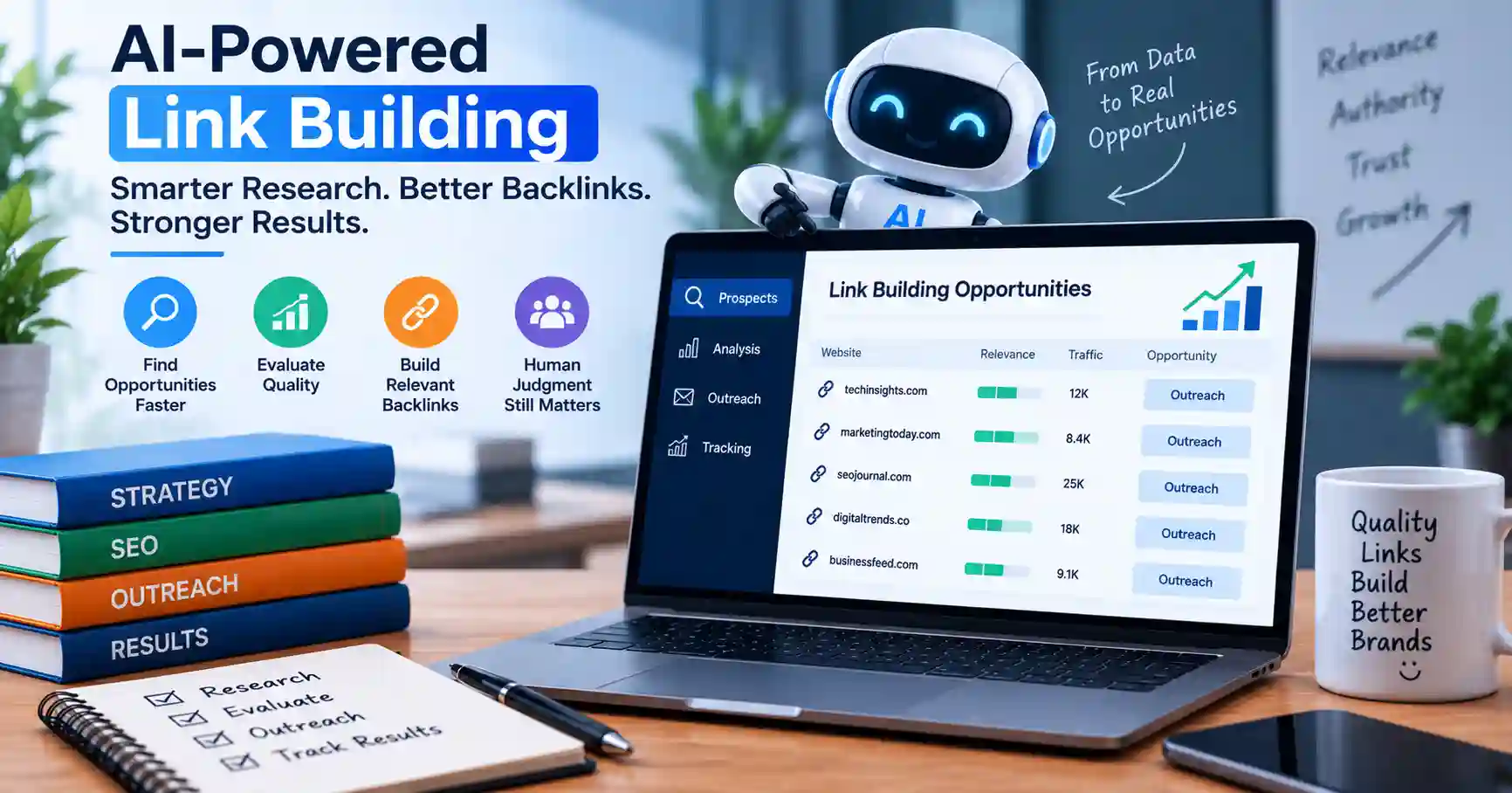
AI has made link-building research faster. A tool can collect hundreds of prospects, group websites by topic, compare metrics and even help prepare outreach messages in a few minutes. That speed is useful, but it creates a new problem: a large list can look intelligent while still containing the wrong opportunities.
The strongest link-building campaigns still depend on human judgment. Someone has to decide whether a placement fits the target page, whether the publisher is genuinely visible in search and whether the link will make sense to a real reader. AI can reduce repetitive work, but it should support the decision rather than replace it.
Let AI handle scale, not the final decision
The first useful role for AI is sorting information. It can help identify websites in a relevant industry, extract recurring topics, compare estimated traffic and flag obvious problems such as irrelevant categories or a large number of outbound commercial links. This is valuable when a campaign begins with a long prospect list.
However, an automated score should be treated as a starting point. A site can have a strong-looking domain metric but very little traffic on the section where a new article would appear. Another site may have a smaller profile but a well-maintained audience and a closely related topic. The better question is not simply, ‘Does this domain look strong?’ It is, ‘Does this placement have a credible reason to exist?’
Start with the page you want to grow
A common mistake is to begin with a spreadsheet of publishers and choose a destination page afterwards. That reverses the strategy. Start by identifying the page that can create business value if it becomes more visible: a service page, a product category, a location page or a useful commercial guide.
Once the target page is clear, review its search intent and current position. Is it trying to educate, compare options or generate an enquiry? Does it already have enough useful content for a new visitor? Is the page indexable and internally linked? A backlink cannot repair a page that does not satisfy the searcher once they arrive.
Add context to the metrics
Metrics are helpful when they answer a specific question. Organic traffic can indicate that a site is actually being discovered. Referring domains can show whether its authority comes from a broad range of sources or from a small group of connected properties. The linking page itself may also have its own visibility, which can be more useful than a domain-wide score.
Look at several signals together:
- Is the website indexed and publishing regularly?
- Does its audience overlap with the people who could benefit from the target page?
- Does the relevant category attract search traffic, or is the site relying mainly on a homepage metric?
- Do existing articles contain useful outbound references, or are most links clearly commercial?
- Has the site maintained a stable topic and editorial standard over time?
AI is good at assembling these observations into a shortlist. It is less reliable at understanding whether the surrounding article would feel natural to a reader in a specific market. That final relevance check is where experienced review still matters.
Check page-level signals before approving a publisher
A domain is not one uniform asset. It contains strong pages, weak pages, old pages, new pages and sections that may receive very little attention. Before approving a guest post, inspect the type of page that will host it and how similar articles perform after publication.
Check whether comparable articles are indexed, whether they appear to receive impressions and whether their links remain live. Review the canonical URL, visible publication date, author information and the number of competing sponsored articles around the same subject. These checks do not guarantee a ranking change, but they reduce the chance of paying for a page that contributes little beyond a metric in a sales listing.
Choose the placement type for the actual objective
Different link-building formats solve different problems. A new guest post can introduce a topic to a publisher’s audience and provide a fresh contextual reference. Landing a link on an established page that already pulls traffic and directly targets your niche is hard to beat. It is basically the holy grail. Yet, if the real goal is getting your name recognized or offering expert commentary to build broader awareness, digital PR usually works much better.
Do not just grab the cheapest option and call it a day. Buying space on an irrelevant site creates far more headaches than it is worth. The reverse is true, too. You can blow a massive budget on a prestigious publication, but if the content does not genuinely fit your market, that cash goes right down the drain. Align the format, the host page, and the publisher with the link’s actual goal. That is the trick.
Keep quality and quantity in balance
A sustainable profile usually contains variation. Not every reference needs to come from a major publication, and not every placement should use the same anchor text. A campaign can combine relevant industry websites, useful resource pages, digital PR, local references and a smaller number of stronger editorial placements.
Consistency, that’s the key. If a profile suddenly erupts with random links, identical anchor text, or articles just there to hawk links, it screams fake. A slower, more natural approach, focused on actual topics, diverse anchors. And quality pages, is much simpler to keep up, and simpler to explain to a client.
Build a verification loop after publication
Publication is not the end of the process. Record the live article URL, destination URL, anchor text, link attribute, publication date and the page’s indexation status. First, jot down that live article link, the final destination URL it points to, and the exact anchor text used. Don’t forget any link attributes it might have. When did it go live, What’s its index status? We need to be absolutely sure the link lands precisely where it should, that the content hasn’t been shifted, hidden, or swapped.
And, hey, watching how that target page ranks over a specific window is smart. Rankings jump around for countless reasons, after all. You can’t just credit or blame one new backlink for everything, but a solid baseline helps the team pinpoint which placements truly hit the mark and which ones we should just ditch next time.
Know when outside support is useful
Businesses with an in-house SEO team can often handle the writing and reporting themselves. The difficult part is connecting target-page strategy, publisher screening, purchasing and post-publication checks into one process. When that coordination becomes a bottleneck, a managed link building service can provide a more structured route. The value should not be a random domain list. It should be a clear explanation of why a placement fits the page, what evidence supports it and what will be checked after the article goes live.
That does not mean outsourcing judgment completely. The client or agency should still approve the target pages, audience, budget and acceptable risk level. A good process keeps those decisions visible while reducing the time spent sorting suppliers and chasing incomplete placements.
The practical role of AI in link building
AI is most useful when it makes a careful process faster. Use it to classify prospects, summarise page topics, identify missing checks, compare patterns and prepare a first draft of an outreach brief. Then use human review to test relevance, search visibility, editorial quality and business fit.
The goal is not to buy the largest number of links or to let a score choose the campaign. The goal is to support pages that deserve to rank with references that make sense to readers and can be verified after publication. When AI handles the repetitive work and people remain responsible for the final decision, link building becomes more efficient without becoming careless.
If you want to explore more sustainable strategies for earning relevant backlinks, this guide to smart link-building strategies covers practical ways to build authority without relying on low-quality or irrelevant links.

Nishanth Kumar is the Lead SEO Strategist at iTech Manthra. With over a decade of experience in the digital marketing landscape, he specializes in technical SEO, link-building strategies, and search engine algorithms. Nishanth has helped hundreds of businesses scale their organic presence through data-driven marketing and sustainable “white-hat” techniques. He is passionate about decoding Google’s ever-changing updates to help brands stay ahead of the competition.